Results by title
482 books match the query '17th century' and 21 start with e
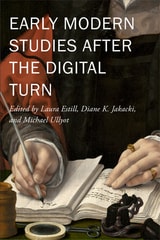
Early Modern Studies after the Digital Turn
Edited by Laura Estill, Diane K. Jakacki, Michael Ullyot
Iter Press, 2016

Early Modern Women's Writing and Sor Juana Ines de la Cruz
Stephanie Merrim
Vanderbilt University Press, 1999
Early modern women writers whose works are explored include Marie de Gournay, Margaret Fell Fox, Catalina de Erauso, Maria de Zayas, Ana Caro, Mme de Lafayette, Anne Bradstreet, St. Teresa, and Margaret Lucas Cavendish.
Merrim's study provides a full-bodied picture of the resources that the cultural and historical climates of the seventeenth century placed at the disposal of women writers, the manners in which women writers instrumentalized them, the building blocks and concerns of early modern women's writing, and the continuities between early modern and modern women's writing.
Written in an engaging, clear manner, this innovative study will be of interest not only to Hispanists but also to scholars in early modern studies, women's studies, history, and comparative literature.
Easy Money
American Puritans and the Invention of Modern CurrencyDror Goldberg
University of Chicago Press, 2023
A sweeping history of the American invention of modern money.
Economists endlessly debate the nature of legal tender monetary systems—coins and bills issued by a government or other authority. Yet the origins of these currencies have received little attention.
Dror Goldberg tells the story of modern money in North America through the Massachusetts colony during the seventeenth century. As the young settlement transitioned to self-governance and its economy grew, the need to formalize a smooth exchange emerged. Printing local money followed.
Easy Money illustrates how colonists invented contemporary currency by shifting its foundation from intrinsically valuable goods—such as silver—to the taxation of the state. Goldberg traces how this structure grew into a worldwide system in which, monetarily, we are all Massachusetts. Weaving economics, law, and American history, Easy Money is a new touchstone in the story of monetary systems.
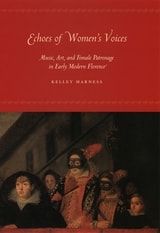
Echoes of Women's Voices
Music, Art, and Female Patronage in Early Modern FlorenceKelley Harness
University of Chicago Press, 2006
Through commissions, patrons sought to promote a vision of the world and their place in it. The unique social norms, laws, educational backgrounds, and life experiences of female patrons meant the expression of a worldview that differed significantly from that of their male counterparts. Joining exceptional archival research with telling analysis of significant examples of music, art, and drama, Kelley Harness challenges the prevailing view that Florence saw a political and artistic decline during this period. She argues convincingly that the female domination of these years brought forth artistic patronage that was both continuous and well-conceived.
Economies of Praise
Value, Labor, and Form in Seventeenth-Century English PoetryRyan Netzley
Northwestern University Press, 2024
Reevaluates early modern poems of praise as, paradoxically, challenging an artistic economy that values exchange and productivity
Early modern poems of praise typically insist that they do not have a purpose or enact real labor beyond their effortless listing of laudable qualities. And yet the poets discussed in this study, including Ben Jonson, Andrew Marvell, Anne Bradstreet, Lucy Hutchinson, and John Milton, hint at an alternative aesthetic economy at work in their verse. Poetic praise, it turns out, might show us a social world outside the organizing principle of exchange.
In Economies of Praise: Value, Labor, and Form in Seventeenth‑Century English Poetry, Ryan Netzley explores how poems of praise imagine alternatives to market and gift economies and point instead to a self-contained aesthetic economy that works against a more expansive and productivist understanding of literary art. By depicting exchange as inconsequential, unproductive, and redundant rather than a necessary constituent of social order, these poems model for modern readers a world without the imperative to create, appraise, and repeatedly demonstrate one’s own value.
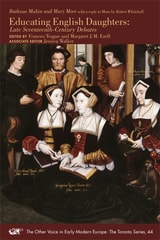
Educating English Daughters
Late Seventeenth-Century DebatesBathsua Makin and Mary More
Iter Press, 2016
This edition offers texts from Bathsua Makin and Mary More, and Robert Whitehall’s response to More’s argument. Makin describes the appropriate education for London merchants’ daughters, arguing that girls should be educated and should aspire to follow learned women in history, and that educated women improve their families and themselves. More argues that women have the right to an education, and that such an education shows that the inequality of married women under English law is a man-made institution. More’s argument drew objections from her Oxford reader, Robert Whitehall, who preserved her manuscript with his own. Makin and More enjoyed a measure of public recognition and esteem, yet after their deaths, they and their texts were largely ignored until the late twentieth century.
Egyptian Oedipus
Athanasius Kircher and the Secrets of AntiquityDaniel Stolzenberg
University of Chicago Press, 2013
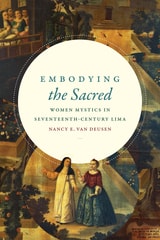
Embodying the Sacred
Women Mystics in Seventeenth-Century LimaNancy E. van Deusen
Duke University Press, 2018
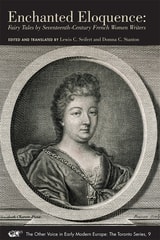
Enchanted Eloquence
Fairy Tales by Seventeenth–Century French Women WritersEdited and Translated by Lewis C. Seifert and Domna C. Stanton
Iter Press, 2010
—Jack Zipes
Professor of German, Emeritus, University of Minnesota
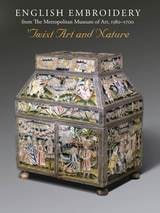
English Embroidery from the Metropolitan Museum of Art, 1580-1700
‘Twixt Art and NatureMelinda Watt
Bard Graduate Center, 2009
English Society
1580-1680Wrightson, Keith
Rutgers University Press, 2003
English Women Staging Islam, 1696-1707
Delarivier Manley and Mary Pix
Iter Press, 2012
English in Print from Caxton to Shakespeare to Milton
Valerie Hotchkiss and Fred C. Robinson
University of Illinois Press, 2007
Enlistment
Lists in Medieval and Early Modern LiteratureEdited by Eva von Contzen and James Simpson
The Ohio State University Press, 2022
Contributors: Suzanne Conklin Akbari, Ingo Berensmeyer, Eva von Contzen, Alex Davis, Andrew James Johnston, Wolfram R. Keller, Alexis Kellner Becker, Kathryn Mogk Wagner, Martha Rust, James Simpson

Errands into the Metropolis
New England Dissidents in Revolutionary LondonJonathan Beecher Field
Dartmouth College Press, 2012

Essaying Shakespeare
Karen Newman
University of Minnesota Press, 2009
A pioneering scholar of Shakespeare and early modern letters provides an overview of work in the field
For more than twenty-five years, Karen Newman has brought her critical acumen to bear on early modern studies. In this collection of her essays on Shakespeare—some acknowledged classics and others never before published—Newman shows how changing theoretical trends have shaped Shakespeare studies, from new historicism and gender studies to critical race studies and globalization.
Central to Newman’s work is social exchange, or the circulation of people and objects. At least two of these essays have had a powerful and lasting impact on Shakespeare studies: “Renaissance Family Politics and Shakespeare’s The Taming of the Shrew” and “‘And wash the Ethiop White’: Femininity and the Monstrous in Othello.” Three essays appear in print for the first time: an examination of clothing of the poor and the portrayal of the king as a beggar in Richard II; a stinging review of Harold Bloom’s book Shakespeare: The Invention of the Human; and a rethinking of claims about the globalization of culture and cultural translation.Essaying Shakespeare chronicles Newman’s own critical development to provide a significant map of critical work on Shakespeare.
European Metals in Native Hands
Rethinking Technological Change 1640-1683Kathleen L. Ehrhardt
University of Alabama Press, 2005
The first detailed analysis of Native metalworking in the Protohistoric/Contact Period
From the time of their earliest encounters with European explorers and missionaries, Native peoples of eastern North America acquired metal trinkets and utilitarian items and traded them to other aboriginal communities. As Native consumption of European products increased, their material culture repertoires shifted from ones made up exclusively of items produced from their own craft industries to ones substantially reconstituted by active appropriation, manipulation, and use of foreign goods. These material transformations took place during the same time that escalating historical, political, economic, and demographic influences (such as epidemics, new types of living arrangements, intergroup hostilities, new political alliances, missionization and conversion, changes in subsistence modes, etc.) disrupted Native systems.
Ehrhardt's research addresses the early technological responses of one particular group, the Late Protohistoric Illinois Indians, to the availability of European-introduced metal objects. To do so, she applied a complementary suite of archaeometric methods to a sample of 806 copper-based metal artifacts excavated from securely dated domestic contexts at the Illiniwek Village Historic Site in Clark County, Missouri.
Ehrhardt's scientific findings are integrated with observations from historical, archaeological, and archival research to place metal use by this group in a broad social context and to critique the acculturation perspective at other Contact Period sites. In revealing actual Native practice, from material selection and procurement to ultimate discard, the author challenges technocentric explanations for Native material and cultural change at contact.
Everyday Nature
Knowledge of the Natural World in Colonial New YorkGronim, Sara S
Rutgers University Press, 2007
In the modern world, the public looks to scientists and scholars for their expertise on issues ranging from the effectiveness of vaccines to the causes of natural disasters. But for early Americans, whose relationship to nature was more intimate and perilous than our own, personal experience, political allegiances, and faith in God took precedence over the experiments of the learned.
In Everyday Nature, Sara Gronim shows how scientific advances were received in the early modern world, from the time Europeans settled in America until just before the American Revolution. Settlers approached a wide range of innovations, such as smallpox inoculation, maps and surveys, Copernican cosmology, and Ben Franklin’s experiments with electricity, with great skepticism. New Yorkers in particular were distrustful because of the chronic political and religious factionalism in the colony. Those discoveries that could be easily reconciled with existing beliefs about healing the sick, agricultural practices, and the revolution of the planets were more readily embraced.
A fascinating portrait of colonial life, this book traces a series of innovations that were disseminated throughout the Atlantic world during the Enlightenment, and shows how colonial New Yorkers integrated new knowledge into their lives.
Exemplary Violence
Rewriting History in Colonial ColombiaAlberto Villate-Isaza
Bucknell University Press, 2021
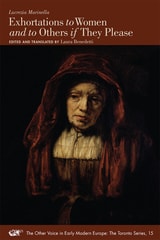
Exhortations to Women and to Others If They Please
Lucrezia Marinella
Iter Press, 2012
—Maria Galli Stampino
Associate Professor of French and Italian
University of Miami
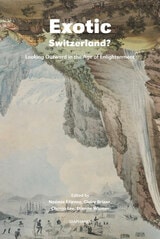
Exotic Switzerland?
Looking Outward in the Age of EnlightenmentEdited by Noémie Étienne, Claire Brizon, Chonja Lee, and Étienne Wismer
Diaphanes, 2020