193 books match the query '1945-' and 7 start with e
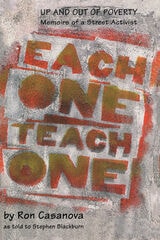
cover of Each One Teach One: Up and Out of Poverty, Memoirs of a Street Activist

Each One Teach One

Up and Out of Poverty, Memoirs of a Street Activist

Ron Casanova and Stephen Blackburn

Northwestern University Press, 2010

Each One Teach One chronicles Ron Casanova's struggle out of poverty, homelessness, and drug addiction to find dignity and purpose in life. Through his own awakening, this Black, Puerto Rican activist ultimately finds his answer in helping other people. Born into a dysfunctional family and placed in an orphanage on Staten Island at an early age, Casanova faced overwhelming odds. His story illuminates some of the major events of our time, including the "police riot" at Tompkins Square, the "Housing Now" march of the homeless on Washington, and community takeovers of housing in Kansas City, New York, and Philadelphia.

Underlying Each One Teach One, with its vivid cast of characters and intimate descriptions of Harlem and other urban areas, is the profound sense that no matter what your circumstance, you can use your past experience to help others. Ultimately, Casanova's story is a message of hope for the future and for the possibility of self-sufficiency and self-empowerment for each individual.

[more]
cover of Economic Organizations and Social Systems

Economic Organizations and Social Systems

Robert A. Solo

University of Michigan Press, 2000
Robert A. Solo’s landmark work, Economic Organizations and Social Systems, presents a sweeping re-examination of the foundations of economic theory and the paradigms that shape the teaching and practice of economics. Written originally outside the confines of the neoclassical tradition, Solo’s analysis seeks to break from convention and provide readers with a new paradigm—one that places the cognitive, cultural, historical, psychological, and political dimensions at the heart of economic understanding.This expanded edition, featuring a new preface, calls for a transformation in economics: a shift away from narrow models toward a holistic social science capable of addressing the complexities of modern economies. Solo offers a comparative analysis of three distinctive forms of economic organization: decentralized market-driven systems, organizational market-negotiated systems (such as large corporations and unions), and centralized politically-directed systems (drawing especially on the former Soviet Union). Each is assessed for efficiency, incentive structures, justice in income distribution, the quality of the social environment, and—critically—their capacity for technological development.The book goes beyond technical analysis, exploring how national economies are built from multiple, interdependent components: the enterprise, political, household, and institutional sectors. The third part delves deeply into the roles of culture, ideology, and cognition in shaping economic change, using the Russian Revolution and the developmental challenges of the Third World as major case studies.Incisively argued and widely praised on publication, Solo’s work stands as both a critique of prevailing economic orthodoxy and a blueprint for integrating economics within the broader social realities of our time—a vital resource for economists, social scientists, and all seeking to understand or reform economic thought and practice.
[more]
cover of Economics and Elections: The Major Western Democracies

Economics and Elections

The Major Western Democracies

Michael S. Lewis-Beck

University of Michigan Press, 1990
Does a government’s fate at the ballot box hinge on the state of the economy? Is it inflation, unemployment, or income that makes the difference? What triggers economic voting for or against the incumbent – do voters look at their pocketbooks, or at the national accounts? Do economic voters “punish” rulers for bad times, but fail to “reward” them for the good times? Are voter’s judgments based on past economic performance or future policy promises? These are some of the questions considered by Michael Lewis-Beck in this major cross-national study of the effect of economic conditions on voting behavior in the Western European democracies and the United States.
 
[more]
cover of Economics and Politics: The Calculus of Support

Economics and Politics

The Calculus of Support

Helmut Norpoth, Michael S. Lewis-Beck, and Jean-Dominique Lafay, Editors

University of Michigan Press, 1991
How do voters weigh economic concerns in their calculus of partisan choice in voting booths and opinion polls? How do voters arrive at their perceptions of economic conditions and assign responsibility for them to incumbent governments? And when do people go beyond electoral reactions in expressing their sentiments about economic well-being?The contributors to Economics and Politics employ sophisticated methods of analysis to isolate the effects of specific economic conditions such as unemployment and inflation. While some look at the effects of aggregate data on the electorate taken as a whole, others examine individual perceptions of economic conditions gleaned from survey data. The contributors, from several European countries as well as the United States, consider the relationships between economics and politics both cross-nationally and individually in West Germany, the United States, France, Britain, and Italy.Taken together, these contributions present the most comprehensive comparative assessment of economic influence on mass political behavior. The crucial role of strategic politicians, intervening in the economy as well as in public evaluations of the economy, receives considerable attention; so do interventions such as wars and political turnover. In sorting out economic facts and assigning responsibility to politicians amid such uncertainty, the publics of Western democracies display considerable sophistication.
[more]
cover of Elites and Economic Development: Comparative Studies on the Political Economy of Latin American Cities

Elites and Economic Development

Comparative Studies on the Political Economy of Latin American Cities

By John Walton

University of Texas Press, 1977

This book is a detailed comparative analysis of development politics in four urban regions of Latin America, two in Mexico and two in Colombia. John Walton has based his studies on the assumption that the problems of economic growth are essentially political, that is, are problems of choice, decision-making, and the exercise of power. His fundamental purpose has been to discover how elites of different kinds are more and less successful in the promotion of economic development, which he defines as a process in the organization of a society leading not only to higher levels of efficient output but also to a more equitable distribution of benefits.

At the time, the four cities compared were the second- and third-largest metropolitan areas in each country, Guadalajara and Monterrey in Mexico, Medellín and Cali in Colombia. This selection allows the author to pair, across countries, cases of early and large-scale industrialization (Monterrey and Medellín) with cases of more recent industrial growth in agricultural-commercial centers (Guadalajara and Cali). Walton presents historical introductions to each of the regions and integrates these with original fieldwork and interviews with more than three hundred members of the political and economic elites.

The findings are extensive, but in general they demonstrate that where political and economic power is more broadly distributed, where elites are more open and accessible, and where organizational life is more active and coordinated, regions tend to develop qualitatively as well as quantitatively, showing increases both in productivity and in such benefits as public services, housing, education, and a more balanced distribution of income. If these characteristics are absent, regions may be industrialized but do not provide a broad sharing of the benefits. Walton places a good deal of emphasis on the role of foreign investments, demonstrating that the more penetrated regions are also the less developed.

Finally, the results of these studies are used to evaluate and advance theories of underdevelopment and particularly of economic dependency.
[more]
cover of Everyday Life under Communism and After: Lifestyle and Consumption in Hungary, 1945–2000

Everyday Life under Communism and After

Lifestyle and Consumption in Hungary, 1945–2000

Tibor Valuch

Central European University Press, 2022

By providing a survey of consumption and lifestyle in Hungary during the second half of the twentieth century, this book shows how common people lived during and after tumultuous regime changes. After an introduction covering the late 1930s, the study centers on the communist era, and goes on to describe changes in the post-communist period with its legacy of state socialism.

Tibor Valuch poses a series of questions. Who could be called rich or poor and how did they live in the various periods? How did living, furnishings, clothing, income, and consumption mirror the structure of the society and its transformations? How could people accommodate their lifestyles to the political and social system? How specific to the regime was consumption after the communist takeover, and how did consumption habits change after the demise of state socialism? The answers, based on micro-histories, statistical data, population censuses and surveys help to understand the complexities of daily life, not only in Hungary, but also in other communist regimes in east-central Europe, with insights on their antecedents and afterlives.
[more]
cover of Explaining Economic Backwardness: Post-1945 Polish Historians on Eastern Europe

Explaining Economic Backwardness

Post-1945 Polish Historians on Eastern Europe

Anna Sosnowska

Central European University Press, 2019

This monograph is about an exciting episode in the intellectual history of Europe: the vigorous debate among leading Polish historians on the sources of the economic development and non-development, including the origins of economic divisions within Europe. The work covers nearly fifty years of this debate between the publication of two pivotal works in 1947 and 1994. Anna Sosnowska provides an insightful interpretation of how local and generational experience shaped the notions of post-1945 Polish historians about Eastern European backwardness, and how their debate influenced Western historical sociology, social theories of development and dependency in peripheral areas, and the image of Eastern Europe in Western, Marxist-inspired social science. Although created under the adverse conditions of state socialism and censorship, this body of scholarship had an important repercussion in international social science of the post-war period, contributing an emphasis on international comparisons, as well as a stress on social theory and explanations. Sosnowska's analysis also helps to understand current differences that lead to conflicts between Europe’s richest and economically most developed core and its southern and eastern peripheries. The historians she studies also investigated analogies between paths in Eastern Europe and regions of West Africa, Latin America and East Asia.
[more]