Results by title
53 books match the query '1970-' and 5 start with e
Economic Policy Making in Mexico
Factors Underlying the 1982 CrisisRobert Looney
Duke University Press, 1985
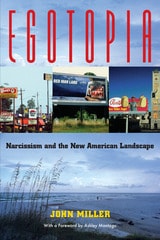
Egotopia
Narcissism and the New American LandscapeJohn Miller
University of Alabama Press, 1999
Egotopia explains why individual political and economic interests have eclipsed aesthetic considerations in the rampant billboards, malls, and urban sprawl of the New American Landscape
Egotopia begins where other critiques of the American landscape end: identifying the physical ugliness that defines and homogenizes America's cities, suburbs, and countryside. Believing that prevailing assessments of the American landscape are inadequate and injudicious, John Miller calls into question the conventional wisdom of environmentalists, urban planners,and architects alike. In this precedent-shattering examination of what he sees as the ugliness that is the American consumer society, Miller contends that our aesthetic condition can be fully understood only by explorers of the metaphoric environment.Metaphorically, the ugliness of America's great suburban sprawl is the physical manifestation of our increasing narcissism- our egotopia. The ubiquity of psychotherapy as a medium promoting self-indulgence has deified private man as it has demonized public man. The New American Landscape, Miller argues, is no longer the physical manifestation of public and communal values. Instead it has become a projection of private fantasies and narcissistic self-indulgence. Individual interests and private passions can no longer tolerate, nor even recognize, aesthetic concerns in such a landscape dedicated to uncompromising notions of utility.
Empire Burlesque
The Fate of Critical Culture in Global AmericaDaniel T. O Hara
Duke University Press, 2003
Empire Burlesque presents several interrelated analyses through readings of a range of writers and cultural figures including Henry James, Freud, Said, De Man, Derrida, and Cordwainer Smith (an academic, spy, and classic 1950s and 1960s science fiction writer). It describes the debilitating effects of globalization on the university in general and the field of literary studies in particular, it critiques literary studies’ embrace of globalization theory in the name of a blind and vacant modernization, and it meditates on the ways critical reading and writing can facilitate an imaginative alternative to institutionalized practices of modernization. Drawing on Lacanian psychoanalytical theory, it diagnoses contemporary American Studies as typically driven by the mindless abjection and transference of professional identities.
A provocative commentary on contemporary cultural criticism, Empire Burlesque will inform debates on the American university across the humanities, particularly among those in literary criticism, cultural studies, and American studies.
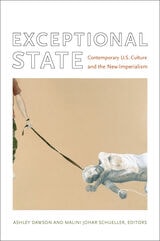
Exceptional State
Contemporary U.S. Culture and the New ImperialismAshley Dawson and Malini Johar Schueller, eds.
Duke University Press, 2007
The contributors address a range of topics, paying particular attention to the dynamics of gender and race. Their essays include a surprising reading of the ostensibly liberal movies Wag the Dog and Three Kings, an exploration of the rhetoric surrounding the plan to remake the military into a high-tech force less dependent on human bodies, a look at the significance of the popular Left Behind series of novels, and an interpretation of the Abu Ghraib prison photos. They scrutinize the national narrative created to justify the US invasions of Afghanistan and Iraq, the ways that women in those countries have responded to the invasions, the contradictions underlying calls for US humanitarian interventions, and the role of Africa in the US imperial imagination. The volume concludes on a hopeful note, with a look at an emerging anti-imperialist public sphere.
Contributors. Omar Dahbour, Ashley Dawson, Cynthia Enloe, Melani McAlister, Christian Parenti, Donald E. Pease, John Carlos Rowe, Malini Johar Schueller, Harilaos Stecopoulos
Expedition Escape from the Classroom
Political Outings on the Campus and the Anxiety of Teaching IROded Löwenheim
University of Michigan Press, 2024
Expedition Escape from the Classroom offers a unique narrative where teaching and its inherent challenges intersect with the intricacies of global politics, history, and identity. While recounting his academic experiment, Löwenheim grapples with the changing landscape of academia in a neoliberal age, while illustrating how personal vulnerabilities can transform into powerful tools for growth, exploration, and enlightenment. Whether you’re an educator, student, or just a curious reader, Expedition Escape from the Classroom promises a journey of reflection, critical thinking, and profound revelations.