Results by title
3703 books match the query '19th century' and 105 start with e
E Pluribus Unum
Nineteenth-Century American Literature and the Constitutional ParadoxHarris, W. C.
University of Iowa Press, 2005
The project of E Pluribus Unum is twofold. Its first and underlying concern is the general philosophic problem of the one and the many as it came to be understood at the time. W. C. Harris supplies a detailed account of the genealogy of the concept, exploring both its applications and its paradoxes as a basis for state and identity formation.
Harris then considers the perilous integration of the one and the many as a motive in the major literary accomplishments of 19th-century U.S. writers. Drawing upon critical as well as historical resources and upon contexts as diverse as cosmology, epistemology, poetics, politics, and Bible translation, he discusses attempts by Poe, Whitman, Melville, and William James to resolve the problems of social construction caused by the paradox of e pluribus unum by writing literary and philosophical texts that supplement the nation’s political founding documents.
Poe (Eureka), Whitman (Leaves of Grass), Melville (Billy Budd), and William James (The Varieties of Religious Experience) provide their own distinct, sometimes contradictory resolutions to the conflicting demands of diversity and unity, equality and hierarchy. Each of these texts understands literary and philosophical writing as having the potential to transform-conceptually or actually-the construction of social order.
This work will be of great interest to literary and constitutional scholars.

E. W. Scripps and the Business of Newspapers
Gerald Baldasty
University of Illinois Press, 1999
Edward Willis Scripps revolutionized the newspaper industry by applying modern business practices. His press empire grew to more than forty newspapers supported by a telegraphic news service and an illustrated news features syndicate. Convinced that big business was corrupting the American press, Scripps resisted supporting his newspapers through advertising. He also aimed them at the working class, an audience virtually ignored by most newspaper publishers of his era.
Drawing on Scripps's business correspondence, Gerald Baldasty provides a portrait of a long-neglected entrepreneurial giant. Maintaining that the press should support the democratic endeavor by informing its largest constituency, Scripps succeeded in creating a string of small, one-penny newspapers that advocated for the common people by crusading for lower streetcar fares, free textbooks for public school children, municipal ownership of utilities, and pure food legislation, among many other causes.
EDUCATING THE PROPER WOMAN READER
VICTORIAN FAMILY LITERARY MAGAZINES & CULTURAL HEALTH OF THE NATIONJennifer Phegley
The Ohio State University Press, 2004
Jennifer Phegley presents an examination of four mid-Victorian magazines that middle-class women read widely. Educating the Proper Woman Reader reevaluates prevailing assumptions about the vexed relationship between nineteenth-century women readers and literary critics.
While many scholars have explored the ways nineteenth-century critics expressed their anxiety about the dangers of women’s unregulated and implicitly uncritical reading practices, which were believed to threaten the sanctity of the home and the cultural status of the nation, Phegley argues that family literary magazines revolutionized the position of women as consumers of print by characterizing them as educated readers and able critics. Her analysis of images of influential women readers (in Harper’s), intellectual women readers (in The Cornhill), independent women readers (in Belgravia), and proto-feminist women readers/critics (in Victoria) indicates that women played a significant role in determining the boundaries of literary culture within these magazines. She argues that these publications supported women’s reading choices, inviting them to define literary culture rather than to consume it passively.
Not only does this book revise our understanding of nineteenth-century attitudes toward women readers, but it also takes a fresh look at the transatlantic context of literary production. Further, Phegley demonstrates the role these publications played in improving cultural literacy among women of the middle classes as well as the interplay between fiction and essays of the time by writers such as Mary Braddon, Charles Dickens, George Eliot, Elizabeth Gaskell, G. H. Lewes, Harriet Martineau, Margaret Oliphant, George Sala, William Thackeray, and Anthony Trollope.
ETERNALLY WOUNDED WOMAN
"WOMEN, DOCTORS, AND EXERCISE IN THE LATPatricia A. Vertinsky
University of Illinois Press, 1994
"A review of thinking is needed in the field of sociohistorical analysis concerning attitudes toward the female body and attempts to regulate female physical activity. Such analyses may generate new insights into the questions of both social control and the unevenness of progress in women's real or perceived opportunities for participating freely and fully in sports and exercise of their choice."
Eardrums
Literary Modernism as Sonic WarfareTyler Whitney
Northwestern University Press, 2019
Eardrums is the first book-length study to explore the relationship between acoustical modernity and German modernism, charting a literary and cultural history written in and around the eardrum. The result is not only a new way of understanding the sonic impulses behind key literary texts from the period. It also outlines an entirely new approach to the study of literature as as the interaction of text and sonic practice, voice and noise, which will be of interest to scholars across literary studies, media theory, sound studies, and the history of science.
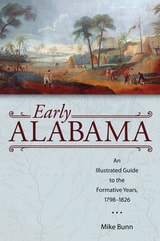
Early Alabama
An Illustrated Guide to the Formative Years, 1798–1826Mike Bunn
University of Alabama Press, 2019
An illustrated guidebook documenting the history and sites of the state’s origins
Alabama’s territorial and early statehood years represent a crucial formative period in its past, a time in which the state both literally and figuratively took shape. The story of the remarkable changes that occurred within Alabama as it transitioned from frontier territory to a vital part of the American union in less than a quarter century is one of the most compelling in the state’s past. This history is rich with stories of charismatic leaders, rugged frontiersmen, a dramatic and pivotal war that shaped the state’s trajectory, raging political intrigue, and pervasive sectional rivalry.
Many of Alabama’s modern cities, counties, and religious, educational, and governmental institutions first took shape within this time period. It also gave way to the creation of sophisticated trade and communication networks, the first large-scale cultivation of cotton, and the advent of the steamboat. Contained within this story of growth and innovation is a parallel story, the dispossession of Native groups of their lands and the forced labor of slaves, which fueled much of Alabama’s early development.
Early Alabama: An Illustrated Guide to the Formative Years, 1798–1826 serves as a traveler’s guidebook with a fast-paced narrative that traces Alabama’s developmental years. Despite the great significance of this era in the state’s overall growth, these years are perhaps the least understood in all of the state’s history and have received relatively scant attention from historians. Mike Bunn has created a detailed guide—appealing to historians and the general public—for touring historic sites and structures including selected homes, churches, businesses, government buildings, battlefields, cemeteries, and museums..
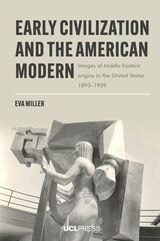
Early Civilization and the American Modern
Images of Middle Eastern Origins in the United States, 1893–1939Eva Miller
University College London, 2024
Early Civilization and the American Modern explores how the teleological narrative that civilization and its benefits—science, law, writing, art, and architecture—began in Egypt and Mesopotamia addressed anxieties about the United States’ unique role in the long march of progress. To tackle this phenomenon, author Eva Miller highlights central collaborators of the creation of progressive visual narratives in key institutions, world’s fairs, and popular media such as Orientalist James Henry Breasted, astronomer George Ellery Hale, architect Bertram Grosvenor Goodhue, and decorative artists Lee Lawrie and Hildreth Meière.
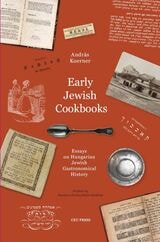
Early Jewish Cookbooks
Essays on Hungarian Jewish Gastronomical HistoryAndrás Koerner
Central European University Press, 2022
Winner of the Association of Jewish Libraries' 2022 Judaica Bibliography Award.
The seven essays in this volume focus such previously unexplored subjects as the world’s first cookbook printed in Hebrew letters, published in 1854, and a wonderful 19th-century Jewish cookbook, which in addition to its Hungarian edition was also published in Dutch in Rotterdam. The author entertainingly reconstructs the history of bólesz, a legendary yeast pastry that was the specialty of a famous, but long defunct Jewish coffeehouse in Pest, and includes the modernized recipe of this distant relative of cinnamon rolls. Koerner also tells the history of the first Jewish bookstore in Hungary (founded as early as in 1765!) and examines the influence of Jewish cuisine on non-Jewish food.
In this volume András Koerner explores key issues of Hungarian Jewish culinary culture in greater detail and more scholarly manner than what space restrictions permitted in his previous work Jewish Cuisine in Hungary: A Cultural History, also published by CEU Press, which received the prestigious National Jewish Book Award in 2020. The current essays confirm the extent to which Hungarian Jewry was part of the Jewish life and culture of the Central European region before their almost total language shift by the turn of the 20th century.
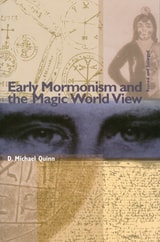
Early Mormonism and the Magic World View
D. Michael Quinn
Signature Books, 1987
This thoroughly researched examination into occult traditions surrounding Smith, his family, and other founding Mormons cannot be understated. Among the practices no longer a part of Mormonism are the use of divining rods for revelation, astrology to determine the best times to conceive children and plant crops, the study of skull contours to understand personality traits, magic formula utilized to discover lost property, and the wearing of protective talismans. Ninety-four photographs and illustrations accompany the text.
East India Company at Home, 1757-1857
Edited by Margot Finn and Kate Smith
University College London, 2018
Eastern Figures
Orient and Empire in British WritingDouglas Kerr
Hong Kong University Press, 2008
Eben Smith
The Dean of Western MiningDavid Forsyth
University Press of Colorado, 2021
The mining teams Smith formed with Chaffee and with industrialist David Moffat were among the most successful and respected in Colorado, and many in the state held Smith in high regard. Yet despite the credit he received during his lifetime for establishing Colorado’s mining industry, Smith has not received much attention from historians, perhaps because he was content to leave public-facing duties to his partners while he concerned himself with managing mine operations.
From Smith’s early years and his labor in the mines to his rise to prominence as an investor and developer, Forsyth shows how Smith used the mining and milling knowledge he acquired in California to become a leader in technological innovation in Colorado’s mining industry.
Echoes of Emerson
Rethinking Realism in Twain, James, Wharton, and CatherDiana Hope Polley
University of Alabama Press, 2017
Probes the ways in which two major periods in nineteenth-century American literature—Romanticism and Realism—have come to be understood and defined.
Echoes of Emerson: Rethinking Realism in Twain, James, Wharton, and Cather traces the complex and unexplored relationship between American realism and the philosophy of Ralph Waldo Emerson. Critics often read American realism as a clear disavowal of earlier American romantic philosophy and as a commitment to recognizing the stark realities of a new postbellum order. Diana Hope Polley’s study complicates these traditional assumptions by reading American realism as an ongoing dialogue with the ideas—often idealisms—of America’s greatest romantic philosopher, Ralph Waldo Emerson.
In this illuminating work, Polley offers detailed readings of Mark Twain’s Adventures of Huckleberry Finn, Henry James’s The Portrait of a Lady, Edith Wharton’s The House of Mirth, and Willa Cather’s My Ántonia—all through the lens of Emersonian philosophy and discourse. This unique contribution to nineteenth- and early twentieth-century literary studies shows how these texts revisit Emerson’s antebellum “republic of the spirit” philosophy, specifically the trope of the Emersonian hero/heroine navigating the harsh contingencies of the modern world.
Romanticism and realism are often seen as opposing binaries, with romanticism celebrating the individual, self-reliance, and nature and realism emphasizing the weight of socio-historical forces. Realism is often characterized as rejecting the transcendent principles of Emersonian thought. Rather than accept those distinct boundaries between romance and realism, Polley argues that American realists struggled between celebrating Emerson’s core philosophies of individual possibility and acknowledging the stark “realities” of American social and historical life. In short, this study recognizes within realism a divided loyalty between two historical trends and explores how these seemingly contradictory notions—Emerson’s romantic philosophy and later nineteenth-century visions of historical reality—exist, simultaneously, within the literature of the period.
Eclipse of Empires
World History in Nineteenth-Century U.S. Literature and CulturePatricia Jane Roylance
University of Alabama Press, 2013
Patricia Jane Roylance’s central claim in Eclipse of Empires is that historical episodes of imperial eclipse, for example Incan Peru yielding to Spain or the Ojibway to the French, heightened the concerns of many American writers about specific intranational social problems plaguing the nation at the time—race, class, gender, religion, economics. Given the eventual dissolution of great civilizations previously plagued by these very same problems, many writers, unlike those who confidently emphasized U.S. exceptionalism, exhibited both an anxiety about the stability of American society and a consistent practice of self-scrutiny in identifying the national defects that they felt could precipitate America’s decline.
Roylance studies, among other texts, James Fenimore Cooper’s The Water-Witch (1830) and The Bravo (1831), which address the eclipse of Venice by New York City as a maritime power in the eighteenth century; William Hickling Prescott’s Conquest of Peru (1847), which responds to widespread anxiety about communist and abolitionist threats to the U.S. system of personal property by depicting Incan culture as a protocommunist society doomed to failure; and Henry Wadsworth Longfellow’s The Song of Hiawatha (1855), which resists the total eclipse of Ojibwa culture by incorporating Ojibway terms and stories into his poem and by depicting the land as permanently marked by their occupation.
Economic Women
Essays on Desire and Dispossession in Nineteenth-Century British CultureEdited by Lana L. Dalley and Jill Rappoport
The Ohio State University Press, 2013
Economies of Feeling
Russian Literature under Nicholas IJillian Porter
Northwestern University Press, 2017
Porter shows how, for Pushkin, Gogol, Dostoevsky, and Faddei Bulgarin, ambition became a staging ground for experiments with transnational literary exchange. In its encounters with the celebrated Russian cultural value of hospitality and the age-old vice of miserliness, ambition appears both timely and anachronistic, suspiciously foreign and disturbingly Russian—it challenges readers to question the equivalence of local and imported words, feelings, and forms.
Economies of Feeling examines founding texts of nineteenth-century Russian prose alongside nonliterary materials from which they drew energy—from French clinical diagnoses of “ambitious monomania” to the various types of currency that proliferated under Nicholas I. It thus contributes fresh and fascinating insights into Russian characters’ impulses to attain rank and to squander, counterfeit, and hoard. Porter’s interdisciplinary approach will appeal to scholars of comparative as well as Russian literature.
Editorializing "The Indian Problem"
The New York Times on Native Americans, 1860-1900Robert Hays. Foreword by: Paul Simon
Southern Illinois University Press, 2007
American history demonstrates time and again the price of Manifest Destiny.
Editors Make War
Donald E. Reynolds
Southern Illinois University Press, 2006
Educating Seeta
The Anglo-Indian Family Romance and the Poetics of Indirect RuleShuchi Kapila
The Ohio State University Press, 2010
Educating Women
Cultural Conflict and Victorian LiteratureLaura Morgan Green
Ohio University Press, 2001
In 1837, when Queen Victoria came to the throne, no institution of higher education in Britain was open to women. By the end of the century, a quiet revolution had occurred: women had penetrated even the venerable walls of Oxford and Cambridge and could earn degrees at the many new universities founded during Victoria's reign. During the same period, novelists increasingly put intellectually ambitious heroines students, teachers, and frustrated scholars—at the center of their books. Educating Women analyzes the conflict between the higher education movement's emphasis on intellectual and professional achievement and the Victorian novel's continuing dedication to a narrative in which women's success is measured by the achievement of emotional rather than intellectual goals and by the forging of social rather than institutional ties.
Focusing on works by Charlotte Brontë, George Eliot, Anna Leonowens, and Thomas Hardy, Laura Morgan Green demonstrates that those texts are shaped by the need to mediate the conflict between the professionalism and publicity increasingly associated with education, on the one hand, and the Victorian celebration of women as emblems of domesticity, on the other. Educating Women shows that the nineteenth-century “heroines” of both history and fiction were in fact as indebted to domestic ideology as they were eager to transform it.
Educating the Sons of Sugar
Jefferson College and the Creole Planter Class of South LouisianaR. Eric Platt
University of Alabama Press, 2017
The education of individual planter classes—cotton, tobacco, sugar—is rarely treated in works of southern history. Of the existing literature, higher education is typically relegated to a footnote, providing only brief glimpses into a complex instructional regime responsive to wealthy planters. R. Eric Platt’s Educating the Sons of Sugar allows for a greater focus on the mindset of French Creole sugar planters and provides a comprehensive record and analysis of a private college supported by planter wealth.
Jefferson College was founded in St. James Parish in 1831, surrounded by slave-holding plantations and their cash crop, sugar cane. Creole planters (regionally known as the “ancienne population”) designed the college to impart a “genteel” liberal arts education through instruction, architecture, and geographic location. Jefferson College played host to social class rivalries (Creole, Anglo-American, and French immigrant), mirrored the revival of Catholicism in a region typified by secular mores, was subject to the “Americanization” of south Louisiana higher education, and reflected the ancienne population’s decline as Louisiana’s ruling population.
Resulting from loss of funds, the college closed in 1848. It opened and closed three more times under varying administrations (French immigrant, private sugar planter, and Catholic/Marist) before its final closure in 1927 due to educational competition, curricular intransigence, and the 1927 Mississippi River flood. In 1931, the campus was purchased by the Society of Jesus (Jesuits) and reopened as a silent religious retreat. It continues to function to this day as the Manresa House of Retreats. While in existence, Jefferson College was a social thermometer for the white French Creole sugar planter ethos that instilled the “sons of sugar” with a cultural heritage resonant of a region typified by the management of plantations, slavery, and the production of sugar.
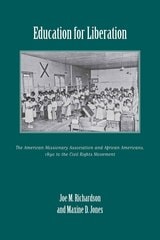
Education for Liberation
The American Missionary Association and African Americans, 1890 to the Civil Rights MovementJoe M. Richardson
University of Alabama Press, 2009
Even after the optimism of Reconstruction was shattered by violence, fraud, and intimidation and the white South relegated African Americans to segregated and disfranchised second-class citizenship, the AMA never abandoned its claim that blacks were equal in God’s sight, that any “backwardness” was the result of circumstance rather than inherent inferiority, and that blacks could and should become equal citizens with other Americans. The organization went farther in recognition of black ability, humanity, and aspirations than much of 19th and 20th century white America by publicly and consistently opposing lynching, segregation, disfranchisement, and discrimination.
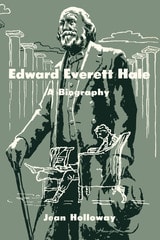
Edward Everett Hale
By Jean Holloway
University of Texas Press, 1956
Edward Everett Hale is remembered by millions as the author of The Man Without a Country. This popular and gifted nineteenth-century writer was an outstanding and prolific contributor to the fields of journalism, fiction, essay, and history. He wrote more than 150 books and pamphlets (one novel sold more than a million copies in his lifetime) and was intimately associated with the publication of many of the early American journals, among them the North American Review, Atlantic Monthly, and Christian Examiner. He served as editor of Old and New and was a frequent contributor to the foremost newspapers and periodicals of his time.
Yet the writings of this “journalist with a touch of genius” were only incidental to Hale’s Christian ministry in New England and in Washington, D.C., where he was for five years Chaplain of the Senate. His literary creed reflected that of his ministry, for Hale’s interpretation of the social gospel comprised an active concern with all phases of human affairs.
Confidant of poets and editors, friend to diplomats and statesmen, Hale helped mold public opinions in economics, sociology, history, and politics through three-quarters of what he called “a most extraordinary century in history.” In recounting Hale’s life and times, Holloway vividly portrays this fascinating and often turbulent era.
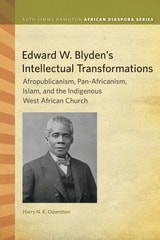
Edward W. Blyden's Intellectual Transformations
Afropublicanism, Pan-Africanism, Islam, and the Indigenous West African ChurchHarry N. K. Odamtten
Michigan State University Press, 2019

Een spiering uitwerpen om een kabeljauw te vangen
How and why the Dutch fished for cod 1818-1911Overgaard Christine
Amsterdam University Press, 2015
Effeminism
The Economy of Colonial DesireRevathi Krishnaswamy
University of Michigan Press, 2011
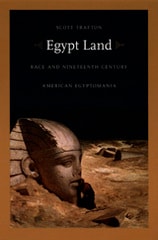
Egypt Land
Race and Nineteenth-Century American EgyptomaniaScott Trafton
Duke University Press, 2004
Drawing on literary and cultural studies, art and architectural history, political history, religious history, and the histories of archaeology and ethnology, Trafton illuminates anxieties related to race in different manifestations of nineteenth-century American Egyptomania, including the development of American Egyptology, the rise of racialized science, the narrative and literary tradition of the imperialist adventure tale, the cultural politics of the architectural Egyptian Revival, and the dynamics of African American Ethiopianism. He demonstrates how debates over what the United States was and what it could become returned again and again to ancient Egypt. From visions of Cleopatra to the tales of Edgar Allan Poe, from the works of Pauline Hopkins to the construction of the Washington Monument, from the measuring of slaves’ skulls to the singing of slave spirituals—claims about and representations of ancient Egypt served as linchpins for discussions about nineteenth-century American racial and national identity.
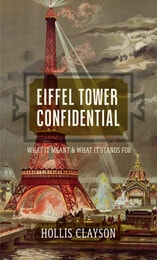
Eiffel Tower Confidential
What It Meant and What It Stands ForHollis Clayson
University of Chicago Press, 2027
A revelatory behind-the-scenes look at a universally recognized landmark: the Eiffel Tower.
The Eiffel Tower is widely photographed, visited, and written about, but it holds a wealth of stories that are rarely told. When it was built, the three-hundred-meter structure was the tallest on earth, but it bore little resemblance to the stripped-down, modernized monument that is known and loved today. With Eiffel Tower Confidential, art historian Hollis Clayson makes this familiar landmark strange again, offering expert insight into the life of the Tower.
Here she traces the creative financing of the Tower before its construction began, shares images made in its early years, and illuminates the role the Tower played in celebrating French Imperialism. She tells the fascinating story of iron ornamentation that helped the Tower win approval as the centerpiece of the 1889 Universal Exposition but was ripped off and discarded in 1937, and she investigates the sinister backstory behind how the dazzling illumination of the Tower—which combined 10,000 gas lights in glass globes, two kinds of electric spotlights placed at the summit, and Bengal flames on the platforms—was designed to function as an instrument of surveillance.
This extraordinary account takes us into the long shadow of the Eiffel Tower, inviting readers to get to know this acclaimed landmark on an unprecedented level.
Eight Months in Illinois
With Information to ImmigrantsWilliam Oliver. Foreword by James E. Davis
Southern Illinois University Press, 2002
The Illinois frontier offered abundant opportunity, noted English traveler William Oliver after his journey to America in 1841–42, but life there was hard. Accordingly, Oliver advised the wealthy and comfortable to remain in England and counseled the unprosperous to seek their fortunes in America. Written for the poor who would migrate and published in 1843, his Eight Months in Illinois: With Information to Immigrants sought only to provide pertinent, valid, and practical information about what people might encounter in the frontier state. What Oliver actually accomplished, however, was much more: he imparted invaluable insights into and analyses of American life during an era of sweeping social, economic, and political change.
In his new foreword to this edition, James E. Davis stresses Oliver’s sincere desire to help British immigrants succeed in America. Oliver, Davis notes, “devoted dozens of pages of advice on numerous matters: various routes to Illinois and their advantages and disadvantages, processes of settling, qualities of western houses, costs of obtaining a new farm.” Oliver discussed other practical matters, such as the importance of having sons. He also assured his intended readership that “in the West, distinction of classes is little known and seldom recognized.”
As a document covering the middle west in the 1840s, Eight Months in Illinois: With Information to Immigrants has few equals. Its portrayal of farming and trade in relatively primitive times is historically accurate. It paints a plain picture, laying out the essential facts and presenting the typical incidents that enable us to trace the course of a settler’s simple, diligent, laborious day-to-day life. According to Davis, Oliver depicted “accurate and balanced slices of life in Illinois and America, including nasty insects, crude conditions, and the necessity of work.” And he did so without a trace of anti-American bias.
Eight Months in Illinois with Information to Immigrants was reprinted with emendations in 1924 by Walter Hill.

El Dorado In West Africa
The Gold Mining Frontier, African Labor, and Colonial CapitalismRaymond E. Dumett
Ohio University Press, 1998
The second half of the nineteenth century witnessed some of the greatest gold mining migrations in history when dreams of bonanza lured thousands of prospectors and diggers to the far corners of the earth—including the Gold Coast of West Africa.
El Dorado in West Africa explores the first modern gold rush of Ghana in all of its dimensions—land, labor, capital, traditional African mining, technology, transport, management, the clash of cultures, and colonial rule. The rich tapestry of events is crisscrossed by unexpected ironies and paradoxes.
Professor Dumett tells the story of the expatriate-led gold boom of 1875-1900 against the background of colonial capitalism. Through the use of oral data, he also brings to light the expansion of a parallel “African gold mining frontier,” which outpaced the expatriate mining sector.
African women, kings and chiefs, and the ordinary Akan farmer/miners, as well as European engineers and speculators, are the focal points of this study. It probes in depth the productive and developmental features and the turbulent and shattering effects of mining capitalism on African societies.
Electoral Incentives in Congress
Jamie L. Carson and Joel Sievert
University of Michigan Press, 2018
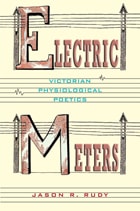
Electric Meters
Victorian Physiological PoeticsJason Rudy
Ohio University Press, 2009
Combining formal poetic analysis with cultural history, Rudy traces the development of Victorian physiological poetics from the Romantic poetess tradition through to the works of Alfred Tennyson, the “Spasmodic” poets, Elizabeth Barrett Browning, Gerard Manley Hopkins, and Algernon Swinburne, among others. He demonstrates how poetic rhythm came increasingly to be understood throughout the nineteenth century as a physiological mechanism, as poets across class, sex, and national boundaries engaged intensely and in a variety of ways with the human body’s subtle response to rhythmic patterns. Whether that opportunity for transcendence was interpersonal or spiritual in nature, nineteenth–century poets looked to electricity as a model for overcoming boundaries, for communicating across the gaps between sound and sense, between emotion and thought, and—perhaps—between individuals in the modern world.
Electric Meters will appeal to those interested in poetry of any period and particularly those interested in nineteenth–century culture and history.
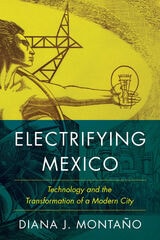
Electrifying Mexico
Technology and the Transformation of a Modern CityBy Diana J. Montaño
University of Texas Press, 2021
2022 Alfred B. Thomas Book Award, Southeastern Council of Latin American Studies (SECOLAS)
2022 Bolton-Johnson Prize, Conference on Latin American History (CLAH)
2022 Best Book in Non-North American Urban History, Urban History Association (Co-winner)
2023 Honorable Mention, Best Book in the Humanities, Latin American Studies Association Mexico Section
2023 Turriano Book Prize, International Committee for the History of Technology
2023 Michael C. Meyer Award for Best Book on Mexican History in a Five-Year Period, Rocky Mountain Council for Latin American Studies
Many visitors to Mexico City’s 1886 Electricity Exposition were amazed by their experience of the event, which included magnetic devices, electronic printers, and a banquet of light. It was both technological spectacle and political messaging, for speeches at the event lauded President Porfirio Díaz and bound such progress to his vision of a modern order.
Diana J. Montaño explores the role of electricity in Mexico’s economic and political evolution, as the coal-deficient country pioneered large-scale hydroelectricity and sought to face the world as a scientifically enlightened “empire of peace.” She is especially concerned with electrification at the social level. Ordinary electricity users were also agents and sites of change. Montaño documents inventions and adaptations that served local needs while fostering new ideas of time and space, body and self, the national and the foreign. Electricity also colored issues of gender, race, and class in ways specific to Mexico. Complicating historical discourses in which Latin Americans merely use technologies developed elsewhere, Electrifying Mexico emphasizes a particular national culture of scientific progress and its contributions to a uniquely Mexican modernist political subjectivity.
Elements of French Deaf Heritage
Ulf Hedberg
Gallaudet University Press, 2019
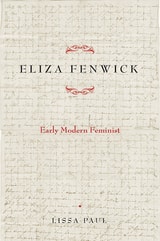
Eliza Fenwick
Early Modern FeministLissa Paul
University of Delaware Press, 2019
Lissa Paul brings to light Fenwick’s letters for the first time to reveal the relationships she developed with many key figures of her era, and to tell Fenwick’s story as depicted by the woman herself. Fenwick began as a writer in the radical London of the 1790s, a member of Mary Wollstonecraft’s circle, and when her marriage crumbled, she became a prolific author of children’s literature to support her family. Eventually Fenwick moved to Barbados, becoming the owner of a school while confronting the reality of slavery in the British colonies. She would go on to establish schools in numerous cities in the United States and Canada, all the while taking care of her daughter and grandchildren and maintaining her friendships through letters that, as presented here, tell the story of her life.
Published by the University of Delaware Press. Distributed worldwide by Rutgers University Press.
Elizabeth Barrett Browning's Spiritual Progress
Face to Face With GodLinda M. Lewis
University of Missouri Press, 1997
Elizabeth Barrett Browning believed that "Christ's religion is essentially poetry—poetry glorified." In Elizabeth Barrett Browning's Spiritual Progress, Linda M. Lewis studies Browning's religion as poetry, her poetry as religion. The book interprets Browning's literary life as an arduous spiritual quest—the successive stages being a rejection of Promethean pride for Christ-like humility, affirmation of the gospels of suffering and of work, internalization of the doctrine of Apocalypse, and ascent to divine love and truth.
Lewis follows this religious crusade from the poet's childhood to her posthumous Last Poems--including such topics as her Bible reading, her introduction to the Greek church fathers and the English Protestant reformers, the theological debates in which she participated, her quarrel with the theology of Paradise Lost, and her scandalous involvement in mesmerism and Swedenborgianism. Using insights from contemporary feminist thought, Lewis argues that Browning's religious assumptions and insights range from the conventional to the iconoclastic and that women's spirituality is, for Browning as well as for other Victorian women writers, separate from orthodox patriarchy. Lewis demonstrates that Browning's political and social ideology--often labeled inconsistent and illogical—really makes sense in light of this spiritual quest, which leads her to confront her God "face to face."
Elizabeth Barrett Browning's Spiritual Progress examines not only Browning's most admired works, such as Sonnets from the Portuguese and Aurora Leigh, but also her large body of political works and her important early poems—The Seraphim and A Drama of Exile. This intertextual book compares Browning's ideology to that of feminists such as Margaret Fuller, Harriet Martineau, and Florence Nightingale; influential conservatives such as Thomas Carlyle; and those most esteemed of Victorian poets, Alfred Lord Tennyson and Robert Browning.
Concluding with an examination of religion as a central focus of Victorian women poets, Lewis clarifies the ways in which Browning differs from Christina Rossetti, Felicia Hemans, Dora Greenwell, Jean Ingelow, and Mary Howitt. Elizabeth Barrett Browning's Spiritual Progress maintains that Browning's peculiar face-to-face struggle with the patristic and poetic tradition—as well as with God—sets her work apart.
Elizabeth Barrett Browning
The Origins of a New PoetryDorothy Mermin
University of Chicago Press, 1989
Barrett Browning's place at the wellhead of a new female tradition remains the single most important fact about her in terms of literary history, and it was central to her self-consciousness as a poet. Mermin's study shows that Barrett Browning's anomalous situation was constantly present to her imagination and that questions of gender shaped almost everything she wrote. Mermin argues that Barrett Browning's poetry covertly inspects and dismantles the barriers set in her path by gender and that in her major works—Sonnets from the Portuguese, Aurora Leigh, her best political poems, "A Musical Instrument"—difficulty is turned into triumph, incorporating the author's femininity, her situation as a woman poet, and her increasingly substantial fame.
Mermin skillfully interweaves biography and close readings of the poems to show precisely how Barrett Browning's life as a woman writer is a part of the essential meaning of her art. Both her personal and her literary achievements are exceptionally well documented, especially for her formative years. Mermin makes extensive use of the poet's early essays, a diary covering most of her twenty-sixth year, and the enormous number of letters that have survived. Ranging from her earliest ambitions through her long periods of discouragement and illness to her happy married life with Robert Browning, this comprehensive study of Elizabeth Barrett Browning is essential reading for students of the Victorian period, English literature, and women's studies.
Elizabeth Manning Hawthorne
A Life in LettersElizabeth Manning Hawthorne
University of Alabama Press, 2006
An annotated selection of unpublished letters by Nathaniel Hawthorne's sister.
Retrieved from seven different libraries, this corpus of letters was preserved by the Manning family chiefly for their value as records of Nathaniel Hawthorne's life and work; but they ironically also illuminate the life and mind of a fascinating correspondent and citizen of New England with incisive views and commentaries on her contemporaries, her role as a woman writer, Boston and Salem literary culture, and family life in mid-19th-century America.
This book illuminates Elizabeth's early life; the trauma caused for sister and brother by the death of their father; her and her brother's education; and the tensions the two children experienced when they moved in with their mother's family, the welthier Mannings, instead of the poorer though socially more venerable Hawthornes, following their father's death. The letters portray Elizabeth's constrained relationship with Nathaniel's wife Sofia Peabody and counter Sophia's portrayal of her sister-in-law as a recluse, oddity, and “queer scribbler.”
These 118 letters also reveal Elizabeth Hawthorne's tremendous gifts as a thinker, correspondent, and essayist, her interest in astronomy, a lifelong drive toward self-edification in many fields, and her extraordinary relationship with Nathaniel. As a sibling and a fellow author, they were sometimes lovingly codependent and sometimes competitive. Finally, her writing reveals the larger worlds of politics, war, the literary landscape, class, family life, and the freedoms and constraints of a woman's role, all by a heretofore understudied figure.
Elizabeth Robins, 1862–1952
Actress, Novelist, FeministJoanne E. Gates
University of Alabama Press, 1994
From Childhood, Elizabeth Robins dreamed of a successful career on the stage. Her first impulse to visit England, in 1888, stemmed from her desire to secure better opportunities as an actress, and she soon gained celebrity playing Ibsen’s heroines. While buoyed by this success, she began writing fiction that treated the feminist issues of her time: organized prostitution, women’s positions in war-torn England, and the dangers of rearmament. In her acting, writing, and political activism, she consistently challenged existing roles for women. Robins’s work is marked by a number of true-life components, and this first biography to use the vast collection of her private papers demonstrates how Robins transformed her own life into literary and dramatic capital.
Robins published several novels under the pseudonym C. E. Raimond, culminating in the sensational male-female bildungsroman, The Open Question: A Tale of Two Temperaments, which was set in her native Zanesville, Ohio, and publication of which finally disclosed her identity.
Her fiction is compared to that of Henry James, Edith Wharton, and Willa Cather. Many of her heroines share the characteristics of exhibiting force or willed silence, and Gates's analysis of this trait has implications for feminist theorists in a number of fields.
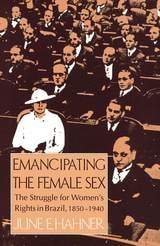
Emancipating the Female Sex
The Struggle for Women's Rights in Brazil, 1850–1940June E. Hahner
Duke University Press, 1990
Hahner traces the history of Brazilian women’s fight for emancipation from its earliest manifestations in the mid-nineteenth century to the successful conclusion of the suffrage campaign in the 1930s. Drawing on interviews with surviving Brazilian suffragists and contemporary feminists as well as manuscripts and printed documents, Hahner explores the strategies and ideological positions of Brazilian feminists. In focusing on urban upper- and middle-class women, from whose ranks the leadership for change arose, she examines the relationship between feminism and social change in Brazil’s complex and highly stratified society.
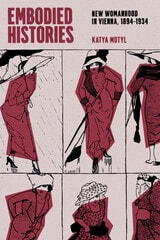
Embodied Histories
New Womanhood in Vienna, 1894–1934Katya Motyl
University of Chicago Press, 2024
In Embodied Histories, historian Katya Motyl explores the everyday acts of defiance that formed the basis for new, unconventional forms of womanhood in early twentieth-century Vienna. The figures Motyl brings back to life defied gender conformity, dressed in new ways, behaved brashly, and expressed themselves freely, overturning assumptions about what it meant to exist as a woman.
Motyl delves into how these women inhabited and reshaped the urban landscape of Vienna, an increasingly modern, cosmopolitan city. Specifically, she focuses on the ways that easily overlooked quotidian practices such as loitering outside cafés and wandering through city streets helped create novel conceptions of gender. Exploring the emergence of a new womanhood, Embodied Histories presents a new account of how gender, the body, and the city merge with and transform each other, showing how our modes of being are radically intertwined with the spaces we inhabit.
Embodied
Victorian Literature and the SensesWilliam A. Cohen
University of Minnesota Press, 2008
Making sense of the body in Victorian literature
What does it mean to be human? British writers in the Victorian period found a surprising answer to this question. What is human, they discovered, is nothing more or less than the human body itself. In literature of the period, as well as in scientific writing and journalism, the notion of an interior human essence came to be identified with the material existence of the body. The organs of sensory perception were understood as crucial routes of exchange between the interior and the external worlds.
Anatomizing Victorian ideas of the human, William A. Cohen considers the meaning of sensory encounters in works by writers including Charles Dickens, Charlotte Brontë, Anthony Trollope, Thomas Hardy, and Gerard Manley Hopkins. Rather than regarding the bodily exterior as the primary location in which identity categories—such as gender, sexuality, race, and disability—are expressed, he focuses on the interior experience of sensation, whereby these politics come to be felt. In these elegant engagements with literary works, cultural history, and critical theory, Cohen advances a phenomenological approach to embodiment, proposing that we encounter the world not through our minds or souls but through our senses.
Emerson and the Defense of Equality
Greg Garvey
University of Massachusetts Press, 2025
Arguing for equality as the necessary foundation of liberty
During Ralph Waldo Emerson’s lifetime, the idea of universal human equality was under intensive assault. Repeatedly—in contexts ranging from slavery, to marriage, to politics and workers’ rights—Americans of the time were being told that equality was an obsolete ideal and that the future would belong to those who accepted the hard truth that liberty lies not in egalitarian values but in hierarchies of domination and submission. Greg Garvey’s Emerson and the Defense of Equality focuses on Emerson as a real-time defender of equality during the antebellum culture wars.
In contrast to studies that treat individual liberty as Emerson’s primary concern, Garvey argues that Emerson’s works define a broad and sustained defense of equality as the necessary foundation of liberty. When read as part of a debate about equality, Emerson’s Nature is a treatise on individuality and the common weal; his anti-slavery speeches and English Traits advance evolutionary theories to rebut polygenesist arguments for white supremacy; the essays “Love” and “Domestic Life” challenge gender spheres and explore equality in marriage, friendship, and citizenship. As Emerson speculates on the future, “Politics” and “The Young American” anticipate a “beneficent socialism” in which human rights will always have priority over property rights. In his career-long effort to defend a threatened ideal, Emerson develops an aspirational vision of society that understands equality to be a fundamental aspect of liberty.
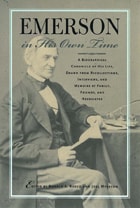
Emerson in His Own Time
A Biographical Chronicle of His Life, Drawn from Recollections, Interviews, and Memoirs by Family, FRonald A. & Joel Bosco & Myerson
University of Iowa Press, 2003
Remembrances from Elizabeth Peabody, Sophia Hawthorne, Oliver Wendell Holmes, Ralph Waldo Emerson, Bronson Alcott, Rebecca Harding Davis, and twenty others printed in Hawthorne in His Own Time follow him from his childhood in Salem, through his years of initial literary obscurity, his days in the Boston and Salem Custom Houses, his service as U.S. Consul to Liverpool and Manchester and his life in the Anglo-American communities at Rome and Florence, to his late years as the “Great Romancer.”
In their enlightening introduction, editors Ronald Bosco and Jillmarie Murphy assess the postmortem building of Hawthorne’s reputation as well as his relationship to the prominent Transcendentalists, spiritualists, Swedenborgians, and other personalities of his time. By clarifying the sentimental associations between Hawthorne’s writings and his actual personality and moving away from the critical review to the personal narrative, these artful and perceptive reminiscences tell the private and public story of a remarkable life.
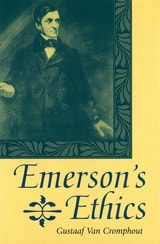
Emerson's Ethics
Gustaaf Van Cromphout
University of Missouri Press, 1999
Everyone knows that Emerson was a moralist, but what does that really mean? In an attempt to answer that question, Gustaaf Van Cromphout provides in Emerson's Ethics a detailed and philosophically grounded discussion of Emerson's moral thought. In this first comprehensive study of Emerson's ethics in the broader context of ethical theory, Van Cromphout explores Emerson's answers to what he considered the basic question facing any thinking human being: "How should I live?"
Van Cromphout begins by examining Emerson's college essays on ethics—essays that reflect his response to the moral thought prevailing in his intellectual environment. He then discusses the mature Emerson's attempt to establish ethics on a surer foundation than the religion inherited from his forebears, showing that Emerson was influenced significantly by Kant's moral thought.
He goes on to examine Emerson's search for a morally competent self in an age when the very notion of "self" was under serious threat. The ethical dimension of Emerson's politics and his theories of friendship and love, as well as the quest for a life worth living in the modern world, are also addressed. The last chapters are devoted to nature and literature. Van Cromphout explores Emerson's understanding of nature as a focus of ethical responsibility, and he examines the corruptibility of language, the ethics of self- expression, and the moral responsibilities of writers toward their audiences. Emerson believed that ethics permeated every aspect of human life. By examining Emerson's understanding of ethics and his contribution to ethical thought, Emerson's Ethics shows one of the truly great minds in American culture confronting issues of fundamental relevance to all human beings. Filling an important gap in Emerson studies, this book will appeal not only to readers interested in Emerson and his significance in American thought and literature but also to readers concerned with ethics and, more generally, with the interrelations of literature and philosophy.
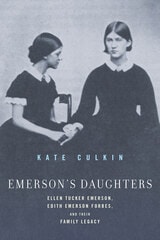
Emerson’s Daughters
Ellen Tucker Emerson, Edith Emerson Forbes, and Their Family LegacyKate Culkin
University of Massachusetts Press, 2025
Longlisted for the 2026 Plutarch Award
Ellen Tucker Emerson and Edith Emerson Forbes, the daughters of Lidian Jackson and Ralph Waldo Emerson, grew up in the heart of Concord, Massachusetts’s famed literary community. In a culture that celebrated self-reliance, Ellen and Edith formed a partnership that only strengthened as their paths diverged, with Ellen remaining in the family home and Edith marrying William Forbes, moving to Milton, Massachusetts, and having eight children. The partnership allowed them to tend to the demands and opportunities created by their father’s career, including serving as his secretaries and editors, and helped them shape his posthumous image. It also enabled them to adapt to historical developments stretching from the Civil War to American imperialism as well as personal ones, including Edith’s growing family and travel and study abroad, and inevitable ones brought on by the aging processes of their parents and themselves.
Emerson’s Daughters is a biography of a sisterhood, the first full-length study of Ellen’s and Edith’s lives. Building on archival research into the extensive correspondence between the sisters, it adds to the growing body of work on women’s contribution to Transcendentalism while opening a window onto the rich, and understudied, family life of the “Sage of Concord.”
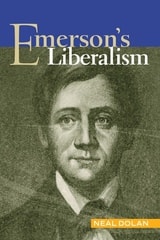
Emerson’s Liberalism
Neal Dolan
University of Wisconsin Press, 2009
Neal Dolan offers the first comprehensive and historically informed exposition of all of Ralph Waldo Emerson’s writings as a contribution to the theory and practice of liberal culture. Rather than projecting twentieth-century viewpoints onto the past, he restores Emerson’s great body of work to the classical liberal contexts that most decisively shaped its general political-cultural outlook—the libertarian-liberalism of John Locke, the Scottish Enlightenment, the American founders, and the American Whigs.
In addition to in-depth consideration of Emerson’s journals and lectures, Dolan provides original commentary on many of Emerson’s most celebrated published works, including Nature, the “Divinity School Address,” “History,” “Compensation,” “Experience,” the political addresses of the early 1840s, “An Address . . . on . . . The Emancipation of the Negroes in the British West Indies,” Representative Men, English Traits, and The Conduct of Life. He considers Emerson’s distinctive elaborations of foundational liberal values—progress, reason, work, property, limited government, rights, civil society, liberty, commerce, and empiricism. And he argues that Emerson’s ideas are a morally bracing and spiritually inspiring resource for the ongoing sustenance of American culture and civilization, reminding us of the depth, breadth, and strength of our common liberal inheritance.

Emily Dickinson and the Labor of Clothing
Daneen Wardrop
University of New Hampshire Press, 2009
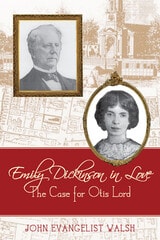
Emily Dickinson in Love
The Case for Otis LordWalsh, John Evangelist
Rutgers University Press, 2012
From the award-winning author of Poe the Detective: The Curious Circumstances Behind "The Mystery of Marie Roget" comes a compelling argument for the identity of Emily Dickinson’s true love
Proud of my broken heart
Since thou didst break it,
Proud of the pain I
Did not feel till thee . . .
Those words were written by Emily Dickinson to a married man. Who was he?
For a century or more the identity of Emily Dickinson’s mysterious “Master” has been eagerly sought, especially since three letters from her to him were found and published in 1955. In Emily Dickinson in Love, John Evangelist Walsh provides the first book-length treatment of this fascinating subject, offering a solution based wholly on documented facts and the poet’s own writings.
Crafting the affair as a love story of rare appeal, and writing with exquisite attention to detail, in Part I Walsh reveals and meticulously proves the Master to be Otis Lord, a friend of the poet’s father and a man of some reputation in law and politics. Part II portrays the full dimensions of their thirty-year romance, most of it clandestine, including a series of secret meetings in Boston.
After uncovering and confirming the Master’s identity, Walsh fits that information into known events of Emily’s life to make sense of facts long known but little understood—Emily’s decision to dress always in white, for instance, or her extreme withdrawal from a normal existence when she had previously been an active, outgoing friend to many men and women.
In a lengthy section of Notes and Sources, Walsh presents his proofs in abundant detail, demonstrating that the evidence favors one man so irresistibly that there is left no room for doubt. Each reader will decide if he has truly succeeded in making the case for Otis Lord.

Emily Dickinson'S Gothic
Goblin With A GaugeDaneen Wardrop
University of Iowa Press, 1996
Emily Dickinson should stand as a major gothic author among her nineteenth-century American contemporaries, but two factors have previously prevented her inclusion in such company. Perhaps the most obvious is the problem of the genre: Dickinson writes gothic poetry, whereas gothic fiction defines the genre. In addition, her poetic personae have served over the decades to prompt critics to “protect” her; traditional critics concentrated on the sweet, romantic elements of her oeuvre. More recent readers, notably Sandra Gilbert and Susan Gubar, Jane Egerwein, and Cynthia Griffin Wolff, have begun studying Dickinson's gothic traits; Emily Dickinson's Gothic explores Dickinsonian gothicism with the systematic rigor it demands and deserves.
Emily Dickinson's Gothic also addresses sociohistorical concerns, from hallowed gothic conventions dating from Horace Walpole's eighteenth century to such modernist neogothic topics as rape, the void, and disjunctive language that appear in the latter nineteenth and early twentieth centuries. Wardrop recognizes the full extent to which the gothic pervades Dickinson's canon and the means by which the gothic determines her aesthetic. Such full consideration of women's gothicism allows the placement of Dickinson within a literary context, both in terms of American writers and in terms of women writers.