Results by title
56 books match the query 'Academic & Scholarly' and 3 start with e
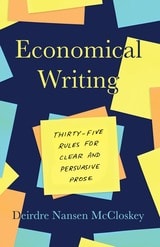
Economical Writing, Third Edition
Thirty-Five Rules for Clear and Persuasive ProseDeirdre Nansen McCloskey
University of Chicago Press, 2019
Economics is not a field that is known for good writing. Charts, yes. Sparkling prose, no.
Except, that is, when it comes to Deirdre Nansen McCloskey. Her conversational and witty yet always clear style is a hallmark of her classic works of economic history, enlivening the dismal science and engaging readers well beyond the discipline. And now she’s here to share the secrets of how it’s done.
Economical Writing is itself economical: a collection of thirty-five pithy rules for making your writing clear, concise, and effective. Proceeding from big-picture ideas to concrete strategies for improvement at the level of the paragraph, sentence, or word, McCloskey shows us that good writing, after all, is not just a matter of taste—it’s a product of adept intuition and a rigorous revision process. Debunking stale rules, warning us that “footnotes are nests for pedants,” and offering an arsenal of readily applicable tools and methods, she shows writers of all levels of experience how to rethink the way they approach their work, and gives them the knowledge to turn mediocre prose into magic.
At once efficient and digestible, hilarious and provocative, Economical Writing lives up to its promise. With McCloskey as our guide, it’s impossible not to see how any piece of writing—on economics or any other subject—can be a pleasure to read.
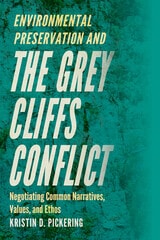
Environmental Preservation and the Grey Cliffs Conflict
Negotiating Common Narratives, Values, and EthosKristin D. Pickering
Utah State University Press, 2024
Though environmental degradation and unauthorized use threatened the Grey Cliffs recreational lake area to the point that the Corps considered closure, community members valued it highly and wanted to keep it open. The community near this damaged and crime-ridden area needed help rejuvenating its landscape and image, but the Corps and community were sharply divided on how to maintain this beloved geographic space because of the stakeholders’ different cultural backgrounds and values, as well as the narratives used to discuss them. By co-constructing and aligning narratives, values, and ethos over time—a difficult and lengthy process—the Corps and community succeeded, and Grey Cliffs remains open to all. Focusing on field notes, participant interviews, and analysis of various texts created throughout the conflict, Pickering applies rhetorical analysis and a grounded theory approach to regulation, identity, sustainability, and community values to analyze this communication process.
Illustrating the positive change that can occur when governmental organizations and rural communities work together to construct shared values and engage in a rhetoric of relationship that preserves the environment, Environmental Preservation and the Grey Cliffs Conflict provides key recommendations for resolving environmental conflicts within local communities, especially for those working in technical and professional communication, organizational communication, environmental science, and public policy.
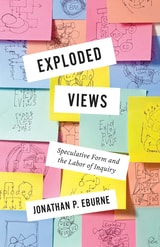
Exploded Views
Speculative Form and the Labor of InquiryJonathan Eburne
University of Minnesota Press, 2025
Idiosyncratic essays use their “exploded” forms to examine how inquiry functions
Insect galls, time, memory systems, orgone energy, and a bookstore that doesn’t yet exist. These disparate topics have persistently fascinated scholar Jonathan P. Eburne, yet each defied his previous efforts at classification through scholarly writing, resulting in five essays suspended in process. In Exploded Views, Eburne returns to these essays with the metaphorical tool of the exploded-view diagram, expanding them into entirely new, hybrid forms that unpack their inspirations and trace the wayward paths they followed.
An experiment into the nature of inquiry that spelunks, rather than shies from, the rabbit holes of scholarly curiosity, each essay gives way to sidelights and dilations to reveal the palimpsest of knowledge hiding beneath the surface of the academic form. A book about process—the process of turning ideas into things, and vice versa, as well as the particular tendency for research, scholarly inquiry, and critical writing to come apart and go awry—Exploded Views is a refreshing exploration of how the tools of creative critical thinking work at their most basic level.
Reflecting on the methods of scholarly knowledge production and the contextual factors that shape new ideas, Eburne boldly replaces the seamlessness of the finished manuscript with the friction and even messiness of the incomplete, inviting readers to think in new and invigorating ways.