Results by title
312 books match the query 'African American authors' and 5 start with e
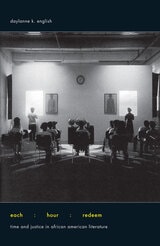
Each Hour Redeem
Time and Justice in African American LiteratureDaylanne K. English
University of Minnesota Press, 2013
Each Hour Redeem advances a major reinterpretation of African American literature from the late eighteenth century to the present by demonstrating how its authors are centrally concerned with racially different experiences of time. Daylanne K. English argues that, from Phillis Wheatley to Suzan-Lori Parks, African American writers have depicted distinctive forms of temporality to challenge racial injustices supported by dominant ideas of time. The first book to explore the representation of time throughout the African American literary canon, Each Hour Redeem illuminates how the pervasive and potent tropes of timekeeping provide the basis for an overarching new understanding of the tradition.
Combing literary, historical, legal, and philosophical approaches, Each Hour Redeem examines a wide range of genres, including poetry, fiction, drama, slave narratives, and other forms of nonfiction. English shows that much of African American literature is characterized by “strategic anachronism,” the use of prior literary forms to investigate contemporary political realities, as seen in Walter Mosley’s recent turn to hard-boiled detective fiction. By contrast, “strategic presentism” is exemplified in the Black Arts Movement and the Harlem Renaissance and their investment in contemporary political potentialities, for example, in Langston Hughes and Amiri Baraka’s adaptation of the jazz of their eras for poetic form and content. Overall, the book effectively demonstrates how African American writers have employed multiple and complex conceptions of time not only to trace racial injustice but also to help construct a powerful literary tradition across the centuries.
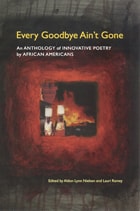
Every Goodbye Ain't Gone
An Anthology of Innovative Poetry by African AmericansEdited by Aldon Lynn Nielsen and Lauri Ramey
University of Alabama Press, 2006
Every Goodbye Ain’t Gone presents the groundbreaking work of many of these poets who carried on the innovative legacies of Melvin Tolson, Gwendolyn Brooks, and Robert Hayden. Whereas poetry by such key figures such as Amiri Baraka, Tolson, Jayne Cortez, Clarence Major, and June Jordan is represented, this anthology also elevates into view the work of less studied poets such as Russell Atkins, Jodi Braxton, David Henderson, Bob Kaufman, Stephen Jonas, and Elouise Loftin. Many of the poems collected in the volume are currently unavailable and some will appear in print here for the first time.
Coeditors Aldon Lynn Nielsen and Lauri Ramey provide a critical introduction that situates the poems historically and highlights the ways such poetry has been obscured from view by recent critical and academic practices. The result is a record of experimentation, instigation, and innovation that links contemporary African American poetry to its black modernist roots and extends the terms of modern poetics into the future.
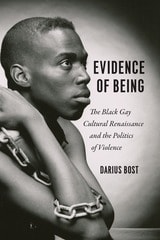
Evidence of Being
The Black Gay Cultural Renaissance and the Politics of ViolenceDarius Bost
University of Chicago Press, 2018
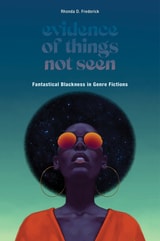
Evidence of Things Not Seen
Fantastical Blackness in Genre FictionsRhonda D. Frederick
Rutgers University Press, 2022
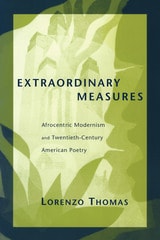
Extraordinary Measures
Afrocentric Modernism and 20th-Century American PoetryLorenzo Thomas
University of Alabama Press, 2000
From early 20th-century writings to present-day poetry slams, African American poetry exhibits an impressive range of style and substance. Lorenzo Thomas has written an important new history of the genre that offers a critical reassessment of its development in the 20th century within the contexts of modernism and the troubled racial history of the United States.
Basing his study on literary history, cultural criticism, and close readings, Thomas revives and appraises the writings of a number of this century's most important African American poets, including Margaret Walker, Amiri Baraka, Askia M. Toure, Harryette Mullen, and Kalamu ya Salaam. Thomas analyzes the work of Fenton Johnson within the context of emerging race consciousness in Chicago, contributes to critical appraisals of William Stanley Braithwaite and Melvin B. Tolson, and examines the Black Arts Movement of the 1960s and 1970s. Throughout the book, Thomas demonstrates the continuity within the Afrocentric tradition while acknowledging the wide range of stylistic approaches and ideological stances that the tradition embraces.
By reassessing the African American poetry tradition, Thomas effectively reassesses the history of all 20th-century American literature by exploring avenues of debate that have not yet received sufficient attention. Written with intelligence and humor, his book is itself an extraordinary measure that reflects years of scholarship and opens up African American poetry to a wider audience.