Results by title
87 books match the query 'Aging' and 4 start with e
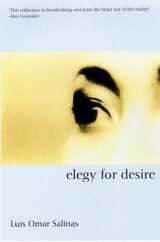
Elegy for Desire
Luis Omar Salinas
University of Arizona Press, 2005
Are those of love and those of death.
I’m half in love and half dead.
It stands to reason that I’ve come upon a difficult task.
Despite his disclaimer, it seems no difficult task at all. One of the pioneers of Chicano poetry and a highly esteemed artist in the Mexican American community, Luis Omar Salinas is a poet with Tex-Mex bordertown roots whose work is studied at the Sorbonne. Beginning with his legendary first book, Crazy Gypsy, he has been a major figure not only in Chicano literature but in all of American poetry—both a poet of the people and a voice for other poets.
In Elegy for Desire, Salinas has crafted visionary poems about growing older and looking back on a rich life of poetry. In this quiet yet hallucinatory volume, Salinas offers us a prismatic collection of odes, elegies, and cantos of desire—complex poems about our place in the world. Poems to be savored in solitude, or better still with an intimate companion. Few poets, Latino or otherwise, are as daring with love poetry that is so honestly fierce. Salinas gives us a meditation on gently aging while continuing to celebrate personal experience that draws upon the world. One need only sample these rich, elegant stanzas to recognize the wealth of wisdom found in their words.
Elegy for Desire is a testament to a singular talent that has survived for decades . . . and will continue to inspire long beyond his lifetime.
The dead can’t complain, and lovers always do.
Well, I’m here, and that is important.
And if life can be as exciting as this,
I must be doing something right.
Embracing Age
How Catholic Nuns Became Models of Aging WellAnna I. Corwin
Rutgers University Press, 2021
Embracing Age: How Catholic Nuns Became Models of Aging Well examines a community of individuals whose aging trajectories contrast mainstream American experiences. In mainstream American society, aging is presented as a “problem,” a state to be avoided as long as possible, a state that threatens one’s ability to maintain independence, autonomy, control over one’s surroundings. Aging “well” (or avoiding aging) has become a twenty-first century American preoccupation. Embracing Age provides a window into the everyday lives of American Catholic nuns who experience longevity and remarkable health and well-being at the end of life. Catholic nuns aren’t only healthier in older age, they are healthier because they practice a culture of acceptance and grace around aging. Embracing Age demonstrates how aging in the convent becomes understood by the nuns to be a natural part of the life course, not one to be feared or avoided. Anna I. Corwin shows readers how Catholic nuns create a cultural community that provides a model for how to grow old, decline, and die that is both embedded in American culture and quite distinct from other American models.
Instructor's Guide is available at no cost (https://www.rutgersuniversitypress.org/media/wysiwyg/documents/corwin_instructor_guide_final.pdf).
Open access edition funded by the National Endowment for the Humanities.
The text of this book is licensed under a Creative Commons Attribution NonCommercial-NoDerivatives 4.0 International License: https://creativecommons.org/licenses/by-nc-nd/4.0/
Download open access ebook here (https://www.rutgersuniversitypress.org/media/wysiwyg/documents/embracing_age_open_access.pdf).
Ending Ageism, or How Not to Shoot Old People
Gullette, Margaret Morganroth
Rutgers University Press, 2017
When the term “ageism” was coined in 1969, many problems of exclusion seemed resolved by government programs like Social Security and Medicare. As people live longer lives, today’s great demotions of older people cut deeper into their self-worth and human relations, beyond the reach of law or public policy. In Ending Ageism, or How Not to Shoot Old People, award-winning writer and cultural critic Margaret Morganroth Gullette confronts the offenders: the ways people aging past midlife are portrayed in the media, by adult offspring; the esthetics and politics of representation in photography, film, and theater; and the incitement to commit suicide for those with early signs of “dementia.”
In this original and important book, Gullette presents evidence of pervasive age-related assaults in contemporary societies and their chronic affects. The sudden onset of age-related shaming can occur anywhere—the shove in the street, the cold shoulder at the party, the deaf ear at the meeting, the shut-out by the personnel office or the obtuseness of a government. Turning intimate suffering into public grievances, Ending Ageism, Or How Not to Shoot Old People effectively and beautifully argues that overcoming ageism is the next imperative social movement of our time.
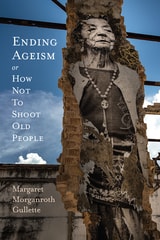
About the cover image:
This elegant, dignified figure--Leda Machado, a Cuban old enough to have seen the Revolution--once the center of a vast photo mural, is now a fragment on a ruined wall. Ageism tears down the structures that all humans need to age well; to end it, a symbol of resilience offers us all brisk blue-sky energy.
“Leda Antonia Machado” from “Wrinkles of the City, 2012.”
Piotr Trybalski / Trybalski.com. Courtesy of the artist.
A Declaration of Grievances
"A Declaration of Grievances" was written by Margaret Morganroth Gullette and is excerpted from her book Ending Ageism, or How Not to Shoot Old People (2017, Rutgers University Press). The poster was designed by Carolyn Kerchof.
- A Declaration of Grievances (in English): https://d3tto5i5w9ogdd.cloudfront.net/wp-content/uploads/2023/01/15175130/A-Declaration-of-Grievances_Eng.pdf
- A Declaration of Grievances (in Spanish): https://d3tto5i5w9ogdd.cloudfront.net/wp-content/uploads/2023/01/15175131/A-Declaration-of-Grievances_Spanish.pdf
- A Declaration of Grievances (in French): https://d3tto5i5w9ogdd.cloudfront.net/wp-content/uploads/2023/01/15175130/A-Declaration-of-Grievances_French.pdf
- A Declaration of Grievances (in German): https://d3tto5i5w9ogdd.cloudfront.net/wp-content/uploads/2023/01/15175131/A-Declaration-of-Grievances_German.pdf
Print the PDF (make sure to click "fit to page") and hang the Declaration up in your home or place of work. Please share this link with other people you know who care about the rights of older persons. Share on social media with the hashtags #ADeclarationOfGrievances and #EndingAgeismGullette.
For more information, an excerpt, links to reviews, and special offers on this book, go to: https://www.rutgersuniversitypress.org/ending-ageism
Related website: (https://www.brandeis.edu/wsrc/scholars/profiles/gullette.html)
Explorations in the Economics of Aging
Edited by David A. Wise
University of Chicago Press, 2011
The next two decades will mark a new phase in the demographic transition of the United States as baby boomers become eligible for Social Security and Medicare. Drawing on evidence from the United States and other nations, Explorations in the Economics of Aging yields important new findings on how economic decisions by households and policy choices by governments will influence the effects of this demographic shift. It explores topics such as the implications of differential mortality rates by income on Social Security, the link between cognition and economic outcomes, and scale variations in self-reported work disability. This volume will be an important reference for economists and policymakers alike.