Results by title
209 books match the query 'Alaska' and 6 start with e
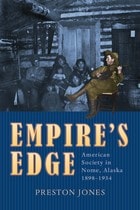
Empire's Edge
American Society in Nome, Alaska, 1898-1934Preston Jones
University of Alaska Press, 2006

Ends of the Earth
PoemsKate Partridge
University of Alaska Press, 2017
While the poems turn an inquisitive, contemporary lens to the subject of Alaska, elements throughout the book are influenced by twentieth-century writers like Elizabeth Bishop and Marianne Moore. The manuscript also combines personal experience with collaged material from the Epic of Gilgamesh, Walt Whitman's notebooks, and other classic sources, to investigate the ideas of love, isolation, and location. Through humor and observation, Partridge takes a new look at what it means to live in urban Alaska and the world at large.
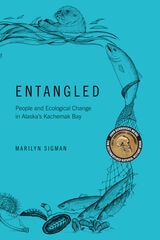
Entangled
People and Ecological Change in Alaska's Kachemak BayMarilyn Sigman
University of Alaska Press, 2018
Kachemak Bay is a place where people and the living resources they depend on have ebbed and flowed for thousands of years. The forces of the earth are dynamic here: they can change in an instant, shaking the ground beneath your feet or overturning kayaks in a rushing wave. Glaciers have advanced and receded over centuries. The climate, like the ocean, has shifted from warmer to colder and back again in a matter of decades. The ocean food web has been shuffled from bottom to top again and again.
In Entangled, Sigman contemplates the patterns of people staying and leaving, of settlement and displacement, nesting her own journey to Kachemak Bay within diasporas of her Jewish ancestors and of ancient peoples from Asia to the southern coast of Alaska. Along the way she weaves in scientific facts about the region as well as the stories told by Alaska’s indigenous peoples. It is a rhapsodic introduction to this stunning region and a siren call to protect the land’s natural resources in the face of a warming, changing world.
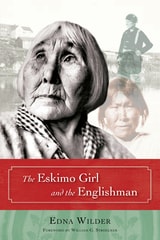
Eskimo Girl and the Englishman
Edna Wilder
University of Alaska Press, 2009
The Eskimo Girl and the Englishman is a sequel to the delightful story Once Upon an Eskimo Time, which recounts the remarkable life of Minnie and her Eskimo mother as she comes of age in a traditional village on Alaska’s western coast. Resuming the tale on the day Minnie encounters her first white man, The Eskimo Girl and the Englishman relates the next century of Minnie’s adventurous life—painting a picture of early twentieth-century village life as Minnie and her Englishman marry and find the determination, strength, and courage to live life in the face of tragedy, rapidly changing technology, and unrelenting hardship along the Bering Sea. Accompanied by photographs of early Eskimo village life, the narrative poignantly captures a sense of a long-lost way of life on the Seward Peninsula.
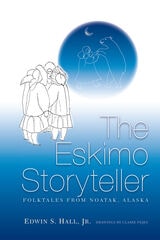
Eskimo Storyteller
Folktales from Noatak, Alaska New EditionEdwin Hall
University of Alaska Press, 1999
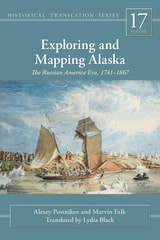
Exploring and Mapping Alaska
The Russian America Era, 1741-1867Alexey Postnikov and Marvin Falk
University of Alaska Press, 2015
Exploring and Mapping Alaska focuses on this foundational period in Arctic cartography. Russia spurred a golden era of cartographic exploration, while shrouding their efforts in a veil of secrecy. They drew both on old systems developed by early fur traders and new methodologies created in Europe. With Great Britain, France, and Spain following close behind, their expeditions led to an astounding increase in the world’s knowledge of North America.
Through engrossing descriptions of the explorations and expert navigators, aided by informative illustrations, readers can clearly trace the evolution of the maps of the era, watching as a once-mysterious region came into sharper focus. The result of years of cross-continental research, Exploring and Mapping Alaska is a fascinating study of the trials and triumphs of one of the last great eras of historic mapmaking.