Results by title
106 books match the query 'Alternative & Renewable' and 8 start with e
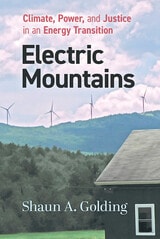
Electric Mountains
Climate, Power, and Justice in an Energy TransitionShaun A. Golding
Rutgers University Press, 2021
Climate change has shifted from future menace to current event. As eco-conscious electricity consumers, we want to do our part in weening from fossil fuels, but what are we actually a part of?
Committed environmentalists in one of North America’s most progressive regions desperately wanted energy policies that address the climate crisis. For many of them, wind turbines on Northern New England’s iconic ridgelines symbolize the energy transition that they have long hoped to see. For others, however, ridgeline wind takes on a very different meaning. When weighing its costs and benefits locally and globally, some wind opponents now see the graceful structures as symbols of corrupted energy politics.
This book derives from several years of research to make sense of how wind turbines have so starkly split a community of environmentalists, as well as several communities. In doing so, it casts a critical light on the roadmap for energy transition that Northern New England’s ridgeline wind projects demarcate. It outlines how ridgeline wind conforms to antiquated social structures propping up corporate energy interests, to the detriment of the swift de-carbonizing and equitable transformation that climate predictions warrant. It suggests, therefore, that the energy transition of which most of us are a part, is probably not the transition we would have designed ourselves, if we had been asked.
[more]
Electrical Design for Ocean Wave and Tidal Energy Systems
Raymond Alcorn
The Institution of Engineering and Technology, 2013
Renewable energy is expected to play a major part in future energy supplies, both to reduce the impact on the world climate and also to make up for any shortfall in conventional energy sources. Ocean energy has the potential to make a significant contribution to future renewable energy supplies as identified in recent reports from the Intergovernmental Panel for Climate Change and the International Energy Agency. Ocean energy is an emerging industry sector and there are a number of promising developments under way. Significant commercial deployments in the gigawatt range are envisaged over the next 10 to 20 years in Europe, USA, Asia and South America.
[more]

Embedded Generation
Nick Jenkins
The Institution of Engineering and Technology, 2000
The use of combined heat and power (CHP) plants and renewable energy sources reduces the amount of greenhouse gases released into the atmosphere and helps to alleviate the consequent climate change. The policies of many governments suggest that the proportion of electrical energy produced by these sources will increase dramatically over the next two decades. Unlike traditional generating units, these new types of power plant are usually 'embedded' in the distribution system or 'dispersed' around the network. As a result, conventional design and operating practices are no longer applicable; for example, power protection principles have to be revised and complex economic questions need to be resolved.
[more]
Energy Generation and Efficiency Technologies for Green Residential Buildings
David S-K. Ting
The Institution of Engineering and Technology, 2019
Residential buildings consume about a quarter of all energy (including electrical and thermal) in industrialized countries and emit around 20% of the carbon emissions there. Older and outdated heating and cooling technology causes high energy demand and, depending on building type, secondary causes can include ventilation and lighting. Technology is available to mitigate high energy consumption, and to enable the use of renewable or environmentally friendly energy, partly generated locally.
[more]

Energy Harvesting for Wireless Sensing and Flexible Electronics through Hybrid Technologies
Muhammad Iqbal
The Institution of Engineering and Technology, 2023
As wearable microelectronics are becoming ubiquitous, there is a growing interest in replacing batteries with a means of harnessing power from the user's environment via embedded systems. Efforts have been made to prolong the harvester's operational lifetime, overcoming energy dissipation, lowering resonant frequency, attaining multi-resonant states, and widening the operating frequency bandwidth of the biomechanical energy harvesters. Such technological advances mean harvesting energy is a viable solution for sustainably powering wearable electronics for health and wellbeing applications, such as continuous medical health monitoring, remote sensing, and motion tracking.
[more]
Energy Storage for Power Systems
A.G. Ter-Gazarian
The Institution of Engineering and Technology, 2011
The supply of energy from primary sources is not constant and rarely matches the pattern of demand from consumers. Electricity is also difficult to store in significant quantities. Therefore, secondary storage of energy is essential to increase generation capacity efficiency and to allow more substantial use of renewable energy sources that only provide energy intermittently. Lack of effective storage has often been cited as a major hurdle to substantial introduction of renewable energy sources into the electricity supply network. The author presents here a comprehensive guide to the different types of storage available. He not only shows how the use of the various types of storage can benefit the management of a power supply system, but also considers more substantial possibilities that arise from integrating a combination of different storage devices into a system. This book will be important to those seeking to develop environmentally sound energy resources.
[more]

Energy Storage for Power Systems
Andrei G. Ter-Gazarian
The Institution of Engineering and Technology, 1994
Energy flow from many primary sources is not constant but depends on the season, time of day and weather conditions. Energy demand also varies with the same circumstances, but generally in reverse. Obviously there needs to be some way for energy suppliers to separate the processes of energy generation and consumption, by storing energy until it is needed.
[more]
Energy
Resources, technologies and the environmentChristian Ngô
The Institution of Engineering and Technology, 2010
This book is aimed at students and professionals as well as anyone interested in having a global vision and perspective on energy.
[more]