Results by title
94 books match the query 'Analysis' and 4 start with e
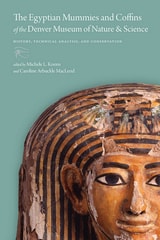
Egyptian Mummies and Coffins of the Denver Museum of Nature & Science
History, Technical Analysis, and ConservationMichele L. Koons
University Press of Colorado, 2020
This interdisciplinary volume provides a history of the mummies’ discovery and relocation to Colorado. It guides the reader through various analytical techniques, detailing past research and introducing new data and best practices for future conservation efforts. The new analysis includes more accurate radiocarbon dating, fully comprehensive data from updated CT scans, examples of Egyptian blue and yellow pigments on the coffins uncovered by non-invasive x-ray fluorescence, unprecedented analysis of the coffin wood, updated translations and stylistic analysis of the text and imagery on the coffins, gas chromatography of the paints and resins, linen analysis, and much more.
The Egyptian Mummies and Coffins of the Denver Museum of Nature & Science provides replicable findings and consistent terminology for institutions performing holistic studies on extant museum collections of a range of material types. It will add substantially to what we know about the effective conservation of Egyptian mummies and coffins.
Contributors: Christopher H. Baisan, Hans Barnard, Bonnie Clark, Pearce Paul Creasman, Farrah Cundiff, Jessica M. Fletcher, Kari L. Hayes, Kathryn Howley, Stephen Humphries, Keith Miller, Vanessa Muros, Robyn Price, David Rubinstein, Judith Southward, Jason Weinman
Elements of Rhetoric
Comprising an Analysis of the Laws of Moral Evidence and of Persuasion, with Rules for Argumentative Composition and ElocutionRichard Whately. Edited with a Critical Introduction by Douglas Ehninger. Foreword by David Potter.
Southern Illinois University Press, 1963
Direct, comprehensive, well organized, simple in statement, Elements of Rhetoric is in all respects well fitted to fulfill its assigned role as a textbook. The remarks on practical problems and the examples and analogies confirm contemporary reports that Whately was himself a talented and stimulating teacher.
The modern field of speech was born near the beginning of the twentieth century, some seventy years after Whately wrote. But influential leaders in the new field endorsed Whately’s judgments, and courses and textbooks in public address have remained strongly influenced by his ideas. Whately’s views on a number of major questions in rhetoric have proved sound and fruitful during many decades of practice, and his book remains one of the most influential works on the subject.
Experimenting with Ethnography
A Companion to AnalysisAndrea Ballestero and Brit Ross Winthereik, editors
Duke University Press, 2021
Contributors. Patricia Alvarez Astacio, Andrea Ballestero, Ivan da Costa Marques, Steffen Dalsgaard, Endre Dányi, Marisol de la Cadena, Marianne de Laet, Carolina Domínguez Guzmán, Rachel Douglas-Jones, Clément Dréano, Joseph Dumit, Melanie Ford Lemus, Elaine Gan, Oliver Human, Alberto Corsín Jiménez, Graham M. Jones, Trine Mygind Korsby, Justine Laurent, James Maguire, George E. Marcus, Annemarie Mol, Sarah Pink, Els Roding, Markus Rudolfi, Ulrike Scholtes, Anthony Stavrianakis, Lucy Suchman, Katie Ulrich, Helen Verran, Else Vogel, Antonia Walford, Karen Waltorp, Laura Watts, Brit Ross Winthereik
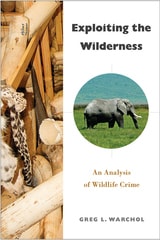
Exploiting the Wilderness
An Analysis of Wildlife CrimeGreg L. Warchol
Temple University Press, 2017
Illegally harvested ivory and endangered plants, mammals, reptiles, birds, and even insects are easily found for sale throughout East and Southern Africa. And this is just one part of the multi-billion-dollar illegal global trade in wildlife.
Wildlife is an important and even vital asset for both intrinsic and economic reasons. Yet it is illegally exploited on a massive scale to the point where some species now risk extinction. Exploiting the Wilderness provides a concise overview of this shameful business, describing some of the main species being exploited and examining select wildlife whose survival is imperiled due to heavy pressure from poachers to meet consumer demand.
Greg Warchol draws on his firsthand experience and research in Africa to examine the structure and operation of the illegal trade in wildlife. He identifies the participants as well as their motivations and operations, and explains the behavior of poachers, traffickers, and consumers of illegally obtained goods. He concludes with a description of legislative and law enforcement efforts to control and prevent wildlife exploitation along with a number of contemporary conservation initiatives designed to improve the ability of rangers to protect wildlife.