Results by title
64 books match the query 'Anarchism' and 2 start with e
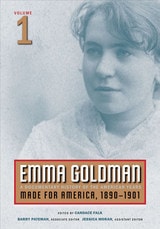
Emma Goldman
A Documentary History of the American Years, Volume 1: Made for America, 1890-1901Emma Goldman. Edited by Candace Falk; Barry Pateman, Assoc Ed; Jessica Moran, A
University of Illinois Press, 2007
Emma Goldman: A Documentary History of the American Years reconstructs the life of Emma Goldman through significant texts and documents. These volumes collect personal letters, lecture notes, newspaper articles, court transcripts, government surveillance reports, and numerous other documents, many of which appear here in English for the first time. Supplemented with thorough annotations, multiple appendixes, and detailed chronologies, the texts bring to life the memory of this singular, pivotal figure in American and European radical history.
Volume 1: Made for America, 1890-1901 introduces readers to the young Emma Goldman as she begins her association with the international anarchist movement and especially with the German, Jewish, and Italian immigrant radicals in New York City. From early on, Goldman's movement through political and intellectual circles is marked by violence, from the attempted murder of industrialist Henry Clay Frick by Goldman's lover, Alexander Berkman, to the assassination of President William McKinley, in which Goldman was falsely implicated. The documents surrounding these events illuminate Goldman's struggle to balance anarchism's positive gains and its destructive costs. This volume introduces many of the themes that would pervade much of Goldman's later writings and speeches: the untold possibilities of anarchism; the transformative power of literature; the interplay of human relationships; and the importance of free speech, education, labor, women's freedom, and radical social reform.

Everyday Anarchism
Prefiguring Utopia in Spain and Argentina, 1890-1930Nathaniel Andrews
University of Illinois Press, 2027
In Spain and Argentina during the late nineteenth and early twentieth centuries, anarchists sought to build their ideal society in the present rather than wait for the revolution. These radicals built their daily lives around their beliefs—a far-sighted cultural project that shaped education, family life, leisure time, and moral values.
Nathaniel Andrews looks at life in four communities to explore how anarchists fused radical politics with the everyday. As Andrews shows, anarchists created networks across the Atlantic that not only shared people and ideas, but practices, too. Small actions—picnics, childrearing, using time differently—became a part of pursuing larger political goals. But these practices also revealed tensions within the movement by highlighting the gap separating ideas and actions, particularly in matters of gender.
Vivid and surprising, <i>Everyday Anarchism</i> reveals a daring program to model a radical society within the very world anarchism hoped to transform.