Results by title
138 books match the query 'Art and society' and 2 start with e
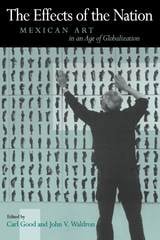
Effects Of The Nation
Mexican Art In Age Of Globalizationedited by Carl Good and John V. Waldron
Temple University Press, 2001
What is the effect of a "nation"? In this age of globalization, is it dead, dying, or only dormant? The essays in this groundbreaking volume use the arts in Mexico to move beyond the national and the global to look at the activity of a community continually re-creating itself within and beyond its own borders.
Mexico is a particularly apt focus, partly because of the vitality of its culture, partly because of its changing political identity, and partly because of the impact of borders and borderlessness on its national character. The ten essays collected here look at a wide range of aesthetic productions -- especially literature and the visual arts -- that give context to how art and society interact.
Steering a careful course between the nostalgia of nationalism and the insensitivity of globalism, these essays examine modernism and postmodernism in the Mexican setting. Individually, they explore the incorporation of historical icons, of vanguardism, and of international influence. From Diego Rivera to Elena Garro, from the Tlateloco massacre to the Chiapas rebellion, from mass-market fiction to the film Aliens, the contributors view the many sides of Mexican life as relevant to the creation of a constantly shifting national culture. Taken together, the essays look both backward and forward at the evolving effect of the Mexican nation.
[more]

Exhibiting Blackness
African Americans and the American Art MuseumBridget R. Cooks
University of Massachusetts Press, 2011
In 1927, the Chicago Art Institute presented the first major museum exhibition of art by African Americans. Designed to demonstrate the artists' abilities and to promote racial equality, the exhibition also revealed the art world's anxieties about the participation of African Americans in the exclusive venue of art museums—places where blacks had historically been barred from visiting let alone exhibiting. Since then, America's major art museums have served as crucial locations for African Americans to protest against their exclusion and attest to their contributions in the visual arts.
In Exhibiting Blackness, art historian Bridget R. Cooks analyzes the curatorial strategies, challenges, and critical receptions of the most significant museum exhibitions of African American art. Tracing two dominant methodologies used to exhibit art by African Americans—an ethnographic approach that focuses more on artists than their art, and a recovery narrative aimed at correcting past omissions—Cooks exposes the issues involved in exhibiting cultural difference that continue to challenge art history, historiography, and American museum exhibition practices. By further examining the unequal and often contested relationship between African American artists, curators, and visitors, she provides insight into the complex role of art museums and their accountability to the cultures they represent.
In Exhibiting Blackness, art historian Bridget R. Cooks analyzes the curatorial strategies, challenges, and critical receptions of the most significant museum exhibitions of African American art. Tracing two dominant methodologies used to exhibit art by African Americans—an ethnographic approach that focuses more on artists than their art, and a recovery narrative aimed at correcting past omissions—Cooks exposes the issues involved in exhibiting cultural difference that continue to challenge art history, historiography, and American museum exhibition practices. By further examining the unequal and often contested relationship between African American artists, curators, and visitors, she provides insight into the complex role of art museums and their accountability to the cultures they represent.
[more]