Results by title
167 books match the query 'Artists, Architects, Photographers' and 5 start with e
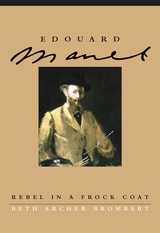
Edouard Manet
Rebel in a Frock CoatBeth Archer Brombert
University of Chicago Press, 1997
"One of the pleasures of reading her is to follow the way she weaves life, art and history into a smooth tapestry. The art emerges from the life, and in the broadest possible context: in terms of its creator's life and concerns and in terns of its historical and cultural setting."—Eric Gibson, The Washington Times Books
"Richly detailed and informative . . . [this biography] exposes the character of an artist who maintained a sharply defined duality between his public and private personas."—Edward J. Sozanski, Philadelphia Inquirer
"Brombert's reading of important canvasses . . . shine, as do her accounts of the changing social and political environment in which Manet worked. . . . Well researched, complexly conceived, and clearly written."—Kirkus Reviews
"Brilliant . . . [this book] grants us a far deeper understanding of why [Manet's] paintings outraged so many of his peers, and why these same masterpieces resonate so richly in our psyches a century later."—Booklist, starred review
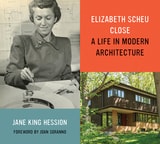
Elizabeth Scheu Close
A Life in Modern ArchitectureJane King Hession
University of Minnesota Press, 2020
An in-depth account of the life and career of Minnesota’s first modern architect
2024 Docomomo US Modernism in America Award of Excellence
2021 Finalist, Minnesota Book Award, Emilie Buchwald Award for Minnesota Nonfiction
Elizabeth “Lisl” Scheu Close (1912–2011) left an indelible mark on Minnesota’s built landscape during her six decades as an architect. In 1938, with her husband, Winston Close, she founded the state’s first architecture firm dedicated to modernism. In addition to designing the first International Style house in Minneapolis, the firm also created more than 250 handsome and efficiently planned modern residences. One of few women who were practicing architects in the mid-twentieth century, she blazed a trail for future generations of women in the profession.
As Jane King Hession shows, the trajectory of Lisl’s architectural career was shaped by the political, economic, and aesthetic upheavals of the twentieth century. Raised in a renowned modern house in Vienna, Austria, Lisl was exposed to revolutionary ideas in art and architecture at a young age. Forced to emigrate to the United States as the Nazis rose to power in Europe, she completed her architectural education at MIT. During the Depression, she struggled to find work and encountered challenges as a young woman in the field. In her pursuit of and devotion to a singular and successful career as a modern architect, she proved herself to be talented, determined, and adept at negotiating obstacles.
Through documentation of Lisl’s projects, this personal and professional biography also explores multiple aspects of modern architecture, including the innovative use of new materials and technologies, the design of prefabricated houses, and the relationship between residential design and changing American lifestyles.

Encounters with Rauschenberg
(A Lavishly Illustrated Lecture)Leo Steinberg
University of Chicago Press, 2000
With the sharpness and confidence that can only come from a critic who has long been involved with Rauschenberg's work, Steinberg offers an in-depth discussion of such major pieces as the Erased DeKooning Drawing, Bed, and Monogram. He explains the subtle differences between his interpretations and those of other critics, such as Clement Greenberg and Hilton Kramer. He candidly reflects on how he has changed his mind over the years, and defends his new ideas about Rauschenberg's work with precise, fresh arguments. He critically evaluates Rauschenberg's more recent work and addresses how it falls short from the artist's earlier work.
From Rauschenberg's silk-screen prints of the 1960s to the vegetable dye transfer prints of the 1990s, Steinberg warns against the dangers of overinterpretation and iconographic enthusiasm. He argues that the unifying strand through this great artist's work is his drive to appropriate, to take objects and images from the world and make them his own by making them become a part of his art.
Provocative, intelligent, and beautifully articulated, Steinberg's words shed light on one remarkable artist and on the post-war New York art scene, on Steinberg's particular appreciation of Rauschenberg and on his life's work as an art critic.
Evidence of My Existence
Jim Lo Scalzo
Ohio University Press, 2007
From a leper colony in India to an American research station on the Antarctic Peninsula, from the back rooms of the White House to the battlefields of Iraq and Afghanistan, Evidence of My Existence tells a unique and riveting story of seventeen years spent racing from one photo assignment to the next. It is also a story of photojournalism and theconsequences of obsessive wanderlust.
When the book opens, Jim Lo Scalzo is a blur to his wife, her remarkable tolerance wearing thin. She is heading to the hospital with her second miscarriage, and Jim is heading to Baghdad to cover the American invasion of Iraq. He hates himself for this—for not giving her a child, for deserting her when she soobviously needs him, for being consumed by his job—but how to stop moving? Sure, there have been some tough trips. He’s been spit on by Mennonites in Missouri, by heroin addicts in Pakistan, and by the KKK in South Carolina. He’s contracted hepatitis on the Navajo Nation, endured two bouts of amoebic dysentery in India and Burma and four cases of giardia in Nepal, Peru, Afghanistan, and Cuba. He’s been shot with rubber bullets in Seattle, knocked to the ground by a water cannon in Quebec, and sprayed with more teargas than he cares to recall. But photojournalism is his career, and travel is his compulsivecraving.
We follow Lo Scalzo through the maze of airports and crowds and countries as he chases the career he has always wanted, struggles with his family problems, and reveals the pleasures of a life singularly focused. For him, as for so many photojournalists, it is always about the going.
Eye Trouble
A Memoir of Imperfect MaculasAlice Mattison
Northwestern University Press, 2027
A candid and enlightening account of life with flawed vision
Alice Mattison observes the world differently: Her sight has been altered by a progressive eye disease. Mattison had hints early in life of something amiss when reading became difficult, and she was diagnosed in her forties with a rare form of macular degeneration—a disease that gradually destroyed her central vision in one eye. Years later, another form of the same disease threatened her other eye, further altering her sight. Her eye ailments affect relationships with friends, students, doctors, her partner—and especially with herself. Mattison asks questions that apply to all of us, whether or not we live with imperfect vision: What can we learn from a medical problem? How do we determine how bad it is? Who gets to decide that—our family and friends, our doctors, or we ourselves? And, perhaps most challenging of all, what good can come of disease?