Results by title
235 books match the query 'Attitudes' and 7 start with e
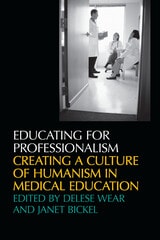
Educating For Professionalism
Creating A Culture Of Humanism In Medical EducationDelese Wear
University of Iowa Press, 2000
The thirteen essays in Educating for Professionalism examine the often conflicting ethical, social, emotional, and intellectual messages that medical institutions send to students about what it means to be a doctor. Because this disconnection between what medical educators profess and what students experience is partly to blame for the current crisis in medical professionalism, the authors offer timely, reflective analyses of the work and opportunities facing medical education if doctors are to win public trust.
In their drive to improve medical professionalism within the world of academic medicine, editors Delese Wear and Janet Bickel have assembled thought-provoking essays that elucidate the many facets of teaching, valuing, and maintaining medical professionalism in the middle of the myriad challenges facing medicine at the dawn of the twenty-first century.
The collection traces how the values of altruism and service can influence not only mission statements and admission policies but also the content of medical school ethics courses, student-led task forces, and mentoring programs, along with larger environmental issues in medical schools and the communities they serve.
Stanley Joel Reiser
Jack Coulehan
Peter C. Williams
Frederic W. Hafferty
Richard Martinez
Judith Andre
Jake Foglio
Howard Brody
Sheila Woods
Sue Fosson
Lois Margaret Nora
Mary Anne C. Johnston
Tana A. Grady-Weliky
Cynthia N. Kettyle
Edward M. Hundert
Norma E. Wagoner
Frederick A. Miller
William D. Mellon
Howard Waitzkin
Donald Wasylenki
Niall Byrne
Barbara McRobb
Edward J. Eckenfels
Lucy Wolf Tuton
Claudia H. Siegel
Timothy B. Campbell

Energy Never Dies
Afro-Optimism and Creativity in ChicagoAyana Contreras
University of Illinois Press, 2021
Passionate and enlightening, Energy Never Dies uses the power of storytelling to show how optimism and courage fuel the dreams of Black Chicago.

Environmentally Devastated Neighborhoods
Perceptions, Policies, and RealitiesGreenberg, Michael
Rutgers University Press, 1996

Erotic Utopia
The Decadent Imagination in Russia's Fin de SiecleOlga Matich
University of Wisconsin Press, 2007
The first generation of Russian modernists experienced a profound sense of anxiety resulting from the belief that they were living in an age of decline. What made them unique was their utopian prescription for overcoming the inevitability of decline and death both by metaphysical and physical means. They intertwined their mystical erotic discourse with European degeneration theory and its obsession with the destabilization of gender. In Erotic Utopia, Olga Matich suggests that same-sex desire underlay their most radical utopian proposal of abolishing the traditional procreative family in favor of erotically induced abstinence.
“Offers a fresh perspective and a wealth of new information on early Russian modernism. . . . It is required reading for anyone interested in fin-de-siècle Russia and in the history of sexuality in general.”—Bernice Glatzer Rosenthal, Slavic and East European Journal
“Thoroughly entertaining.”—Avril Pyman, Slavic Review
Exemplary Violence
Rewriting History in Colonial ColombiaAlberto Villate-Isaza
Bucknell University Press, 2021
Exile and Cultural Hegemony
Spanish Intellectuals in Mexico, 1939-1975Sebastiaan Faber
Vanderbilt University Press, 2002
The first study of its kind to place the exiles' ideological evolution in a broad historical context, Exile and Cultural Hegemony takes into account developments in both Spanish and Mexican politics from the early 1930s through the 1970s. Faber pays particular attention to the intellectuals' persistent nationalism and misplaced illusions of pan-Hispanist grandeur, which included awkward and ironic overlaps with the rhetoric employed by their enemies on the Francoist right. This embrace of nationalism, together with the intellectuals' dependence on the increasingly authoritarian Mexican regime and the international climate of the Cold War, eventually caused them to abandon the Gramscian ideal of the intellectual as political activist in favor of a more liberal, apolitical stance preferred by, among others, the Spanish philosopher Jose Ortega y Gasset.
With its comprehensive approach to topics integral to Spanish culture, both students of and those with a general interest in twentieth-century Spanish literature, history, or culture will find Exile and Cultural Hegemony a fascinating and groundbreaking work.
Expected Miracles
Surgeons at WorkJoan Cassell
Temple University Press, 1991
Expected Miracles explores the world of surgeons from their own perspective—how they perceive themselves, their work, colleagues, and communities. Recognizing that surgery is an art, a craft, a science, and a business, Joan Cassell offers, through poignant, painful, and thrilling descriptions, a vivid portrayal of the culture of surgery.
Cassell has entered a realm where laypersons are usually horizontal, naked, and anesthetized. Using the central metaphor of the surgical "miracle," she illuminates the drama of the operating room, where surgeons and patients alike expect heroic performance. She takes us backstage to overhear conversations about patients, families, and colleagues, observe operations, eavesdrop on gossip about surgeons’ performances, and examine the values, behavior, and misbehavior of surgeons at work.
Said one Chief of Surgery, "You couldn’t have a good surgeon who didn’t believe in the concept of the Hero." Following this lead, Cassell explores the heroic temperament of those who perform surgical "miracles" and finds that the demands and pressures of surgical practice require traits that in other fields, or in personal interactions, are often regarded as undesirable. She observes, "surgeons must tread a fine line between courage and recklessness, confidence and hubris, a positive attitude and a magical one." This delicate balance and frequent imbalance is portrayed through several character sketches. She contrasts the caring attention and technical mastery of The Exemplary Surgeon with the theatrical posturing of The Prima Donna and the slick showiness and questionable morals of The Sleazy Surgeon.
She also identifies the attributes that surgeons admire in each other. They believe that only peers can really evaluate each other, and, while doctors might not speak negatively about colleagues in public, the community of surgeons exerts considerable pressure on its members to perform competently.
Unlike "doctor-bashing" chronicles, Expected Miracles seeks to understand the charismatic authority of surgeons, its instability, and its price-to surgeons and to patients.