Results by title
101 books match the query 'Behavior' and 4 start with e

Eleonora's Falcon
Adaptations to Prey and Habitat in a Social RaptorHarmut Walter
University of Chicago Press, 1979
Named after a Sardinian princess of the fourteenth century who established laws protecting falcons, Eleonora's falcon is the only European bird to breed in autumn and feed its brood on the mass of birds that migrate from Europe to Africa between July and October. It breeds on small Mediterranean islands in colonies of up to 200 pairs and hunts often in groups, preying on more than 90 species of migrant birds. During the winter this falcon visits the rain-soaked woodlands of Madagascar.
In this study—illustrated beautifully and extensively with 59 line drawings and 38 photographs—Hartmut Walter shows how the unique geographical and biological situation of Falco eleonorae makes the species' health an important indicator of environmental decay. For though it lives in relatively isolated areas, Eleonora's falcon nevertheless may ingest the many pollutants contained in its diet of birds migrating from industrial Europe. Walter, who has studied raptors on several continents and has been an ornithologist since his early youth, examines several discrete colonies of Eleonora's falcon. He concentrates on the species' intraspecific behavior and ecology—such as the falcons' aggressive actions, hunting strategies, and response to fluctuating environmental conditions—and investigates their evolutionary past.
In this study—illustrated beautifully and extensively with 59 line drawings and 38 photographs—Hartmut Walter shows how the unique geographical and biological situation of Falco eleonorae makes the species' health an important indicator of environmental decay. For though it lives in relatively isolated areas, Eleonora's falcon nevertheless may ingest the many pollutants contained in its diet of birds migrating from industrial Europe. Walter, who has studied raptors on several continents and has been an ornithologist since his early youth, examines several discrete colonies of Eleonora's falcon. He concentrates on the species' intraspecific behavior and ecology—such as the falcons' aggressive actions, hunting strategies, and response to fluctuating environmental conditions—and investigates their evolutionary past.
[more]
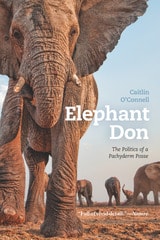
Elephant Don
The Politics of a Pachyderm PosseCaitlin O'Connell
University of Chicago Press, 2015
Meet Greg. He’s a stocky guy with an outsized swagger. He’s been the intimidating yet sociable don of his posse of friends—including Abe, Keith, Mike, Kevin, Torn Trunk, and Willie. But one arid summer the tide begins to shift and the third-ranking Kevin starts to get ambitious, seeking a higher position within this social club. But this is no ordinary tale of gangland betrayal—Greg and his entourage are bull elephants in Etosha National Park, Namibia, where, for the last twenty-three years, Caitlin O’Connell has been a keen observer of their complicated friendships.
In Elephant Don, O’Connell, one of the leading experts on elephant communication and social behavior, offers a rare inside look at the social world of African male elephants. Elephant Don tracks Greg and his group of bulls as O’Connell tries to understand the vicissitudes of male friendship, power struggles, and play. A frequently heart-wrenching portrayal of commitment, loyalty, and affection between individuals yearning for companionship, it vividly captures an incredible repertoire of elephant behavior and communication. Greg, O’Connell shows, is sometimes a tyrant and other times a benevolent dictator as he attempts to hold onto his position at the top. Though Elephant Don is Greg’s story, it is also the story of O’Connell and the challenges and triumphs of field research in environs more hospitable to lions and snakes than scientists.
Readers will be drawn into dramatic tales of an elephant society at once exotic and surprisingly familiar, as O’Connell’s decades of close research reveal extraordinary discoveries about a male society not wholly unlike our own. Surely we’ve all known a Greg or two, and through this book we may come to know them in a whole new light.
[more]
Environmental Perception and Behavior
An Inventory and ProspectEdited by Thomas F. Saarinen, David Seamon, and James L. Sell
University of Chicago Press, 1984
[more]
Ethnography and Human Development
Context and Meaning in Social InquiryEdited by Richard Jessor, Anne Colby, and Richard A. Shweder
University of Chicago Press, 1996
Studies of human development have taken an ethnographic turn in the 1990s. In this volume, leading anthropologists, psychologists, and sociologists discuss how qualitative methodologies have strengthened our understanding of cognitive, emotional, and behavioral development, and of the difficulties of growing up in contemporary society.
Part 1, informed by a post-positivist philosophy of science, argues for the validity of ethnographic knowledge. Part 2 examines a range of qualitative methods, from participant observation to the hermeneutic elaboration of texts. In Part 3, ethnographic methods are applied to issues of human development across the life span and to social problems including poverty, racial and ethnic marginality, and crime.
Restoring ethnographic methods to a central place in social inquiry, these twenty-two lively essays will interest everyone concerned with the epistemological problems of context, meaning, and subjectivity in the behavioral sciences.
[more]