Results by title
484 books match the query 'Biblical Studies' and 22 start with e
Early Christians and Their Art
Mikeal C. Parsons
SBL Press, 2023
Early Jewish Writings
Eileen Schuller
SBL Press, 2017
New from the Bible and Women Series
This collection of essays deals with aspects of women and gender relations in early Judaism (during the Persian, Greek, and Roman empires). Some essays focus on specific writings: the Greek (Septuagint) version of Esther, Judith, Joseph and Aseneth, and the Letter of Jeremiah. Others explore how certain biblical texts are reinterpreted: Eve in the Life of Adam and Eve, the mixing of the sons of God with the daughters of men from Genesis 6:1–4, the Egyptian princess at the birth of Moses, and how Josephus retells biblical stories. The third group of essays explore specific social contexts: Philo's views of women in the Roman empire, the Sectarian Dead Sea Scrolls, and women philosophers of the Therapeutae in Egyptian Alexandria.
Features
- An International team of contributors from Europe and North America
- A breadth of materials covered, including many lesser-known early Jewish writings
- Focus is on a gendered perspective and gender specific questions
Early Judaism and Its Modern Interpreters
Matthias Henze
SBL Press, 2020
An essential resource for scholars and students
Since the publication of the first edition of Early Judaism and Its Modern Interpreters in 1986, the field of early Judaism has exploded with new data, the publication of additional texts, and the adoption of new methods. This new edition of the classic resource honors the spirit of the earlier volume and focuses on the scholarly advances in the past four decades that have led to the study of early Judaism becoming an academic discipline in its own right. Essays written by leading scholars in the study of early Judaism fall into four sections: historical and social settings; methods, manuscripts, and materials; early Jewish literatures; and the afterlife of early Judaism.
Ecclesial Exegesis
A Synthesis of Ancient and Modern Approaches to ScriptureGregory Vall
Catholic University of America Press, 2022
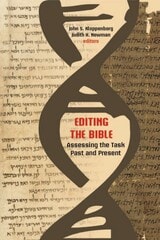
Editing the Bible
Assessing the Task Past and PresentJohn S. Kloppenborg
SBL Press, 2012
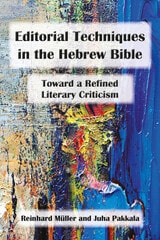
Editorial Techniques in the Hebrew Bible
Toward a Refined Literary CriticismReinhard Müller
SBL Press, 2022
Editorial Techniques in the Hebrew Bible: Toward a Refined Literary Criticism presents and applies a model for understanding and reconstructing the diachronic development of the Hebrew Bible through historical criticism (or the historical-critical method). Reinhard Müller and Juha Pakkala refine the methodologies of literary and redaction criticism through a systematic investigation of the evidence of additions, omissions, replacements, and transpositions that are documented by divergent ancient textual traditions. At stake is not only historical criticism but also the Hebrew Bible as a historical source, for historical criticism has been and continues to be the only method to unwind those scribal changes that left no traces in textual variants.
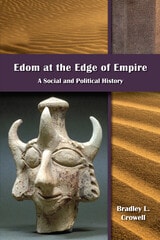
Edom at the Edge of Empire
A Social and Political HistoryBradley L. Crowell
SBL Press, 2021
A comprehensive history of a state on Judah’s border
Edom at the Edge of Empire combines biblical, epigraphic, archaeological, and comparative evidence to reconstruct the history of Judah's neighbor to the southeast. Crowell traces the material and linguistic evidence, from early Egyptian sources that recall conflicts with nomadic tribes to later Assyrian texts that reference compliant Edomite tribal kings, to offer alternative scenarios regarding Edom's transformation from a collection of nomadic tribes and workers in the Wadi Faynan as it relates to the later polity centered around the city of Busayra in the mountains of southern Jordan. This is the first book to incorporate the important evidence from the Wadi Faynan copper mines into a thorough account of Edom's history, providing a key resource for students and scholars of the ancient Near East and the Hebrew Bible.
Embracing the Nonhuman in the Gospel of Mark
Dong Hyeon Jeong
SBL Press, 2023
Empire and Gender in LXX Esther
Meredith J. Stone
SBL Press, 2018
A new perspective on essential aspects of Esther’s plot and characters for students and scholars
Empire and Gender in LXX Esther foregrounds and highlights empire as the central lens in this provocative new reading of Esther. This book provides a unique synchronic reading of LXX Esther with the Additions, allowing the presence and negotiation of imperial power to be further illuminated throughout the story’s plot. Stone explores and demonstrates how performances of gender are inextricably intertwined with the exertion and negotiation of imperial power portrayed in LXX Esther and offers examples of connections to the range of imperial power experienced by Jewish people during the late Second Temple period.
Features:
- An exploration of the tenets and methodology of imperial-critical approaches
- Focused attention to the final form of LXX Esther
- Construction of early audiences for LXX Esther in first-century BCE Ptolemaic Alexandria and Hasmonean Judea
Empirical Models Challenging Biblical Criticism
Raymond F. Person
SBL Press, 2016
Cutting edge reflections on biblical text formation
Empirical models based on ancient Near Eastern literature and variations between different textual traditions have been used to lend credibility to the identification of the sources behind biblical literature and the different editorial layers. In this volume, empirical models are used to critique the exaggerated results of identifying sources and editorial layers by demonstrating that, even though much of ancient literature had such complex literary histories, our methods are often inadequate for the task of precisely identifying sources and editorial layers. The contributors are Maxine L. Grossman, Bénédicte Lemmelijn, Alan Lenzi, Sara J. Milstein, Raymond F. Person Jr., Robert Rezetko, Stefan Schorch, Julio Trebolle Barrera, Ian Young, and Joseph A. Weaks.
Features:
- Evidence that many ancient texts are composite texts with complex literary histories
- Ten essays and an introduction cover texts from Mesopotamia, the Hebrew Bible, the New Testament, and the Dead Sea Scrolls
Encounters in the Dark
Identity Formation in the Jacob StoryNoel Forlini Burt
SBL Press, 2020
An interdisciplinary study of a familiar patriarchal narrative
Encounters in the Dark: Identity Formation in the Jacob Story traces the many moments of darkness in the life of Jacob. From the darkness of his mother's womb, to the darkness Jacob uses to deceive his father and his brother, to the night he sleeps on the ground with just a stone for a pillow at Bethel, and to the triumphant scene of wrestling God by the Jabbok River, the biblical story frequently situates Jacob in the darkness. Through an exploration of key moments in Jacob's story, Noel Forlini Burt follows Jacob's journey from home to exile and back home again. His story symbolizes the larger story of Israel's own wrestling with God in the darkness of exile and return.
Features
- An exploration of the poetics and rhetoric of the Jacob story
- An examination of characterization in its ancient and modern contexts
- An analysis of individual and collective identity
Enoch and the Synoptic Gospels
Reminiscences, Allusions, IntertextualityLoren T. Stuckenbruck
SBL Press, 2016
Essential research for students and scholars of Second Temple Judaism and the New Testament
Since Richard Laurence published the first English translation of 1 Enoch in 1821, its importance for an understanding of early Christianity has been generally recognized. The present volume is the first book of essays contributed by international specialists in Second Temple Judaism devoted to the significance of traditions found in 1 Enoch for the interpretation of the Synoptic Gospels in the New Testament. Areas covered by the contributions include demonology, Christology, angelology, cosmology, birth narratives, forgiveness of sins, veneration, wisdom, and priestly tradition. The contributors are Joseph L. Angel, Daniel Assefa, Leslie Baynes, Gabriele Boccaccini, Kelley Coblentz Bautch, Henryk Drawnel, André Gagné, Lester L. Grabbe, Daniel M. Gurtner, Andrei A. Orlov, Anders Klostergaard Petersen, Amy E. Richter, Loren T. Stuckenbruck, Benjamin Wold, and Archie T. Wright.
Features:
- Multiple approaches to thinking about the relationship between 1 Enoch and the Synoptic Gospels
- Exploration of the common socio-cultural and religious framework within which the traditions concerning Enoch and Jesus developed
- Articles presented at the Seventh Enoch Seminar in 2013
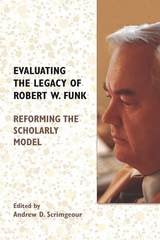
Evaluating the Legacy of Robert W. Funk
Reforming the Scholarly ModelAndrew D. Scrimgeour
SBL Press, 2018
Enter the world of an academic trailblazer
Robert W. Funk, professor of New Testament, former Executive Secretary of the Society of Biblical Literature, and founder of Scholars Press and the Jesus Seminar, was one of the most gifted, controversial figures in modern biblical scholarship. The volume includes nineteen of his essays, correspondences, interviews, and administrative papers pertaining to the Society of Biblical Literature and Scholars Press. Colleagues introduce each section with reflections on the life and contributions of Funk.
Features:
- Evaluation of the changes to scholarly societies and to scholarly research that Funk advocated
- Exploration of the shift in the interpretation of Jesus’s parables initiated by Funk
- Previously unpublished writings
Everyone's Apocalypse
A Reflection Guide, 2nd EditionDonal A. McIlraith
Saint Paul Seminary Press, 2024
Evidence of Editing
Growth and Change of Texts in the Hebrew BibleReinhard Müller
SBL Press, 2014
A new perspective on editorial activity in the Hebrew Bible for research and teaching
Evidence of Editing lays out the case for substantial and frequent editorial activity within the Hebrew Bible. The authors show how editors omitted, expanded, rewrote, and compiled both smaller and larger phrases and passages to address religious and political change. The book refines the exegetical method of literary and redaction criticism, and its results have important consequences for the future use of the Hebrew Bible in historical and theological studies.
Features:
- Hebrew, Greek, and Aramaic examples of editorial activity
- Clear explanations of the distinctions between textual, literary, and redaction criticism
- Fifteen chapters attesting to continual editorial activity in the Torah, the Prophets, and the Writings
Experientia, Volume 2
Linking Text and ExperienceColleen Shantz
SBL Press, 2012

Explaining Christian Origins and Early Judaism
Contributions from Cognitive and Social SciencePetri Luomanen
SBL Press, 2016
Now in paperback!
Cognitive science of religion is a radically new paradigm in the study of religion. Historians of religion have shown increasing interest in this approach. The book is in four parts: an introduction to cognitive and social-scientific approaches, applications of cognitive science, applications of conceptual blending theory, and applications of socio-cognitive analyses.
Features:
- Paperback format of an essential Brill resource
- Essays that combine cognitive analysis with historical and social-scientific approaches to biblical materials, Christian origins, and early Judaism
- Research for historians of religion, biblical scholars, and those working in the cognitive science of religion.
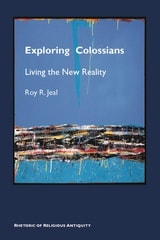
Exploring Colossians
Living the New RealityRoy R. Jeal
SBL Press, 2024
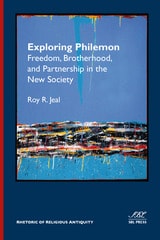
Exploring Philemon
Freedom, Brotherhood, and Partnership in the New SocietyRoy R. Jeal
SBL Press, 2015
A new, sociorhetorical interpretation of the Letter to Philemon
Exploring Philemon shows how this letter entered the world of the ancient Mediterranean and the early church with a dramatic and powerful rhetorical force by analyzing the range of textures interwoven with each other to produce a profound effect on an early Christian (Philemon) and on the church that met in his home. It demonstrates that many striking and subtle features work together to present a rhetorical argument that the new Christian society must be one of freedom, brotherhood, and partnership not just for the powerful, but for all.
Features:
- An analysis of the visual imagery of the letter
- Application of up-to-date rhetorical, sensory-aesthetic, and intertextual interpretive methods
- Use of Social and cultural, ideological, and theological strategies
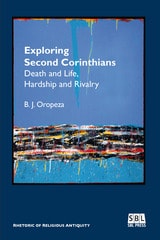
Exploring Second Corinthians
Death and Life, Hardship and RivalryB. J. Oropeza
SBL Press, 2016
A multi-faceted commentary that breathes fresh insight into Paul's letter
In Second Corinthians, Paul responds to reports of the Corinthian congregation questioning his competency as a divinely sent messenger. Through apologetic demegoria and the use of graphic imagery related to triumphal processions, siege warfare, and emissary travels and negotiation, Paul defends his constancy, persona, and speaking abilities as he extends the offer of clemency and reconciliation to his auditors. Oropeza combines rhetorical pictures (rhetography) with interpretative layers (literary features, intertextuality, socio-cultural, ideological, and sacred textures) to arrive at the rhetorical impact of Paul's message for ancient Mediterranean discourse.
Features:- A visual, sensory, and imaginative interpretation of the scripture
- A comprehensive commentary
- An avant-garde approach to biblical interpretation
Exploring Sublime Rhetoric in Biblical Literature
Roy R. Jeal
SBL Press, 2024
Ezekiel 1–24
Introduction and CommentaryDale F. Launderville
SBL Press, 2026