Results by title
277 books match the query 'Biology' and 11 start with e
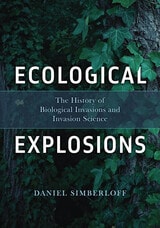
Ecological Explosions
The History of Biological Invasions and Invasion ScienceDaniel Simberloff
University of Chicago Press, 2025
From the arrival of the naval shipworm in the Black Sea in the first millennium BC to the escape of the Burmese python in Florida in 1992, humans have moved species to new locations, deliberately or inadvertently, for thousands of years. Agricultural and environmental impacts of some invasions were evident early, although whether observers recognized that the cause was an introduced species is uncertain. The history of invasion biology truly begins in the sixteenth through eighteenth centuries, when explorers noticed European species on various distant islands and in North America. In the nineteenth century, biogeographers, studying species distributions across the globe, introduced the first native and non-native species categorizations, and prominent researchers like Charles Darwin began to describe the impacts of introduced species. In the nineteenth and twentieth centuries, as humans moved increasing numbers of species across the globe, the advent of modern ecology deepened our understanding of the scope of the problem.
In Ecological Explosions, invasive species expert Daniel Simberloff provides a thorough overview of the development of invasion science, from early research—including from the perspectives of leading scientists like Aldo Leopold—to the field’s future. Simberloff explores the work of pioneering ecologists like Charles Elton, antecedents of what became today’s invasion biology, before discussing the field’s true emergence in the 1980s, its explosive methodological and theoretical expansion, its integration with other disciplines, and its increasing visibility, not only within the biological literature but also in government policies across the world in the 1990s. Finally, he investigates current controversies, such as the debate over whether the entire science is xenophobic, and asks how ecosystems might adapt to a rapidly globalizing world and ever-increasing numbers of introduced species—including the joro spider, lionfish, spotted lanternfly, common reed, and Asian carp.
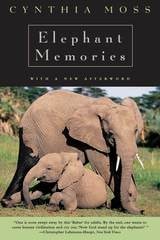
Elephant Memories
Thirteen Years in the Life of an Elephant FamilyCynthia J. Moss
University of Chicago Press, 2000
Cynthia Moss studied the elephants in Kenya's Amboseli National Park for decades, and her long-term research revealed much of what we now know about these complex and intelligent animals. In Elephant Memories she turns that knowledge in an accessible, engaging, even moving story of individual elephants and their complicated relationships. With Moss as our guide, we get to know a number of elephants who are in a family group that is led by matriarchs Teresia, Slit Ear, Torn Ear, Tania, and Tuskless. and we develop new understanding of what elephants do when allowed to live in the wild. An afterword offers a view of the the families from a few years later and addresses current conservation issues.
Emergence of Life on Earth
A Historical and Scientific OverviewFry, Iris
Rutgers University Press, 2000
Topics include:
- Aristotle and the Greek atomists' conceptions of the organism
- Alexander Oparin and J.B.S. Haldane's 1920s breakthrough papers
- Possible life on Mars?
Emergence of Life on Earth
A Historical and Scientific OverviewFry, Iris
Rutgers University Press, 2000
--Michael Ruse, author of Mystery of Mysteries: Is Evolution a Social Construction?
"Fry has fashioned a masterful account of the history, philosophy, and science of the origin of life and the possibility of extraterrestrial life. Her story weaves profound Western ideas of who we are and where we came from, from Aristotle to Gould, from Kant to NASA."
--Woodruff Sullivan, University of Washington
"A rich source for the specialist and thought-provoking reading for the lay person."
--Gunter Wachtershauser, University of Regensburg, Germany
How did life emerge on Earth? Is there life on other worlds? These questions, until recently confined to the pages of speculative essays and tabloid headlines, are now the subject of legitimate scientific research. This book presents a unique perspective--a combined historical, scientific, and philosophical anaylsis, which does justice to the complex nature of the subject. The book's first part offers an overview of the main ideas on the origin of life as they developed from antiquity until the twentieth century. The second, more detailed part of the book examines contemporary theories and major debates within the origin-of-life scientific community.
Topics include:
- Aristotle and the Greek atomists' conceptions of the organism
- Alexander Oparin and J.B.S. Haldane's 1920s breakthrough papers
- Possible life on Mars?
Evolution As Entropy
Toward a Unified Theory of BiologyDaniel R. Brooks and E. O. Wiley
University of Chicago Press, 1988
"This book is unquestionably mandatory reading not only for every living biologist but for generations of biologists to come."—Jack P. Hailman, Animal Behaviour, review of the first edition
"An important contribution to modern evolutionary thinking. It fortifies the place of Evolutionary Theory among the other well-established natural laws."—R.Gessink,TAXON
Evolution and the Genetics of Populations, Volume 1
Genetic and Biometric FoundationsSewall Wright
University of Chicago Press, 1968
Evolution and the Machinery of Chance
Philosophy, Probability, and Scientific Practice in BiologyMarshall Abrams
University of Chicago Press, 2023
Natural selection is one of the factors responsible for changes in biological populations. Some traits or organisms are fitter than others, and natural selection occurs when there are changes in the distribution of traits in populations because of fitness differences. Many philosophers of biology insist that a trait’s fitness should be defined as an average of the fitnesses of individual members of the population that have the trait.
Marshall Abrams argues convincingly against this widespread approach. As he shows, it conflicts with the roles that fitness is supposed to play in evolutionary theory and with the ways that evolutionary biologists use fitness concepts in empirical research. The assumption that a causal kind of fitness is fundamentally a property of actual individuals has resulted in unnecessary philosophical puzzles and years of debate. Abrams came to see that the fitnesses of traits that are the basis of natural selection cannot be defined in terms of the fitnesses of actual members of populations, as philosophers of biology often claim. Rather, it is an overall population-environment system—not actual, particular organisms living in particular environmental conditions—that is the basis of trait fitnesses. Abrams argues that by distinguishing different classes of fitness concepts and the roles they play in the practice of evolutionary biology, we can see that evolutionary biologists’ diverse uses of fitness concepts make sense together and are consistent with the idea that fitness differences cause evolution.
Abrams’s insight has broad significance, for it provides a general framework for thinking about the metaphysics of biological evolution and its relations to empirical research. As such, it is a game-changing book for philosophers of biology, biologists who want deeper insight into the nature of evolution, and anyone interested in the applied philosophy of probability.
Evolution of Desert Biota
Edited by David W. Goodall
University of Texas Press, 1976
Written by specialists in the field, the papers in this volume explore evolution of animals and plants on the deserts of North America, South America, and Australia. Together, the articles constitute a complete survey of the geological history of the deserts of three continents, the evolution of the animals and plants of those deserts, and their adaptations to the environments in which they live.
The first paper, by Otto T. Solbrig, discusses the flora of the South American temperate and semidesert regions, citing numerous genera and reasons that they are found in the different areas. John S. Beard uses the same approach in his discussion of the evolution of Australian desert plants and focuses on western Australian areas. Guillermo Sarmiento appraises the evolution of arid vegetation in tropical America, including the Lesser Antilles and the Coast Range of Venezuela and Colombia. A. R. Main surveys the adaptation of Australian vertebrates to desert conditions and gives examples of how various species of birds, reptiles, and amphibians adapt to their environment in order for the greatest number to survive. James A. MacMahon designates specific communities in the Mojave, Sonoran, and Chihuahuan deserts and discusses the similarity of species of the North American desert mammal faunas found there, while Bobbi S. Low focuses on the evolution of amphibian life histories in the desert and compiles a lengthy table of amphibia comparing egg size, habitat, number of eggs per clutch, and so forth. Finally, W. Frank Blair treats adaptation of anurans to equivalent desert scrub of North and South America and cites various species of frogs and toads that are found in similar areas.
The volume also includes an introduction by the editor and an index. Evolution of Desert Biota is the result of a symposium held during the First International Congress of Systematic and Evolutionary Biology in Boulder, Colorado; in August 1973.
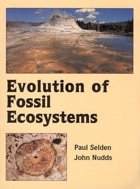
Evolution of Fossil Ecosystems
Paul A. Selden and John R. Nudds
University of Chicago Press, 2005
Beginning with a general introduction to fossil Lagerstätten, Evolution of Fossil Ecosystems goes on, chapter by chapter, to consider each fossil site, detailing its evolutionary position and significance; a brief history of the locality; its background sedimentology, stratigraphy, and paleoenvironment; its biota and paleoecology; and its commonalities with similar Lagerstätten. Considering deposits both marine and terrestrial, the book covers one fossil site from the Precambrian era, five sites from the Paleozoic era, five sites from the Mesozoic era, and three sites from the Cenozoic era.
Illustrated with hundreds of color photographs and drawings, Evolution of Fossil Ecosystems is a sophisticated yet accessible guide to these critical sites. Containing useful appendixes listing important museums, instructions on how to visit the fossil sites, and additional suggested reading, this book will attract students, academics, and professionals in paleontology, evolution, and the earth and life sciences, as well as dedicated amateurs interested in fossils and geology.
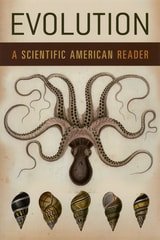
Evolution
A Scientific American ReaderEdited by Scientific American
University of Chicago Press, 2006
From the Scopes “Monkey Trial” of 1925 to the court ruling against the Dover Area School Board’s proposed intelligent design curriculum in 2005, few scientific topics have engendered as much controversy—or grabbed as many headlines—as evolution. And since the debate shows no signs of abating, there is perhaps no better time to step back and ask: What is evolution? Defined as the gradual process by which something changes into a different and usually more complex and efficient form, evolution explains the formation of the universe, the nature of viruses, and the emergence of humans. A first-rate summary of the actual science of evolution, this Scientific American reader is a timely collection that gives readers an opportunity to consider evolution’s impact in various settings.
Divided into four sections that consider the evolution of the universe, cells, dinosaurs, and humans, Evolution brings together more than thirty articles written by some of the world’s most respected evolutionary scientists. As tour guides through the genesis of the universe and complex cells, P. James E. Peebles examines the evidence in support of an expanding cosmos, while Christian de Duve discusses the birth of eukaryotes. In an article that anticipated his book Full House, Stephen Jay Gould argues that chance and contingency are as important as natural selection for evolutionary change. And Ian Tatersall makes two fascinating contributions, submitting his view that the schematic of human evolution looks less like a ladder and more like a bush.
With the latest on what’s being researched at every level of evolutionary studies, from prospects of life on other planets to the inner working of cells, Evolution offers general readers an opportunity to update their knowledge on this hot topic while giving students an introduction to the problems and methodologies of an entire field of inquiry.
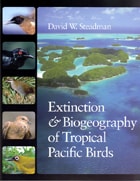
Extinction and Biogeography of Tropical Pacific Birds
David W. Steadman
University of Chicago Press, 2006
Reconstructing the avian world in the same way archeologists re-create ancient human societies, David Steadman—a leading authority on tropical Pacific avian paleontology—has spent the past two decades in the field, digging through layers of soil in search of the bones that serve as clues to the ancient past of island bird communities. His years of indefatigable research and analysis are the foundation for Extinction and Biogeography of Tropical Pacific Birds, a monumental study of the landbirds of tropical Pacific islands—especially those from Fiji eastward to Easter Island—and an intricate history of the patterns and processes of island biology over time.
Using information gleaned from prehistoric specimens, Steadman reconstructs the birdlife of tropical Pacific islands as it existed before the arrival of humans and in so doing corrects the assumption that small, remote islands were unable to support rich assemblages of plants and animals. Easter Island, for example, though devoid of wildlife today, was the world’s richest seabird habitat before Polynesians arrived more than a millennium ago. The forests of less isolated islands in the Pacific likewise teemed with megapodes, rails, pigeons, parrots, kingfishers, and songbirds at first human contact.
By synthesizing data from the distant past, Steadman hopes to inform present conservation programs. Grounded in geology, paleontology, and archeology, but biological at its core, Extinction and Biogeography of Tropical Pacific Birds is an exceptional work of unparalleled scholarship that will stimulate creative discussions of terrestrial life on oceanic islands for years to come.