Results by title
159 books match the query 'Birds' and 6 start with e
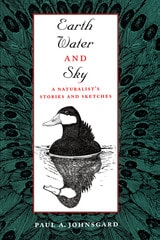
Earth, Water, and Sky
A Naturalist's Stories and SketchesBy Paul A. Johnsgard
University of Texas Press, 1999
"As I write this, I am sitting in a cabin at Cedar Point Biological Station in southwestern Nebraska.... The glorious elemental mixture of earth, water, and sky around me is the home of nearly three hundred species of birds, and comprises one of my favorite places in the world. Here no radio stations blare out the most recent results of meaningless sports events ... no traffic noises confound the senses. Instead the wind is the unquestioned dominating summer influence. The prairie grasses bend willingly and gracefully before it, and the leaves of the cottonwood trees convert its breezes into soft music."
Paul Johnsgard is one of America's most prominent ornithologists and a world authority on waterfowl behavior. In these popularly written, often lyrical essays, he describes some of his most fascinating encounters with birds, from watching the annual mating displays of prairie-chickens on a hilltop in Pawnee County, Nebraska, to attempting to solve some of the mysteries surrounding Australia's nearly flightless musk duck.
Reflecting his worldwide interests and travels, the birds Johnsgard describes inhabit many parts of the globe. Grouping the birds by the element they frequent most—earth, water, or sky—he weaves a wealth of accurate natural history into personal stories drawn from a lifetime of avian observation. And, as a bonus, Johnsgard's lovely pen-and-ink drawings illustrate each species he describes.

Edgar Heap of Birds
Bill Anthes
Duke University Press, 2015

Eleonora's Falcon
Adaptations to Prey and Habitat in a Social RaptorHarmut Walter
University of Chicago Press, 1979
In this study—illustrated beautifully and extensively with 59 line drawings and 38 photographs—Hartmut Walter shows how the unique geographical and biological situation of Falco eleonorae makes the species' health an important indicator of environmental decay. For though it lives in relatively isolated areas, Eleonora's falcon nevertheless may ingest the many pollutants contained in its diet of birds migrating from industrial Europe. Walter, who has studied raptors on several continents and has been an ornithologist since his early youth, examines several discrete colonies of Eleonora's falcon. He concentrates on the species' intraspecific behavior and ecology—such as the falcons' aggressive actions, hunting strategies, and response to fluctuating environmental conditions—and investigates their evolutionary past.
Evolutionary Dynamics of a Natural Population
The Large Cactus Finch of the GalapagosB. Rosemary Grant and Peter R. Grant
University of Chicago Press, 1989
Extinction and Biogeography of Tropical Pacific Birds
David W. Steadman
University of Chicago Press, 2006
Reconstructing the avian world in the same way archeologists re-create ancient human societies, David Steadman—a leading authority on tropical Pacific avian paleontology—has spent the past two decades in the field, digging through layers of soil in search of the bones that serve as clues to the ancient past of island bird communities. His years of indefatigable research and analysis are the foundation for Extinction and Biogeography of Tropical Pacific Birds, a monumental study of the landbirds of tropical Pacific islands—especially those from Fiji eastward to Easter Island—and an intricate history of the patterns and processes of island biology over time.
Using information gleaned from prehistoric specimens, Steadman reconstructs the birdlife of tropical Pacific islands as it existed before the arrival of humans and in so doing corrects the assumption that small, remote islands were unable to support rich assemblages of plants and animals. Easter Island, for example, though devoid of wildlife today, was the world’s richest seabird habitat before Polynesians arrived more than a millennium ago. The forests of less isolated islands in the Pacific likewise teemed with megapodes, rails, pigeons, parrots, kingfishers, and songbirds at first human contact.
By synthesizing data from the distant past, Steadman hopes to inform present conservation programs. Grounded in geology, paleontology, and archeology, but biological at its core, Extinction and Biogeography of Tropical Pacific Birds is an exceptional work of unparalleled scholarship that will stimulate creative discussions of terrestrial life on oceanic islands for years to come.
Extreme Measures
The Ecological Energetics of Birds and MammalsBrian K. McNab
University of Chicago Press, 2012
Along with reproduction, balancing energy expenditure with the limits of resource acquisition is essential for both a species and a population to survive. But energy is a limited resource, as we know well, so birds and mammals—the most energy-intensive fauna on the planet—must reduce energy expenditures to maintain this balance, some taking small steps, and others extreme measures.
Here Brian K. McNab draws on his over sixty years in the field to provide a comprehensive account of the energetics of birds and mammals, one fully integrated with their natural history. McNab begins with an overview of thermal rates—much of our own energy is spent maintaining our 98.6?F temperature—and explains how the basal rate of metabolism drives energy use, especially in extreme environments. He then explores those variables that interact with the basal rate of metabolism, like body size and scale and environments, highlighting their influence on behavior, distribution, and even reproductive output. Successive chapters take up energy and population dynamics and evolution. A critical central theme that runs through the book is how the energetic needs of birds and mammals come up against rapid environmental change and how this is hastening the pace of extinction.