Results by title
63 books match the query 'Bolivia' and 6 start with e
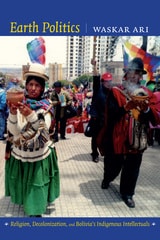
Earth Politics
Religion, Decolonization, and Bolivia's Indigenous IntellectualsWaskar Ari
Duke University Press, 2014
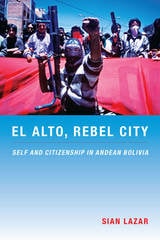
El Alto, Rebel City
Self and Citizenship in Andean BoliviaSian Lazar
Duke University Press, 2007
Drawing on ethnographic fieldwork conducted between 1997 and 2004, Lazar contends that in El Alto, citizenship is a set of practices defined by one’s participation in a range of associations, many of them collectivist in nature. Her argument challenges Western liberal notions of the citizen by suggesting that citizenship is not only individual and national but in many ways communitarian and distinctly local, constituted through different kinds of affiliations. Since in El Alto these affiliations most often emerge through people’s place of residence and their occupational ties, Lazar offers in-depth analyses of neighborhood associations and trade unions. In so doing, she describes how the city’s various collectivities mediate between the state and the individual. Collective organization in El Alto and the concept of citizenship underlying it are worthy of attention; they are the basis of the city’s formidable power to mobilize popular protest.

Embodied Protests
Emotions and Women's Health in BoliviaMaria Tapias
University of Illinois Press, 2015
Evocative and compassionate, Embodied Protests gives voice to the human costs of the ongoing neoliberal experiment.

Evo Morales and the Movimiento Al Socialismo in Bolivia
The First Term in Context, 2005-2009Edited by Adrian Pearce
University of London Press, 2011
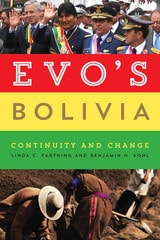
Evo's Bolivia
Continuity and ChangeBy Linda C. Farthing and Benjamin H. Kohl
University of Texas Press, 2014
In this compelling and comprehensive look at the rise of Evo Morales and Bolivia’s Movimiento al Socialismo (MAS), Linda Farthing and Benjamin Kohl offer a thoughtful evaluation of the transformations ushered in by the western hemisphere’s first contemporary indigenous president. Accessible to all readers, Evo’s Bolivia not only charts Evo’s rise to power but also offers a history of and context for the MAS revolution’s place in the rising “pink tide” of the political left. Farthing and Kohl examine the many social movements whose agendas have set the political climate in Bolivia and describe the difficult conditions the administration inherited. They evaluate the results of Evo’s policies by examining a variety of measures, including poverty; health care and education reform; natural resources and development; and women’s, indigenous, and minority rights. Weighing the positive with the negative, the authors offer a balanced assessment of the results and shortcomings of the first six years of the Morales administration.
At the heart of this book are the voices of Bolivians themselves. Farthing and Kohl interviewed women and men in government, in social movements, and on the streets throughout the country, and their diverse backgrounds and experiences offer a multidimensional view of the administration and its progress so far. Ultimately the “process of change” Evo promised is exactly that: an ongoing and complicated process, yet an important example of development in a globalized world.
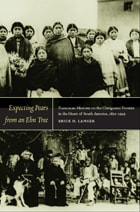
Expecting Pears from an Elm Tree
Franciscan Missions on the Chiriguano Frontier in the Heart of South America, 1830–1949Erick D. Langer
Duke University Press, 2009
Expecting Pears from an Elm Tree is based on twenty years of research, including visits to the sites of nearly every mission discussed and interviews with descendants of mission Indians, Indian chiefs, Franciscan friars, mestizo settlers, and teachers. Langer chronicles how, beginning in the 1840s, the establishment of missions fundamentally changed the relationship between the Chiriguano villages and national society. He looks at the Franciscan missionaries’ motives, their visions of ideal missions, and the realities they faced. He also examines mission life from the Chiriguano point of view, considering their reasons for joining missions and their resistance to conversion, as well as the interrelated issues of Indian acculturation and the development of the mission economy, particularly in light of the relatively high rates of Indian mortality and outmigration. Expanding his focus, Langer delves into the complex interplay of Indians, missionaries, frontier society, and the national government until the last remaining missions were secularized in 1949. He concludes with a comparative analysis between colonial and republican-era missions throughout Latin America.