Results by title
96 books match the query 'Buddhism' and 3 start with e

Encounters with Korean Folk Religion
The Goddesses of Eight Peaks MountainClark W. Sorensen
Rutgers University Press, 2027
Encounters with Korean Folk Religion is an account of forty-five years of engagement with the cult of goddesses on Eight Peaks Mountain in Korea’s western Kangwŏn Province, the shaman who tended to the goddesses there from 1977 to 2015, and the folk religion of the surrounding village of Eight Peaks. Since the 1980s, South Korea has urbanized and the village of Eight Peaks has been transformed from a remote agricultural village into a rafting and ski resort. While communal worship ceremonies have been dying out in most of Korea, they have only grown on Eight Peaks Mountain, which has been a site of worship since at least the 15th century. What was a small-scale local ceremony in 1977 has grown into a large-scale regional celebration attracting shamans and tourists from far and wide. The manuscript delves in a historically and anthropologically innovative way into the social, religious, and historical reasons for this efflorescence.
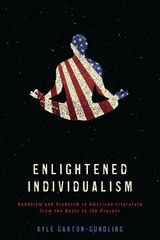
Enlightened Individualism
Buddhism and Hinduism in American Literature from the Beats to the PresentKyle Garton-Gundling
The Ohio State University Press, 2019
This “enlightened individualism” uses Buddhist and Hindu philosophy to reframe American freedom in terms of spiritual liberation, and it also reinterprets Asian teachings through Western traditions of political activism and countercultural provocation. Garton-Gundling argues that even though works by Kerouac, Walker, Kingston, and others wrestle with issues of exoticism and appropriation, their characters are also meaningfully challenged and changed by Asian faiths. These literary adaptations, then, can help Americans reenvision individualism in a more transcendent and cosmopolitan context.
Experience
Thinking, Writing, Language, and ReligionNorman Fischer
University of Alabama Press, 2015
An exploration of how language, creativity, and spiritual practice shape human experience.
By what narrow path is the ineffable silence of Zen cleft by the scratch of a pen? The distilled insights of forty years, Norman Fischer’s Experience: Thinking, Writing, Language, and Religion is a collection of essays by Zen master Fischer about experimental writing as a spiritual practice.
Raised in a Conservative Jewish family, Fischer embraced the twin practices of Zen Buddhism and innovative poetics in San Francisco in the early 1970s. His work includes original poetry, descriptions of Buddhist practice, translations of the Hebrew psalms, and eclectic writings on a range of topics from Homer to Heidegger to Kabbalah. Both Buddhist priest and participant in avant-garde poetry’s Language movement, Fischer has limned the fertile affinities and creative contradictions between Zen and writing, accumulating four decades of rich insights he shares in Experience.
Fischer’s work has been deeply enriched through his collaborations with leading rabbis, poets, artists, esteemed Zen Buddhist practitioners, Trappist monks, and renowned Buddhist leaders, among them the Dalai Lama. Alone and with others, he has carried on a deep and sustained investigation into the intersection of writing and consciousness as informed by meditation.
The essays in this artfully curated collection range across divers, fascinating topics such as time, the Heart Sutra, God in the Hebrew psalms, the supreme “uselessness” of art making, “late work” as a category of poetic appreciation, and the subtle and dubious notion of “religious experience.” From the theoretical to the revealingly personal, Fischer’s essays, interviews, and notes point toward a dramatic expansion of the sense of religious feeling in writing.
Readers who join Fischer on this path in Experience can discover how language is not a description of experience, but rather an experience itself: shifting, indefinite, and essential.