57 books match the query 'Business Ethics' and 3 start with e
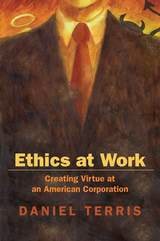
cover of Ethics at Work: Creating Virtue at an American Corporation

Ethics at Work

Creating Virtue at an American Corporation

Daniel Terris

Brandeis University Press, 2013
The defense industry has, to some people’s surprise, the broadest and most sustained set of ethics programs of any sector of American business today. Lockheed Martin, which specializes in a host of high-technology products and services for the federal government, has dramatically escalated its formal ethics and business conduct program since the mega-corporation was formed through a merger in 1995. The Ethics and Business Conduct Division employs 65 “ethics officers” in sites around the United States, and it requires the firm’s 130,000-plus employees to devote at least one hour per year to consideration of the ethical issues of the business, at a cost of millions of dollars per year. Daniel Terris spent two years researching Lockheed Martin materials and interviewing its ethics officers and ordinary employees to develop this rich case study of the ethics program at this powerful global corporation. This study begins with a survey of American attitudes toward ethics in business over the past century, raising the question of whether ethics can be genuinely built into the modern mega-corporation. Terris then develops a portrait of Lockheed Martin—its history and the nature of its far-flung businesses—turning at last to its ethics program, which was created following a series of bribery, overcharging, and corruption scandals in the 1970s and 1980s. By 1996, Lockheed Martin had in place some dull, preachy ethics programs designed to provide basic information on telling right from wrong in business practice. But then-CEO Norm Augustine wanted to liven things up, so he turned to an unlikely source of inspiration: the irreverent Dilbert comic strip. The company came up with a board game that resembled Clue, but used Dilbert characters to explore ethical case studies drawn from real-life Lockheed Martin incidents. Terris examines the success of the board game, as well as subsequent efforts including special workshops, a film festival, and biennial ethics surveys to engage employees in broad-based discussions of ethics at work. Although Terris applauds Lockheed Martin’s ethics program as “gloriously democratic” in its focus on the responsibility of every worker for the ethical dimensions of his or her actions, he is concerned that the broad-based focus tends to divert attention from the ethical responsibilities of senior management and the moral complexities of collective decision-making. While he admires the ambitious scope of the program, he notes that the corporation’s definition of “ethics” focuses on individual behavior rather than on the impact of the corporation’s broader policies on local, national, and global communities. The ultimate effect of such programs may be to create more ethical business practices—but, ironically, at the expense of the public good.
[more]
cover of Ethics, Business and Capitalism: Thailand and Indonesia in an Asian Perspective

Ethics, Business and Capitalism

Thailand and Indonesia in an Asian Perspective

Edited by Janet Hunter, Patnaree Srisuphaolarn, Pierre van der Eng, and Julia Yongue

National University of Singapore Press, 2024

Academic analysis of business ethics in Southeast Asia. 

Taking cues from the Japanese concept of ethical or stakeholder capitalism, this book demonstrates how the business activities of firms in Thailand and Indonesia are guided by their perceptions of morality in society and their concerns about the environment. The authors explore the likelihood that foreign influences contributed to the development of such management philosophies, for example through the expansion of Japanese subsidiary firms in the 1980s or the spread of foreign articulations of the concept of corporate social responsibility (CSR) since the 2000s. Companies in both countries may exercise a degree of pragmatism in how they develop these activities. As the authors reveal, the perceptions of morality in business that have shaped many entrepreneurs and companies in Thailand and Indonesia are their responses to the dynamic political, social, and economic factors that have formed the business environments of both countries.

[more]
cover of Everyone's Business: What Companies Owe Society

Everyone's Business

What Companies Owe Society

Amit Ron and Abraham A. Singer

University of Chicago Press, 2024

Business is political. What are the ethics of it?

Businesses are political actors. They not only fund political campaigns, take stances on social issues, and wave the flags of identity groups – they also affect politics in their everyday hiring and investment decisions. As a highly polarized public demands political alignment from the powerful businesses they deal with, what’s a company to do?

Amit Ron and Abraham Singer show that the unavoidably political role of companies in modern life is both the fundamental problem and inescapable fact of business ethics: corporate power makes business ethics necessary, and business ethics must strive to mitigate corporate power. Because of its economic and social influence, Ron and Singer forcefully argue that modern business’s primary social responsibility is to democracy. Businesses must work to avoid wielding their power in ways that undermine key democratic practices like elections, public debate, and social movements. Pragmatic and urgent, Everyone’s Business offers an essential new framework for how we pursue profit—and democracy—in our increasingly divided world.

[more]