Results by title
547 books match the query 'California' and 12 start with e
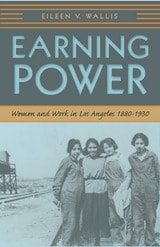
Earning Power
Women and Work in Los Angeles, 1880-1930Eileen Wallis
University of Nevada Press, 2010
The half-century between 1880 and 1930 saw rampant growth in many American cities and an equally rapid movement of women into the work force. In Los Angeles, the city not only grew from a dusty cow town to a major American metropolis but also offered its residents myriad new opportunities and challenges.Earning Power examines the role that women played in this growth as they attempted to make their financial way in a rapidly changing world. Los Angeles during these years was one of the most ethnically diverse and gender-balanced American cities. Moreover, its accelerated urban growth generated a great deal of economic, social, and political instability. In Earning Power, author Eileen V. Wallis examines how women negotiated issues of gender, race, ethnicity, and class to gain access to professions and skilled work in Los Angeles. She also discusses the contributions they made to the region’s history as political and social players, employers and employees, and as members of families. Wallis reveals how the lives of women in the urban West differed in many ways from those of their sisters in more established eastern cities. She finds that the experiences of women workers force us to reconsider many assumptions about the nature of Los Angeles’s economy, as well as about the ways women participated in it. The book also considers how Angelenos responded to the larger national social debate about women’s work and the ways that American society would have to change in order to accommodate working women. Earning Power is a major contribution to our understanding of labor in the urban West during this transformative period and of the crucial role that women played in shaping western cities, economies, society, and politics.
Earthquake Weather
PoemsJanice Gould
University of Arizona Press, 1996
Showing a steady courage in the midst of this alienation, her words are also stark testimony to the struggle of an individual caught in social and emotional contexts defined by others. In Earthquake Weather, as in an evolving friendship, Gould opens herself to the reader in stages. "I did not know how lonely I was / till we began to talk," she writes in an opening section, setting the introspective tone of what’s to come. She begins with a focus on those universal truths that both bind us and isolate us from each other: the pain of loss, the finality of death, our longing to see beneath the surface of things. Next, the poet turns to her growing-up years during the Vietnam War and the civil rights movement. She describes a family in turmoil and an Indian heritage that, oddly, was one of the factors that made her feel most disconnected from other people. And she writes poignantly about her increasing alienation from prescribed sexual roles. "What’s wrong with me? / Where do I belong? Why / am I here? Why can’t I / hold on?" Finally, as in a trusting friendship, Gould offers the reader vivid word portraits of relationships in her life—women she has loved and who have loved her.
Erotic and deeply personal, these poems serve as both a reconciliation and affirmation of her individuality. "Yet would you deny / that between women desire exists / that in our friendship a delicate / and erotic strand of fire unites us?" The poems in this book, says critic Toby Langen, are most powerful for their "courageous drawing on experience and feelings." They will speak to many general readers as well as anyone interested in questions of gender and identity, including students of literature, lesbian/women’s studies, social/cultural studies, or American Indian studies.
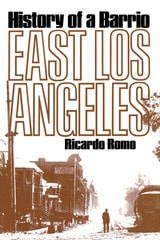
East Los Angeles
History of a BarrioBy Ricardo Romo
University of Texas Press, 1983
This is the story of the largest Mexican-American community in the United States, the city within a city known as "East Los Angeles." How did this barrio of over one million men and women—occupying an area greater than Manhattan or Washington D.C.—come to be?
Although promoted early in this century as a workers' paradise, Los Angeles fared poorly in attracting European immigrants and American blue-collar workers. Wages were low, and these workers were understandably reluctant to come to a city which was also troubled by labor strife. Mexicans made up the difference, arriving in the city in massive numbers.
Who these Mexicans were and the conditions that caused them to leave their own country are revealed in East Los Angeles. The author examines how they adjusted to life in one of the fastest-growing cities in the United States, how they fared in this country's labor market, and the problems of segregation and prejudice they confronted.
East of East
The Making of Greater El MonteRomeo Guzmán
Rutgers University Press, 2020
Ed Ruscha's Streets of Los Angeles
Artist, Image, Archive, CityAndrew Perchuk
J. Paul Getty Trust, The, 2025
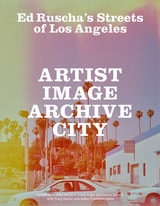
In 1966, Ed Ruscha drove a car rigged with a motorized camera to capture Los Angeles’ most iconic street: Sunset Boulevard. He created a time capsule of its famed facades, beginning a sixty-year-long commitment to documenting the changing urban landscape of postwar Los Angeles. The Streets of Los Angeles project that comprises these photographs is likely the most comprehensive artistic record of any city, with over 900,000 images of major thoroughfares. Ruscha’s photographs constitute an unparalleled visual chronicle of both iconic and everyday sites in L.A., including popular music venues, neighborhood restaurants, and billboards promoting Hollywood’s latest blockbusters.
In this volume, scholars from disciplines such as urban planning, cultural geography, architecture, art history, and musicology explore the Streets of Los Angeles Archive as a rich repository for analyzing Ruscha’s practice and the city’s visual culture. Using his photographs and new data visualizations, the authors consider what it means to interpret an archive mostly accessible through digital technologies, and they demonstrate how histories of art have been indelibly reshaped since the advent of the information age in the 1960s.
This publication was created using Quire™, a multiformat publishing tool from Getty. The free online edition of this open-access publication is available at www.getty.edu/publications/ruscha/ and includes video, data visualizations, and zoomable illustrations. Free PDF and EPUB downloads of the book are also available.
El Teatro Campesino
Theater in the Chicano MovementBy Yolanda Broyles-González
University of Texas Press, 1994
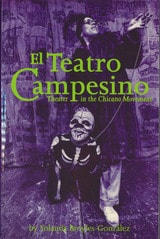
Born in 1965 as an organizing tool within César Chávez's United Farm Workers union, El Teatro Campesino became the premier Chicana/o performance ensemble to emerge out of the Chicano movement of the 1960s and 1970s. This study demythologizes and reinterprets the company's history from its origins in California's farm labor struggles to its successes in Europe and on Broadway until the disbanding of the original collective ensemble in 1980 with the subsequent adoption of mainstream production techniques.
Yolanda Broyles-González corrects many misconceptions concerning the Teatro's creation and evolution. She draws from a rich storehouse of previously untapped material, such as interviews with numerous ensemble members, production notes, and unpublished diaries, to highlight the reality of the collective creation that characterized the Teatro's work.
Writing within contemporary cultural studies theory, Broyles-González sheds light on class, gender, race, and cultural issues. Her work situates the Teatro within working-class Mexican performance history, the Chicano movement, gender relations, and recent attempts to mainstream.
Embodied Politics
Indigenous Migrant Activism, Cultural Competency, and Health Promotion in CaliforniaRebecca J. Hester
Rutgers University Press, 2022
Ethnic Los Angeles
Roger Waldinger
Russell Sage Foundation, 1996

Everyday Desistance
The Transition to Adulthood Among Formerly Incarcerated YouthAbrams, Laura S.
Rutgers University Press, 2017
In Everyday Desistance, Laura Abrams and Diane J. Terry examine the lives of young people who spent considerable time in and out of correctional institutions as adolescents. These formerly incarcerated youth often struggle with the onset of adult responsibilities at a much earlier age than their more privileged counterparts. In the context of urban Los Angeles, with a large-scale gang culture and diminished employment prospects, further involvement in crime appears almost inevitable. Yet, as Abrams and Terry point out, these formerly imprisoned youth are often quite resilient and can be successful at creating lives for themselves after months or even years of living in institutions run by the juvenile justice system.
This book narrates the day-to-day experiences of these young men and women, focusing on their attempts to surmount the challenges of adulthood, resisting a return to criminal activity, and formulating long-term goals for a secure adult future.

Exiled in L.A.
The Untold Story of Leopold Fischer’s Domestic ArchitectureVolker M. Welter
J. Paul Getty Trust, The, 0
In 1936, Leopold Fischer (1901–1975), in exile from Nazi Germany, arrived in California, where he created a small but distinct oeuvre of mostly domestic architecture. In contrast to his famous peers Rudolph Schindler and Richard Neutra, immigrants whose Southern California buildings are frequently examined—and who, like Fischer, studied with the modernist architect Adolf Loos—Fischer and his California structures have, until now, escaped the attention of architectural history.
Exiled in L.A. examines Fischer’s important, yet overlooked, contributions to Southern California architecture. As the whereabouts of Fischer’s archives remain unknown, Volker M. Welter grounds the designer’s California works in comparison with his pre-exile projects and the compositions of fellow architects in California. In the 1920s, Fischer created experimental working-class housing estates in Germany that pioneered ecological construction and living practices. Comparable to their predecessors, Fischer's California buildings revolve around the “functioning, the organization of a home,” as he defined domestic architecture in 1926. Featuring new photography and detailed architectural plans, this book is an original contribution to the literature on Southern California’s built heritage.

Explosivity
Following What RemainsJavier Arbona-Homar
University of Minnesota Press, 2025
How explosions across history reveal the violence embedded in San Francisco’s landscape
Offering a novel approach to contemporary landscape studies, Explosivity unearths the hidden legacies of violence that have shaped the physical and cultural environment of the San Francisco Bay area. As he sifts through the historical debris of previous centuries, Javier Arbona-Homar analyzes a series of explosions that took place between 1866 and 2011 to call attention to the scattered remnants of militarism and racialized capitalism embedded in the region’s geography.
From incidents involving nineteenth-century explosives manufacturing and World War II munitions loading to radical activism and contemporary television productions, Arbona-Homar locates a pattern of historical violence that refocuses the broader racial and colonial context. Citing the material, social, and political conditions that gave rise to these disparate episodes, he reviews the historic erasure of those driving forces and puts forth alternative possibilities for how such disasters might be memorialized.
Synthesizing a diverse set of field research methods, including oral histories and site visits, and supplemented by specially commissioned landscape photographs by Andrea Gaffney, Explosivity presents a radical exercise in the exposition of public memory.
Retail e-book files for this title are screen-reader friendly with images accompanied by short alt text and/or extended descriptions.
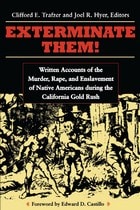
Exterminate Them
Written Accounts of the Murder, Rape, and Enslavement of Native Americans during the California Gold RushClifford E. Trafzer
Michigan State University Press, 1999
Popular media depict miners as a rough-and-tumble lot who diligently worked the placers along scenic rushing rivers while living in roaring mining camps in the foothills of the Sierra Nevada Mountains. Trafzer and Hyer destroy this mythic image by offering a collection of original newspaper articles that describe in detail the murder, rape, and enslavement perpetrated by those who participated in the infamous gold rush. "It is a mercy to the Red Devils," wrote an editor of the Chico Courier, "to exterminate them." Newspaper accounts of the era depict both the barbarity and the nobility in human nature, but while some protested the inhumane treatment of Native Americans, they were not able to end the violence. Native Americans fought back, resisting the invasion, but they could not stop the tide of white miners and settlers. They became "strangers in a stolen land."