Results by title
165 books match the query 'Caribbean Area' and 4 start with e
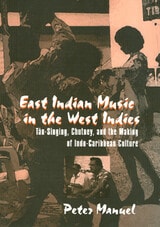
East Indian Music
Peter Manuel
Temple University Press, 2000
Trinidadian sitarist, composer, and music authority Mangal Patasar once remarked and tan-singing, "You take a capsule from India, leave it here for a hundred years, and this is what you get." Patasar was referring to what may be the most sophisticated and distinctive art form cultivated among the one and a half million East Indians whose ancestors migrated as indentured laborers from colonial India to the West Indies between 1845 and 1917. Known in Trinidad and Guyana as "tan-singing" or "local-classical music" and in Suriname as "baithak gana" ("sitting music"), tan-singing has evolved in to a unique idiom, embodying the rich poetic and musical heritage brought from India as modified by a diaspora group largely cut off from its ancestral homeland.
In recent decades, however, tan-singing has been declining, regarded as quaint and crude by younger generations raised on MTV, Hindi film music, and disco. At the same time, Indo-Caribbeans have been participating in their countries' economic, political, and cultural lives to a far greater extent than previously. Accompanying this participation has been a lively cultural revival, encompassing both an enhanced assertion of Indianness and a spirit of innovative syncretism. One of the most well-known products of this process is chutney, a dynamic music and dance phenomenon that is simultaneously a folk revival and a pop hybrid. In Trinidad, it has also been the vehicle for a controversial form of female empowerment and an agent of a new, more inclusive, conception of national identity.
Thus, East Indian Music in the West Indies is a portrait of a diaspora community in motion. It documents the social and cultural development of a people "without history," a people who have sometimes been dismissed as foreigners who merely perpetuate the culture of the homeland rather than becoming "truly" Caribbean. Professor Manuel shows how inaccurate this characterization is. On the one hand, in the form of tan-singing, it examines the distinctiveness of traditional Indo-Caribbean musical culture. On the other, in the form of chutney, it examines the new assertiveness and syncretism of Indo-Caribbean popular music.
Students of Indo-Caribbean music and curious world-music fans alike will be fascinated by Professor Manuel's guided tour through the complex and exciting world of Indo-Caribbean musical culture.
[more]
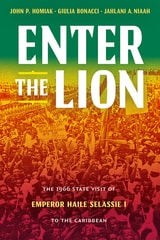
Enter the Lion
The 1966 State Visit of Emperor Haile Selassie I to the CaribbeanJohn P. Homiak, Giulia Bonacci, and Jahlani A. Niaah
Duke University Press, 2026
On April 21, 1966, tens of thousands of Jamaicans exuberantly greeted Ethiopia’s Emperor Haile Selassie I in Kingston, Jamaica. The emperor came to express gratitude for the peoples’ support during the Italo-Ethiopian War and bolster the ongoing struggle for liberation in Rhodesia. This state visit repositioned Rastafari in Jamaican society and ignited widespread cultural, social, and political transformations across the Caribbean. Enter the Lion assembles a vital archive of this landmark event, gathering British colonial records, newspaper reportage from the Caribbean and Ethiopia, the official records of the Ethiopian Ministry of Information, and oral history. The authors paint an illuminating picture of the diverse political interests at play, exploring how the visit reshaped the Rastafari movement, Jamaican society, the wider Caribbean, and their Pan-African connections.
[more]
Erotic Cartographies
Decolonization and the Queer Caribbean ImaginationKrystal Nandini Ghisyawan
Rutgers University Press, 2022
Erotic Cartographies uses subjective mapping, a participatory data collection technique, to demonstrate how Trinidadian same-sex-loving women use their gender performance, erotic autonomy, and space-making practices to reinforce and resist colonial ascriptions on subject bodies. The women strategically embody their sexual identities to challenge imposed subject categories and to contest their invisibility and exclusion from discourses of belonging. Erotic Cartographies refers to the processes of mapping territories of self-knowing and self-expression, both cognitively in the imagination and on paper during the mapping exercise, exploring how meaning is given to space, and how it is transformed. Using the women’s quotes and maps, the book focuses on the false binary of public-private, the practices of home and family, and religious nationalism and spiritual self-seeking, to demonstrate the women’s challenges to the structural, symbolic, and interpersonal violence of colonial discourses and practices related to gender, knowledge, and power in Trinidadian society.
[more]
Exorbitance
A Speculative Ethnography of InheritanceDeborah A. Thomas
Duke University Press, 2025
In Exorbitance, Deborah A. Thomas calls for new approaches to political sovereignty grounded in the embodied forms of autonomy and relation created in daily life. Rather than rooting sovereignty in the violence of the state and its institutions, Thomas conceives of sovereignty as the embodied refusal of law and dominion. Drawing on the insights of Caribbeanist thought and studies of Jamaican social, political, and spiritual life, Thomas proposes an exorbitant sovereignty enacted through a phenomenological notion of inheritance. Such a sovereignty emerges from alternative genealogies of governance, community, and ceremony that exceed Enlightenment expectations of political life. Thomas contends that the articulations of exorbitant sovereignty are emergent, ephemeral, and ultimately, relational. By outlining the perils and promises of our inheritance of colonial logics and the tools to refuse them, Thomas models a collaborative and collective anthropology oriented toward improvisational experimentation rather than ethnographic extraction.
[more]