Results by title
99 books match the query 'Censorship' and 4 start with e

Edited Clean Version
Technology and the Culture of ControlRaiford Guins
University of Minnesota Press, 2009
Where is censorship in the age of digital technology?
Not long ago it would have been an absurd idea to purchase a television, CD or MP3 or DVD player, computer software, or game console with the intention of limiting its capabilities. However, as Raiford Guins demonstrates in Edited Clean Version, today’s media technology is marketed and sold for what it does not contain and what it will not deliver.
TVs equipped with V-chips, Internet filters, editing DVD players, clean-version CDs and MP3s, and game consoles with parental control features can block out, monitor, disable, and filter information. As Guins argues in this provocative book, consumers now find themselves in new relationships with their everyday media in which they inscribe their viewing, listening, and playing experiences with self-prescribed and technologically enabled values and morals. Censorial practices are not so much enacted on media by regulatory bodies today as they are in our media technology.According to Guins, these new “control technologies” are designed to embody an ethos of neoliberal governance—through the very media that have been previously presumed to warrant management, legislation, and policing. Repositioned within a discourse of empowerment, security, and choice, the action of regulation, he reveals, has been relocated into the hands of users.[more]
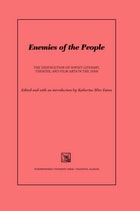
Enemies of the People
The Destruction of Soviet Literary, Theater, and FKatherine Bliss Eaton
Northwestern University Press, 2002
"Katherine Eaton has compiled a collection of essays on the destruction of the arts in Russia in the 1930s. The essays provide information about what we know was lost, and speculation about what might have been lost, in the Stalinist Great Purge"
[more]
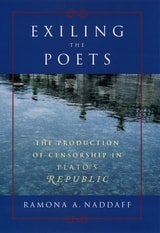
Exiling the Poets
The Production of Censorship in Plato's RepublicRamona A. Naddaff
University of Chicago Press, 2002
The question of why Plato censored poetry in his Republic has bedeviled scholars for centuries. In Exiling the Poets, Ramona A. Naddaff offers a strikingly original interpretation of this ancient quarrel between poetry and philosophy. Underscoring not only the repressive but also the productive dimension of literary censorship, Naddaff brings to light Plato's fundamental ambivalence about the value of poetic discourse in philosophical investigation.
Censorship, Nadaff argues, is not merely a mechanism of silencing but also provokes new ways of speaking about controversial and crucial cultural and artistic events. It functions philosophically in the Republic to subvert Plato's most crucial arguments about politics, epistemology, metaphysics, and ethics. Naddaff develops this stunning argument through an extraordinary reading of Plato's work. In books 2 and 3, the first censorship of poetry, she finds that Plato constitutes the poet as a rival with whom the philosopher must vie agonistically. In other words, philosophy does not replace poetry, as most commentators have suggested; rather, the philosopher becomes a worthy and ultimately victorious poetic competitor. In book 10's second censorship, Plato exiles the poets as a mode of self-subversion, rethinking and revising his theory of mimesis, of the immortality of the soul, and, most important, the first censorship of poetry. Finally, in a subtle and sophisticated analysis of the myth of Er, Naddaff explains how Plato himself censors his own censorships of poetry, thus producing the unexpected result of a poetically animated and open-ended dialectical philosophy.
Censorship, Nadaff argues, is not merely a mechanism of silencing but also provokes new ways of speaking about controversial and crucial cultural and artistic events. It functions philosophically in the Republic to subvert Plato's most crucial arguments about politics, epistemology, metaphysics, and ethics. Naddaff develops this stunning argument through an extraordinary reading of Plato's work. In books 2 and 3, the first censorship of poetry, she finds that Plato constitutes the poet as a rival with whom the philosopher must vie agonistically. In other words, philosophy does not replace poetry, as most commentators have suggested; rather, the philosopher becomes a worthy and ultimately victorious poetic competitor. In book 10's second censorship, Plato exiles the poets as a mode of self-subversion, rethinking and revising his theory of mimesis, of the immortality of the soul, and, most important, the first censorship of poetry. Finally, in a subtle and sophisticated analysis of the myth of Er, Naddaff explains how Plato himself censors his own censorships of poetry, thus producing the unexpected result of a poetically animated and open-ended dialectical philosophy.
[more]
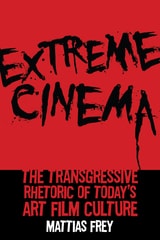
Extreme Cinema
The Transgressive Rhetoric of Today's Art Film CultureFrey, Mattias
Rutgers University Press, 2016
Honorable mention, 2017 Best Monograph Award from the British Association of Film, Television and Screen Studies (BAFTSS)
From Shortbus to Shame and from Oldboy to Irreversible, film festival premieres regularly make international headlines for their shockingly graphic depictions of sex and violence. Film critics and scholars alike often regard these movies as the work of visionary auteurs, hailing directors like Michael Haneke and Lars von Trier as heirs to a tradition of transgressive art. In this provocative new book, Mattias Frey offers a very different perspective on these films, exposing how they are also calculated products, designed to achieve global notoriety in a competitive marketplace.
From Shortbus to Shame and from Oldboy to Irreversible, film festival premieres regularly make international headlines for their shockingly graphic depictions of sex and violence. Film critics and scholars alike often regard these movies as the work of visionary auteurs, hailing directors like Michael Haneke and Lars von Trier as heirs to a tradition of transgressive art. In this provocative new book, Mattias Frey offers a very different perspective on these films, exposing how they are also calculated products, designed to achieve global notoriety in a competitive marketplace.
Paying close attention to the discourses employed by film critics, distributors, and filmmakers themselves, Extreme Cinema examines the various tightropes that must be walked when selling transgressive art films to discerning audiences, distinguishing them from generic horror, pornography, and Hollywood product while simultaneously hyping their salacious content. Deftly tracing the links between the local and the global, Frey also shows how the directors and distributors of extreme art house fare from both Europe and East Asia have significant incentives to exaggerate the exotic elements that would differentiate them from Anglo-American product.
Extreme Cinema also includes original interviews with the programmers of several leading international film festivals and with niche distributors and exhibitors, giving readers a revealing look at how these institutions enjoy a symbiotic relationship with the “taboo-breakers” of art house cinema. Frey also demonstrates how these apparently transgressive films actually operate within a strict set of codes and conventions, carefully calibrated to perpetuate a media industry that fuels itself on provocation.
[more]