63 books match the query 'Christian Ministry' and 3 start with e

cover of Evangelical News: Politics, Gender, and Bioethics in Conservative Christian Magazines of the 1970s and 1980s

Evangelical News

Politics, Gender, and Bioethics in Conservative Christian Magazines of the 1970s and 1980s

Anja-Maria Bassimir

University of Alabama Press, 2022

A comprehensive study of evangelical magazine discourse during the 1970s and 1980s and how it navigated and sustained religious convictions in a time of dramatic social change

The 1970s and 1980s were a tumultuous period in US history. In tandem with a dramatic political shift to the right, evangelicalism also entered the public discourse as a distinct religious movement and was immediately besieged by cultural appropriations and internal fragmentations. Americans in general and evangelicals in particular grappled with issues and ideas such as feminism, abortion, birth control, and restructuring traditional roles for women and the family. During this time, there was a surge in readership for evangelical periodicals such as Christianity Today, Moody Monthly, Eternity, and Post-Americans/Sojourners as well as the feminist newsletter Daughters of Sarah.

While each of these magazines—and other publications and media—contributed to and participated in the overall dissemination of evangelical ideology, they also had their own outlooks and political leanings concerning hot-button issues. In Evangelical News: Politics, Gender, and Bioethics in Conservative Christian Magazines of the 1970s and 1980s, Anja-Maria Bassimir presents a nuanced view of evangelicalism in the late twentieth century through the lens of the movement’s own media.

Bassimir argues that community can be produced in discourse, especially when shared rhetoric, concepts, and perspectives signal belonging. To accomplish this, Evangelical News traces the emergence of evangelical social and political awareness in the 1970s to the height of its power as a political program. The chapters investigate such topics as how evangelicals reenvisioned gender norms and relations in light of the feminist movement, the use of childhood as a symbol of unspoiled innocence, and the place of evangelicals as political actors.


[more]
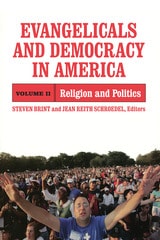
cover of Evangelicals and Democracy in America: Religion and Politics

Evangelicals and Democracy in America

Religion and Politics

Steven G. Brint

Russell Sage Foundation, 2009
Separation of church and state is a bedrock principal of American democracy, and so, too, is active citizen engagement. Since evangelicals comprise one of the largest and most vocal voting blocs in the United States, tensions and questions naturally arise. In the two-volume Evangelicals and Democracy in America, editors Steven Brint and Jean Reith Schroedel have assembled an authoritative collection of studies of the evangelical movement in America. Religion and Politics, the second volume of the set, focuses on the role of religious conservatives in party politics, the rhetoric evangelicals use to mobilize politically, and what the history of the evangelical movement reveals about where it may be going. Part I of Religion and Politics explores the role of evangelicals in electoral politics. Contributor Pippa Norris looks at evangelicals around the globe and finds that religiosity is a strong predictor of ideological leanings in industrialized countries. But the United States remains one of only a handful of post-industrial societies where religion plays a significant role in partisan politics. Other chapters look at voting trends, especially the growing number of higher-income evangelicals among Republican ranks, how voting is influenced both by "values" and race, and the management of the symbols and networks behind the electoral system of moral-values politics. Part II of the volume focuses on the mobilizing rhetoric of the Christian Right. Nathaniel Klemp and Stephen Macedo show how the rhetorical strategies of the Christian Right create powerful mobilizing narratives, but frequently fail to build broad enough coalitions to prevail in the pluralistic marketplace of ideas. Part III analyzes the cycles and evolution of the Christian Right. Kimberly Conger looks at the specific circumstances that have allowed evangelicals to become dominant in some Republican state party committees but not in others. D. Michael Lindsay examines the "elastic orthodoxy" that has allowed evangelicals to evolve into a formidable social and political force. The final chapter by Clyde Wilcox presents a new framework for understanding the relationship between the Christian Right and the GOP based on the ecological metaphor of co-evolution. With its companion volume on religion and society, this second volume of Evangelicals and Democracy in America offers the most complete examination yet of the social circumstances and political influence of the millions of Americans who are white evangelical Protestants. Understanding their history and prospects for the future is essential to forming a comprehensive picture of America today.
[more]
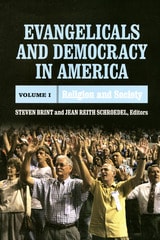
cover of Evangelicals and Democracy in America: Religion and Society

Evangelicals and Democracy in America

Religion and Society

Steven G. Brint

Russell Sage Foundation, 2009

By the end of the nineteenth century, the vast majority of U.S. churches were evangelical in outlook and practice. America's turn toward modernism and embrace of science in the early twentieth century threatened evangelicalism's cultural prominence. But as confidence in modern secularism wavered in the 1960s and 1970s, evangelicalism had another great awakening. The two volumes of Evangelicals and Democracy in America trace the development and current role of evangelicalism in American social and political life. Volume I focuses on who evangelicals are today, how they relate to other groups, and what role they play in U.S. social institutions. Part I of Religion and Society examines evangelicals' identity and activism. Contributor Robert Wuthnow explores the identity built around the centrality of Jesus, church and community service, and the born-again experience. Philip Gorski explores the features of American evangelicalism and society that explain the recurring mobilization of conservative Protestants in American history. Part II looks at how evangelicals relate to other key groups in American society. Individual chapters delve into evangelicals' relationship to other conservative religious groups, women and gays, African Americans, and mainline Protestants. These chapters show sources of both solidarity and dissension within the "traditionalist alliance" and the hidden strengths of mainline Protestants' moral discourse. Part III examines religious conservatives' influence on American social institutions outside of politics. W. Bradford Wilcox, David Sikkink, Gabriel Rossman, and Rogers Smith investigate evangelicals' influence on families, schools, popular culture, and the courts, respectively. What emerges is a picture of American society as a consumer marketplace with a secular legal structure and an arena of pluralistic competition interpreting what constitutes the public good. These chapters show that religious conservatives have been shaped by these realities more than they have been able to shape them. Evangelicals and Democracy in America, Volume I is one of the most comprehensive examinations ever of this important current in American life and serves as a corrective to erroneous popular representations. These meticulously balanced studies not only clarify the religious and social origins of evangelical mobilization, but also detail both the scope and limits of evangelicals' influence in our society. This volume is the perfect complement to its companion in this landmark series, Evangelicals and Democracy in America, Volume II: Religion and Politics.
[more]