Results by title
74 books match the query 'Church' and 3 start with e
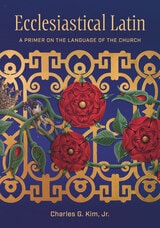
Ecclesiastical Latin
A Primer on the Language of the ChurchCharles G. Kim, Jr.
Catholic University of America Press, 2024
Ecclesiastical Latin: A Primer on the Language of the Church offers a thorough introduction to the Latin language in 32 chapters, which can be completed in one academic year. The text presents each section in plain language, fully explaining complicated grammar terms which may be unfamiliar to a contemporary audience. Every chapter includes copious examples and practice sentences of the grammar covered, as well as stories drawn from the Vulgate, or Church tradition. In addition to encountering the vocabulary and grammar in practice sentences, the text also offers prayers from the liturgy which illustrate the grammar, as well as sentences which come directly from the corpus of original Ecclesiastical Latin. By the end of the book, students will feel comfortable reading through the Vulgate or praying the liturgy in Latin with more understanding. The grammar structures for each chapter roughly follow the organization of grammar as it is presented in Hans Orberg's Lingua Latina. The student can thus practice more of the language in full immersion with confidence, while also learning the vocabulary and style of later Ecclesiastical Latin.
[more]
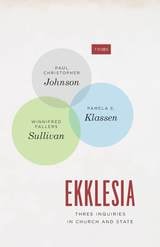
Ekklesia
Three Inquiries in Church and StatePaul Christopher Johnson, Pamela E. Klassen, and Winnifred Fallers Sullivan
University of Chicago Press, 2018
Ekklesia: Three Inquiries in Church and State offers a New World rejoinder to the largely Europe-centered academic discourse on church and state. In contrast to what is often assumed, in the Americas the relationship between church and state has not been one of freedom or separation but one of unstable and adaptable collusion. Ekklesia sees in the settler states of North and South America alternative patterns of conjoined religious and political power, patterns resulting from the undertow of other gods, other peoples, and other claims to sovereignty. These local challenges have led to a continuously contested attempt to realize a church-minded state, a state-minded church, and the systems that develop in their concert. The shifting borders of their separation and the episodic conjoining of church and state took new forms in both theory and practice.
The first of a closely linked trio of essays is by Paul Johnson, and offers a new interpretation of the Brazilian community gathered at Canudos and its massacre in 1896–97, carried out as a joint churchstate mission and spectacle. In the second essay, Pamela Klassen argues that the colonial churchstate relationship of Canada came into being through local and national practices that emerged as Indigenous nations responded to and resisted becoming “possessions” of colonial British America. Finally, Winnifred Sullivan’s essay begins with reflection on the increased effort within the United States to ban Bibles and scriptural references from death penalty courtrooms and jury rooms; she follows with a consideration of the political theological pressure thereby placed on the jury that decides between life and death. Through these three inquiries, Ekklesia takes up the familiar topos of “church and state” in order to render it strange.
The first of a closely linked trio of essays is by Paul Johnson, and offers a new interpretation of the Brazilian community gathered at Canudos and its massacre in 1896–97, carried out as a joint churchstate mission and spectacle. In the second essay, Pamela Klassen argues that the colonial churchstate relationship of Canada came into being through local and national practices that emerged as Indigenous nations responded to and resisted becoming “possessions” of colonial British America. Finally, Winnifred Sullivan’s essay begins with reflection on the increased effort within the United States to ban Bibles and scriptural references from death penalty courtrooms and jury rooms; she follows with a consideration of the political theological pressure thereby placed on the jury that decides between life and death. Through these three inquiries, Ekklesia takes up the familiar topos of “church and state” in order to render it strange.
[more]
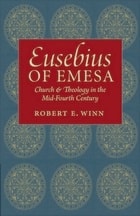
Eusebius of Emesa
Church and Theology in the Mid-Fourth CenturyRobert E. Winn
Catholic University of America Press, 2011
Through a careful examination of his extant sermons, some of which survive in Latin and others in classical Armenian, this book invites readers to hear a bishop's voice from the mid- fourth century, an important period in late antique Christianity
[more]