Results by title
121 books match the query 'Cinema' and 6 start with e
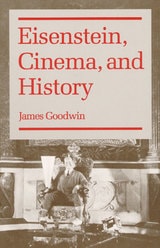
Eisenstein, Cinema, and History
James Goodwin
University of Illinois Press, 1993
stands alone as the maker of a fully historical cinema. James Goodwin treats
issues of revolutionary history and historical representation as central to
an understanding of Eisentein's work, which explores two movements within Soviet
history and consciousness: the Bolshevik Revolution and the Stalinist state.
Goodwin articulates intersections
between Eisentein's ideas and aspects of the thought of Walter Benjamin, Georg
Lukács, Ernst Bloch, and Bertolt Brecht. He also shows how the formal
properties and filmic techniques of each work reveal perspectives on history
. Individual chapters focus on Strike, Battleship Potemkin, October, Old
and New, projects of the 1930s, Alexander Nevsky, and Ivan the
Terrible.
Empty Moments
Cinema, Modernity, and DriftLeo Charney
Duke University Press, 1998
Empty Moments creates a catalytic dialogue among those who, at the time of the invention of film, attempted to define the experience of the fleeting present. Interspersing philosophical discussions with stylistically innovative prose, Charney mingles Proust’s conception of time/memory with Cubism’s attempt to interpret time through perspective and Surrealism’s exploration of subliminal representations of the present. Other topics include Husserl’s insistence that the present can only be fantasy or fabrication and the focus on impossibility, imperfection, and loss in Kelvin’s laws of thermodynamics. Ultimately, Charney’s work hints at parallels among such examples, the advent and popularity of cinema, and early film theory.
A book with a structural modernity of its own, Empty Moments will appeal to those interested in cinema and its history, as well as to other historians, philosophers, literary, and cultural scholars of modernity.
Endless Intervals
Cinema, Psychology, and Semiotechnics around 1900Jeffrey West Kirkwood
University of Minnesota Press, 2022
Revealing cinema’s place in the coevolution of media technology and the human
Cinema did not die with the digital, it gave rise to it. According to Jeffrey West Kirkwood, the notion that digital technologies replaced analog obscures how the earliest cinema laid the technological and philosophical groundwork for the digital world. In Endless Intervals, he introduces a theory of semiotechnics that explains how discrete intervals of machines came to represent something like a mind—and why they were feared for their challenge to the uniqueness of human intelligence.
Examining histories of early cinematic machines, Kirkwood locates the foundations for a scientific vision of the psyche as well as the information age. He theorizes an epochal shift in the understanding of mechanical stops, breaks, and pauses that demonstrates how cinema engineered an entirely new model of the psyche—a model that was at once mechanical and semiotic, discrete and continuous, physiological and psychological, analog and digital.
Recovering largely forgotten and untranslated texts, Endless Intervals makes the case that cinema, rather than being a technology assaulting the psyche, is in fact the technology that produced the modern psyche. Kirkwood considers the ways machines can create meaning, offering a fascinating theory of how the discontinuous intervals of soulless mechanisms ultimately produced a rich continuous experience of inner life.
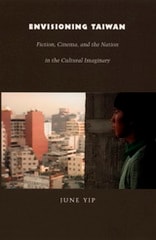
Envisioning Taiwan
Fiction, Cinema, and the Nation in the Cultural ImaginaryJune Yip
Duke University Press, 2004
Yip traces a distinctly Taiwanese sense of self vis-à-vis China, Japan, and the West through two of the island’s most important cultural movements: the hsiang-t’u (or “nativist”) literature of the 1960s and 1970s, and the Taiwanese New Cinema of the 1980s and 1990s. At the heart of the book are close readings of the work of the hsiang-t’u writer Hwang Chun-ming and the New Cinema filmmaker Hou Hsiao-hsien. Key figures in Taiwan’s assertion of a national identity separate and distinct from China, both artists portray in vibrant detail daily life on the island. Through Hwang’s and Hou’s work and their respective artistic movements, Yip explores “the imagining of a nation” on the local, national, and global levels. In the process, she exposes a perceptible shift away from traditional models of cultural authenticity toward a more fluid, postmodern hybridity—an evolution that reflects both Taiwan’s peculiar multicultural reality and broader trends in global culture.

Europe and Love in Cinema
Edited by Luisa Passerini, Jo Labanyi, and Karen Diehl
Intellect Books, 2012
Europe and Love in Cinema explores the relationship between love and Europeanness in a wide range of films from the 1920s to the present. A critical look at the manner in which love—in its broadest sense—is portrayed in cinema from across Europe and the United States, this volume exposes constructed notions of "Europeanness" that both set Europe apart and define some parts of it as more "European" than others. Through the international distribution process, these films in turn engage with ideas of Europe from both outside and within, while some, treated extensively in this volume, even offer alternative models of love. A bracing collection of essays from top film scholars, Europe and Love in Cinema demonstrates the centrality of desire to film narrative and explores multiple models of love within Europe's frontiers.
European Identity in Cinema
Edited by Wendy Everett
Intellect Books, 1995
While the book’s critical essays offer keen insight into the complex identities of European cinema, its combination of breadth and detail, and its interdisciplinary focus and background ensure its wider relevance to anyone interested in questions of contemporary culture and European affairs in general. Its stylistic clarity and freedom from jargon make it readable and accessible.
Topics include questions of memory and identity; filmic autobiography and first-person narration; cultural identity; peripheral voices; popular film and political film. Individual directors, and different national cinemas, including those of France, Germany, Northern Ireland, Russia, Scotland and Spain, are viewed in a wider pan- European context.