Results by title
206 books match the query 'City Planning & Urban Development' and 4 start with e
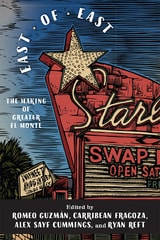
East of East
The Making of Greater El MonteRomeo Guzmán
Rutgers University Press, 2020
East of East: The Making of Greater El Monte, is an edited collection of thirty-one essays that trace the experience of a California community over three centuries, from eighteenth-century Spanish colonization to twenty-first century globalization. Employing traditional historical scholarship, oral history, creative nonfiction and original art, the book provides a radical new history of El Monte and South El Monte, showing how interdisciplinary and community-engaged scholarship can break new ground in public history. East of East tells stories that have been excluded from dominant historical narratives—stories that long survived only in the popular memory of residents, as well as narratives that have been almost completely buried and all but forgotten. Its cast of characters includes white vigilantes, Mexican anarchists, Japanese farmers, labor organizers, civil rights pioneers, and punk rockers, as well as the ordinary and unnamed youth who generated a vibrant local culture at dances and dive bars.
[more]
Empowering Smart Cities through Community-Centred Public Private Partnerships and Innovations
Debra Lam
The Institution of Engineering and Technology, 2024
Cities are at the heart of the biggest challenges facing humanity - from the cost-of-living crisis to the COVID-19 pandemic, to climate change to inequality and social injustice. Local governments around the world are facing increased expectations to support the transition to a more just and sustainable society and are under pressure to do more with fewer resources. Rapid urbanization is creating significant pressure on cities to expand and improve housing and infrastructure, and improve social equity, health and quality of life, all while fostering a robust economy that can provide good jobs for all. Nonetheless, cities are also our best hope for the future and remain at the heart of economic growth, innovation and job creation.
[more]
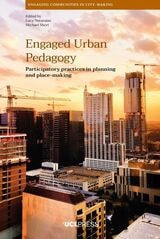
Engaged Urban Pedagogy
Participatory Practices in Planning and Place-MakingEdited by Lucy Natarajan and Michael Short
University College London, 2023
A practical handbook for teaching about the built environment.
Engaged Urban Pedagogy presents a participatory approach to teaching about the built environment by exploring twelve examples of real-world engagement in urban planning involving people within, and beyond, the university. Starting with curriculum review, course content is analyzed in light of urban pasts, race, queer identity, lived experiences, and the concerns of urban professionals. Case studies then shift to focus on techniques for participatory critical pedagogy, including expanding the classroom with links to live place-making processes, connections made through digital co-design exercises, and student-led podcasting assignments. Finally, the book turns to activities beyond formal university teaching, such as those where school-age children learn about their own participation in urban processes together alongside university students and researchers. Drawing on foundational works of critical pedagogy, the contributors present a distinctly urban praxis that will help those in universities respond to the built environment challenges of today.
Engaged Urban Pedagogy presents a participatory approach to teaching about the built environment by exploring twelve examples of real-world engagement in urban planning involving people within, and beyond, the university. Starting with curriculum review, course content is analyzed in light of urban pasts, race, queer identity, lived experiences, and the concerns of urban professionals. Case studies then shift to focus on techniques for participatory critical pedagogy, including expanding the classroom with links to live place-making processes, connections made through digital co-design exercises, and student-led podcasting assignments. Finally, the book turns to activities beyond formal university teaching, such as those where school-age children learn about their own participation in urban processes together alongside university students and researchers. Drawing on foundational works of critical pedagogy, the contributors present a distinctly urban praxis that will help those in universities respond to the built environment challenges of today.
[more]
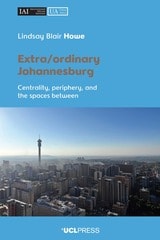
Extra/ordinary Johannesburg
Centrality, Periphery and the Spaces BetweenLindsay Blair Howe
University College London, 2025
Structured around urban centers and peripheries, Extra/ordinary Johannesburg reimagines the African city as an “ordinary” space.
In Extra/ordinary Johannesburg, urbanist Lindsay Blair Howe argues that Johannesburg, part of the highly urbanized Gauteng City-Region and often labeled as an “apartheid city,” is an “ordinary” space where spatial changes both marginalize and create opportunities for people in their everyday lives. Structured around the concepts of urbanization and peripheralization and drawing on Henri Lefebvre’s theory of spatial dialectics, the book uses empirical research methods like smartphone applications and volunteered geographic information to draw theoretical conclusions, providing exciting new insights into urban denizens’ daily lives and how urbanization in the Gauteng region relates to the decolonial project. One central premise is that understanding how people navigate the urban fabric of centralities, peripheries, and the spaces in between is crucial for reimagining effective ways to address poverty and inequality in urban Africa.
In Extra/ordinary Johannesburg, urbanist Lindsay Blair Howe argues that Johannesburg, part of the highly urbanized Gauteng City-Region and often labeled as an “apartheid city,” is an “ordinary” space where spatial changes both marginalize and create opportunities for people in their everyday lives. Structured around the concepts of urbanization and peripheralization and drawing on Henri Lefebvre’s theory of spatial dialectics, the book uses empirical research methods like smartphone applications and volunteered geographic information to draw theoretical conclusions, providing exciting new insights into urban denizens’ daily lives and how urbanization in the Gauteng region relates to the decolonial project. One central premise is that understanding how people navigate the urban fabric of centralities, peripheries, and the spaces in between is crucial for reimagining effective ways to address poverty and inequality in urban Africa.
[more]