Results by title
188 books match the query 'City planning' and 4 start with e

Empire City
The Making And Meaning OfDavid Scobey
Temple University Press, 2003
Author David Scobey paints a remarkable panorama of New York's uneven development, a city-building process careening between obsessive calculation and speculative excess. Envisioning a new kind of national civilization, "bourgeois urbanists" attempted to make New York the nation's preeminent city. Ultimately, they created a mosaic of grand improvements, dynamic change, and environmental disorder. Empire City sets the stories of the city's most celebrated landmarks -- Central Park, the Brooklyn Bridge, the downtown commercial center -- within the context of this new ideal of landscape design and a politics of planned city building. Perhaps such an ambitious project for guiding growth, overcoming spatial problems, and uplifting public was bound to fail; still, it grips the imagination.
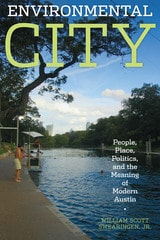
Environmental City
People, Place, Politics, and the Meaning of Modern AustinBy William Scott Swearingen, Jr.
University of Texas Press, 2010
As Austin grew from a college and government town of the 1950s into the sprawling city of 2010, two ideas of Austin as a place came into conflict. Many who promoted the ideology of growth believed Austin would be defined by economic output, money, and wealth. But many others thought Austin was instead defined by its quality of life. Because the natural environment contributed so much to Austin's quality of life, a social movement that wanted to preserve the city's environment became the leading edge of a larger movement that wanted to retain a unique sense of place. The "environmental movement" in Austin became the political and symbolic arm of the more general movement for place.
This is a history of the environmental movement in Austin—how it began; what it did; and how it promoted ideas about the relationships between people, cities, and the environment. It is also about a deeper movement to retain a sense of place that is Austin, and how that deeper movement continues to shape the way Austin is built today. The city it helped to create is now on the forefront of national efforts to rethink how we build our cities, reduce global warming, and find ways that humans and the environment can coexist in a big city.
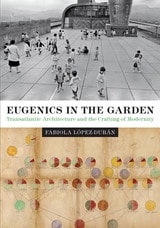
Eugenics in the Garden
Transatlantic Architecture and the Crafting of ModernityBy Fabiola López-Durán
University of Texas Press, 2018
Winner, Robert Motherwell Book Award, Outstanding Book on Modernism in the Arts, The Dedalus Foundation, 2019
As Latin American elites strove to modernize their cities at the turn of the twentieth century, they eagerly adopted the eugenic theory that improvements to the physical environment would lead to improvements in the human race. Based on Jean-Baptiste Lamarck’s theory of the “inheritance of acquired characteristics,” this strain of eugenics empowered a utopian project that made race, gender, class, and the built environment the critical instruments of modernity and progress.
Through a transnational and interdisciplinary lens, Eugenics in the Garden reveals how eugenics, fueled by a fear of social degeneration in France, spread from the realms of medical science to architecture and urban planning, becoming a critical instrument in the crafting of modernity in the new Latin world. Journeying back and forth between France, Brazil, and Argentina, Fabiola López-Durán uncovers the complicity of physicians and architects on both sides of the Atlantic, who participated in a global strategy of social engineering, legitimized by the authority of science. In doing so, she reveals the ideological trajectory of one of the most celebrated architects of the twentieth century, Le Corbusier, who deployed architecture in what he saw as the perfecting and whitening of man. The first in-depth interrogation of eugenics’ influence on the construction of the modern built environment, Eugenics in the Garden convincingly demonstrates that race was the main tool in the geopolitics of space, and that racism was, and remains, an ideology of progress.
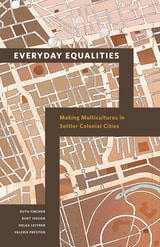
Everyday Equalities
Making Multicultures in Settler Colonial CitiesRuth Fincher
University of Minnesota Press, 2019
A timely new look at coexisting without assimilating in multicultural cities
If city life is a “being together of strangers,” what forms of being together should we strive for in cities with ethnic and racial diversity? Everyday Equalities seeks evidence of progressive political alternatives to racialized inequality that are emerging from everyday encounters in Los Angeles, Melbourne, Sydney, and Toronto—settler colonial cities that, established through efforts to dispossess and eliminate indigenous societies, have been destinations for waves of immigrants from across the globe ever since.
Everyday Equalities finds such alternatives being developed as people encounter one another in the process of making a home, earning a living, moving around the city, and forming collective actions or communities. Here four leading scholars in critical urban geography come together to deliver a powerful and cohesive message about the meaning of equality in contemporary cities. Drawing on both theoretical reflection and urban ethnographic research, they offer the formulation “being together in difference as equals” as a normative frame to reimagine the meaning and pursuit of equality in today’s urban multicultures.
As the examples in Everyday Equalities indicate, much emotional labor, combined with a willingness to learn from each other, negotiate across differences, and agitate for change goes into constructing environments that foster being together in difference as equals. Importantly, the authors argue, a commitment to equality is not only a hope for a future city but also a way of being together in the present.