80 books match the query 'Clergy' and 2 start with e
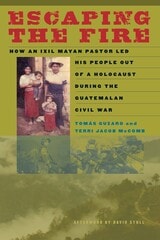
cover of Escaping the Fire: How an Ixil Mayan Pastor Led His People Out of a Holocaust During the Guatemalan Civil War

Escaping the Fire

How an Ixil Mayan Pastor Led His People Out of a Holocaust During the Guatemalan Civil War

By Tomás Guzaro and Terri Jacob McComb

University of Texas Press, 2010

During the height of the Guatemalan civil war, Tomás Guzaro, a Mayan evangelical pastor, led more than two hundred fellow Mayas out of guerrilla-controlled Ixil territory and into the relative safety of the government army's hands. This exodus was one of the factors that caused the guerrillas to lose their grip on the Ixil, thus hastening the return of peace to the area.

In Escaping the Fire, Guzaro relates the hardships common to most Mayas and the resulting unrest that opened the door to civil war. He details the Guatemalan army's atrocities while also describing the Guerrilla Army of the Poor's rise to power in Ixil country, which resulted in limited religious freedom, murdered church leaders, and threatened congregations. His story climaxes with the harrowing vision that induced him to guide his people out of their war-torn homeland.

Guzaro also provides an intimate look at his spiritual pilgrimage through all three of Guatemala's main religions. The son of a Mayan priest, formerly a leader in the Catholic Church, and finally a convert to Protestantism, Guzaro, in detailing his religious life, offers insight into the widespread shift toward Protestantism in Latin America over the past four decades.

Riveting and highly personal, Escaping the Fire ultimately provides a counterpoint to the usual interpretation of indigenous agency during the Guatemalan civil war by documenting the little-studied experiences of Protestants living in guerrilla-held territory.
[more]
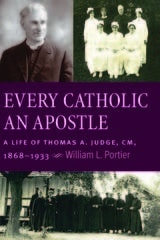
cover of Every Catholic An Apostle: A Life of Thomas A. Judge, CM, 1868-1933

Every Catholic An Apostle

A Life of Thomas A. Judge, CM, 1868-1933

William L. Portier

Catholic University of America Press, 2017

Born in Boston of immigrant parents, Thomas A. Judge, CM (1868-1933) preached up and down the east coast on the Vincentian mission band between 1903 and 1915. Disturbed by the “leakage” of the immigrant poor from the church, he enlisted and organized lay women he met on the missions to work for the “preservation of the faith,” his watchword. His work grew apace with, and in some ways anticipated, the growing body of papal teaching on the lay apostolate. When he became superior of the godforsaken Vincentian Alabama mission in 1915, he invited the lay apostles to come south to help. “This is the layman’s hour,” he wrote in 1919. By then, however, many of his lay apostles had evolved in the direction of vowed communal life. This pioneer of the lay apostle founded two religious communities, one of women and one of men. With the indispensable help of his co-founder, Mother Boniface Keasey, he spent the last decade of his life trying to gain canonical approval for these groups, organizing them, and helping them learn “to train the work-a-day man and woman into an apostle, to cause each to be alert to the interests of the Church, to be the Church.” The roaring twenties saw the work expanded beyond the Alabama missions as far as Puerto Rico, which Judge viewed as a gateway to Latin America. The Great Depression ended this expansive mood and time and put agonizing pressure on Judge, his disciples, and their work. In 1932, the year before Judge’s death, the apostolic delegate, upon being appraised of Judge’s financial straits, described his work as “the only organized movement of its kind in the Church today that so completely meets the wishes of the Holy Father with reference to the Lay Apostolate.”
[more]