Results by title
50 books match the query 'Colonialism' and 3 start with e

Environmental Futures
An International Literary AnthologyEdited by Caren Irr, et al.
Brandeis University Press, 2024
Featuring short stories, poetry, drama, and creative nonfiction from around the world, this anthology showcases contemporary literature to envision the future of the environment. While environmental literature written in English has been dominated by English and American men who make solo explorations into an unspoiled natural world, Environmental Futures emphasizes local and indigenous writers contending with global landscapes that are far from pristine. Their work opens up decolonial perspectives from Anglophone Africa, South Asia, India, China, South America, the peripheries of Europe, and BIPoC North America. Introducing many writers who will be unfamiliar to English-speaking readers, this collection explores resistance to the oil economy, the impact of storms and natural disasters, extinction, and relations between humans and animals, among other themes.
The pieces are organized by geographical area in five sections: Africa, Asia, Europe, Latin America, and North America. Expert scholars and translators—Kurt Cavender, Roberto Forns-Broggi, Cajetan Iheka, Upamanyu (Pablo) Mukherjee, Irina Sadovina, and Shaobo Xie—selected the works and provided critical introductions for each section.
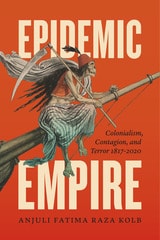
Epidemic Empire
Colonialism, Contagion, and Terror, 1817–2020Anjuli Fatima Raza Kolb
University of Chicago Press, 2021
Terrorism is a cancer, an infection, an epidemic, a plague. For more than a century, this metaphor has figured insurgent violence as contagion in order to contain its political energies. In Epidemic Empire, Anjuli Fatima Raza Kolb shows that this trope began in responses to the Indian Mutiny of 1857 and tracks its tenacious hold through 9/11 and beyond. The result is the first book-length study to approach the global War on Terror from a postcolonial literary perspective.
Raza Kolb assembles a diverse archive from colonial India, imperial Britain, French and independent Algeria, the postcolonial Islamic diaspora, and the neoimperial United States. Anchoring her book are studies of four major writers in the colonial-postcolonial canon: Rudyard Kipling, Bram Stoker, Albert Camus, and Salman Rushdie. Across these sources, she reveals the tendency to imagine anticolonial rebellion, and Muslim insurgency specifically, as a virulent form of social contagion. Exposing the long history of this broken but persistent narrative, Epidemic Empire is a major contribution to the rhetorical history of our present moment.
Ethnopornography
Sexuality, Colonialism, and Archival KnowledgePete Sigal, Zeb Tortorici, and Neil L. Whitehead, editors
Duke University Press, 2020
Contributors. Joseph A. Boone, Pernille Ipsen, Sidra Lawrence, Beatrix McBride, Mireille Miller-Young, Bryan Pitts, Helen Pringle, Pete Sigal, Zeb Tortorici, Neil L. Whitehead