440 books match the query 'Colonialism & Post-Colonialism' and 18 start with e
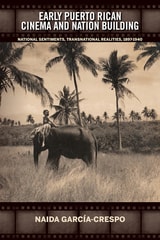
cover of Early Puerto Rican Cinema and Nation Building: National Sentiments, Transnational Realities, 1897-1940

Early Puerto Rican Cinema and Nation Building

National Sentiments, Transnational Realities, 1897-1940

Naida García-Crespo

Bucknell University Press, 2019

Early Puerto Rican Cinema and Nation Building focuses on the processes of Puerto Rican national identity formation as seen through the historical development of cinema on the island between 1897 and 1940. Anchoring her work in archival sources in film technology, economy, and education, Naida García-Crespo argues that Puerto Rico’s position as a stateless nation allows for a fresh understanding of national cinema based on perceptions of productive cultural contributions rather than on citizenship or state structures. This book aims to contribute to recently expanding discussions of cultural networks by analyzing how Puerto Rican cinema navigates the problems arising from the connection and/or disjunction between nation and state. The author argues that Puerto Rico’s position as a stateless nation puts pressure on traditional conceptions of national cinema, which tend to rely on assumptions of state support or a bounded nation-state. She also contends that the cultural and business practices associated with early cinema reveal that transnationalism is an integral part of national identities and their development. García-Crespo shows throughout this book that the development and circulation of cinema in Puerto Rico illustrate how the “national” is built from transnational connections.  

Published by Bucknell University Press. Distributed worldwide by Rutgers University Press.
[more]
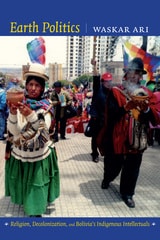
cover of Earth Politics: Religion, Decolonization, and Bolivia's Indigenous Intellectuals

Earth Politics

Religion, Decolonization, and Bolivia's Indigenous Intellectuals

Waskar Ari

Duke University Press, 2014

Earth Politics focuses on the lives of four indigenous activist-intellectuals in Bolivia, key leaders in the Alcaldes Mayores Particulares (AMP), a movement established to claim rights for indigenous education and reclaim indigenous lands from hacienda owners. The AMP leaders invented a discourse of decolonization, rooted in part in native religion, and used it to counter structures of internal colonialism, including the existing racial systems. Waskar Ari calls their social movement, practices, and discourse earth politics, both because the AMP emphasized the idea of the earth and the place of Indians on it, and because of the political meaning that the AMP gave to the worship of the Aymara gods. Depicting the social worlds and life work of the activists, Ari traverses Bolivia's political and social landscape from the 1920s into the early 1970s. He reveals the AMP 's extensive geographic reach, genuine grassroots quality, and vibrant regional diversity. Ari had access to the private archives of indigenous families, and he collected oral histories, speaking with men and women who knew the AMP leaders. The resulting examination of Bolivian indigenous activism is one of unparalleled nuance and depth.
[more]
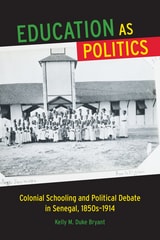
cover of Education as Politics: Colonial Schooling and Political Debate in Senegal, 1850s–1914

Education as Politics

Colonial Schooling and Political Debate in Senegal, 1850s–1914

Kelly M. Duke Bryant

University of Wisconsin Press, 2015

In 1914, Blaise Diagne was elected as Senegal’s first black African representative to the National Assembly in France. Education as Politics reinterprets the origins and significance of this momentous election, showing how colonial schools had helped reshape African power and politics during the preceding decades and how they prepared the way for Diagne’s victory.
            Kelly M. Duke Bryant demonstrates the critical impact of colonial schooling on Senegalese politics by examining the response to it by Africans from a variety of backgrounds and statuses—including rural chiefs, Islamic teachers, and educated young urbanites. For those Africans who chose to engage with them, the French schools in Senegal provided a new source of patronage, a potentially beneficial connection to the bureaucratizing colonial state, a basis for claims to authority or power, or an arena in which to debate pressing issues like the future of Qur’anic schooling and the increasing racism of urban society under colonial rule.
            Based on evidence from archives in Senegal and France, and on interviews Duke Bryant conducted in Senegal, she demonstrates that colonial schooling remade African politics during this period of transition to French rule, creating political spaces that were at once African and colonial, and ultimately allowing Diagne to claim election victory.
[more]
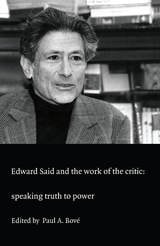
cover of Edward Said and the Work of the Critic: Speaking Truth to Power

Edward Said and the Work of the Critic

Speaking Truth to Power

Paul A. Bové, ed.

Duke University Press, 2000

For at least two decades the career of Edward Said has defined what it means to be a public intellectual today. Although attacked as a terrorist and derided as a fraud for his work on behalf of his fellow Palestinians, Said’s importance extends far beyond his political activism. In this volume a distinguished group of scholars assesses nearly every aspect of Said’s work—his contributions to postcolonial theory, his work on racism and ethnicity, his aesthetics and his resistance to the aestheticization of politics, his concepts of figuration, his assessment of the role of the exile in a metropolitan culture, and his work on music and the visual arts.

In two separate interviews, Said himself comments on a variety of topics, among them the response of the American Jewish community to his political efforts in the Middle East. Yet even as the Palestinian struggle finds a central place in his work, it is essential—as the contributors demonstrate—to see that this struggle rests on and gives power to his general "critique of colonizers" and is not simply the outgrowth of a local nationalism. Perhaps more than any other person in the United States, Said has changed how the U.S. media and American intellectuals must think about and represent Palestinians, Islam, and the Middle East. Most importantly, this change arises not as a result of political action but out of a potent humanism—a breadth of knowledge and insight that has nourished many fields of inquiry. Originally a special issue of boundary 2, the book includes new articles on minority culture and on orientalism in music, as well as an interview with Said by Jacqueline Rose.

Supporting the claim that the last third of the twentieth century can be called the "Age of Said," this collection will enlighten and engage students in virtually any field of humanistic study.


Contributors. Jonathan Arac, Paul A. Bové, Terry Cochran, Barbara Harlow, Kojin Karatani, Rashid I. Khalidi, Sabu Kohsu, Ralph Locke, Mustapha Marrouchi, Jim Merod, W. J. T. Mitchell, Aamir R. Mufti, Jacqueline Rose, Edward W. Said, Gayatri Chakravorty Spivak, Lindsay Waters
[more]
cover of Elementary Aspects of the Political: Histories from the Global South

Elementary Aspects of the Political

Histories from the Global South

Prathama Banerjee

Duke University Press, 2020
In Elementary Aspects of the Political Prathama Banerjee moves beyond postcolonial and decolonial critiques of European political philosophy to rethink modern conceptions of "the political" from the perspective of the global South. Drawing on Indian and Bengali practices and philosophies from the late nineteenth and early twentieth centuries, Banerjee identifies four elements of the political: the self, action, the idea, and the people. She examines selfhood in light of precolonial Indic traditions of renunciation and realpolitik; action in the constitutive tension between traditional conceptions of karma and modern ideas of labor; the idea of equality as it emerges in the dialectic between spirituality and economics; and people in the friction between the structure of the political party and the atmospherics of fiction and theater. Throughout, Banerjee reasserts the historical specificity of political thought and challenges modern assumptions about the universality, primacy, and self-evidence of the political. In formulating a new theory of the political, Banerjee gestures toward a globally salient political philosophy that displaces prevailing Western notions of the political masquerading as universal.
[more]
cover of Empire of Liberty: Power, Desire, and Freedom

Empire of Liberty

Power, Desire, and Freedom

Anthony Bogues

Dartmouth College Press, 2010
In this thoughtful and timely consideration of the nature of American power and empire, Anthony Bogues argues that America’s self-presentation as the bastion of liberty is an attempt to force upon the world a single universal truth, which has the objective of eradicating the radical imagination. Central to this project of American supremacy is the elaboration and construction of a language of power in which a form of self-government appears as the form of sovereignty. Grappling with issues of power, race, slavery, violence, and the nature of postcolonial criticism and critical theory, Bogues offers reconsiderations of the writings of W. E. B. DuBois and Frantz Fanon in order to break holes in this accepted structure of empire. At its heart this is a work of radical humanistic theory that seeks to glean from the postcolonial world and empire an alternative to its imperial form of freedom.
[more]
cover of Empire's Garden: Assam and the Making of India

Empire's Garden

Assam and the Making of India

Jayeeta Sharma

Duke University Press, 2011
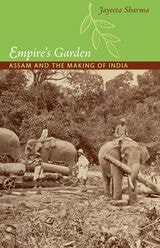
In the mid-nineteenth century the British created a landscape of tea plantations in the northeastern Indian region of Assam. The tea industry filled imperial coffers and gave the colonial state a chance to transform a jungle-laden frontier into a cultivated system of plantations. Claiming that local peasants were indolent, the British soon began importing indentured labor from central India. In the twentieth century these migrants were joined by others who came voluntarily to seek their livelihoods. In Empire’s Garden, Jayeeta Sharma explains how the settlement of more than one million migrants in Assam irrevocably changed the region’s social landscape. She argues that the racialized construction of the tea laborer catalyzed a process by which Assam’s gentry sought to insert their homeland into an imagined Indo-Aryan community and a modern Indian political space. Various linguistic and racial claims allowed these elites to defend their own modernity while pushing the burden of primitiveness onto “non-Aryan” indigenous tribals and migrant laborers. As vernacular print arenas emerged in Assam, so did competing claims to history, nationalism, and progress that continue to reverberate in the present.
[more]
cover of Empty Spaces: perspectives on emptiness  in modern history

Empty Spaces

perspectives on emptiness in modern history

Edited by Courtney J. Campbell, Allegra Giovine, and Jennifer Keating

University of London Press, 2019

How is emptiness made and what historical purpose does it serve? What cultural, material and natural work goes into maintaining ‘nothingness’? Why have a variety of historical actors, from colonial powers to artists and urban dwellers, sought to construct, control and maintain (physically and discursively) empty space, and by which processes is emptiness discovered, visualised and reimagined? This volume draws together contributions from authors working on landscapes and rurality, along with national and imperial narratives, from Brazil to Russia and Ireland. It considers the visual, including the art of Edward Hopper and the work of the British Empire Marketing Board, while concluding with a section that examines constructions of emptiness in relation to capitalism, development and the (re)appropriation of urban space. In doing so, it foregrounds the importance of emptiness as a productive prism through which to interrogate a variety of imperial, national, cultural and urban history.
[more]
cover of Enacting Decolonization: Political Subjectivity in Contemporary Arab Thought

Enacting Decolonization

Political Subjectivity in Contemporary Arab Thought

Yasmeen Daifallah

Duke University Press, 2027
In Enacting Decolonization, Yasmeen Daifallah examines the forms that intellectual decolonization takes after the demise of anticolonial revolutions. Daifallah argues that rather than crafting political visions, decolonization operates through anticolonial thinkers’ efforts to cultivate a political subjectivity capable of mastering and critically reworking a colonially imparted modernity. She recovers this argument through Abdallah Laroui and Mohammed Abed al-Jabri, two of the most consequential Arab thinkers of the twentieth century. Although they are typically read as opponents over the fate of the Islamic tradition, Daifallah argues that Laroui and Jabri share a diagnosis: Colonialism produced an epistemological rupture that cannot be wished away. What differs is the ecology of critique each cultivates in response. Laroui wields Marxist historicism to submit anticolonial Arab thought to critique, recovering its possibilities for a subject capable of contesting the postcolonial present, while Jabri deploys structuralism to reinterpret the Islamic tradition, modeling a relationship of command and critical distance toward it. Through close readings of their work, Daifallah shows how these thinkers inventively weave conceptual and rhetorical devices to bring decolonized political subjects into being.
[more]
cover of Enemies to Their Country: The Marblehead Addressers and Consensus in the American Revolution

Enemies to Their Country

The Marblehead Addressers and Consensus in the American Revolution

Nicholas W. Gentile

University of Massachusetts Press, 2025

Runner-up, 2025 Journal of the American Revolution Book of the Year Award

Complicating the American Revolution through a microhistory of one Massachusetts town

In 1774, a group of elite men in the town of Marblehead, Massachusetts, just outside Salem, wrote an address to the royal governor thanking him for his service to the colony, even as town residents began demanding independence from Great Britain. Town meeting records reveal how the town’s patriot majority pressured the signers to withdraw their support for the governor and demanded public recantations and issued damning reports, even forcing some of the signers into exile.

Enemies to Their Country tells the story of the year following the Address, chronicling the town’s struggle to achieve consensus even as the war for American independence started. This microhistory of one vitally important town, the second largest in Massachusetts at the time, with a thriving local economy based on fishing and a robust community of religious and civically engaged citizens, complicates simplistic ideas of the American Revolution. Through compelling stories of neighboring individuals and families, many of which have not been told, it also provides an example of a politically polarized constituency struggling to find consensus at a time of great conflict.

[more]
cover of Engaging Mbembe

Engaging Mbembe

Sindre Bandstad and Bjørn Enge Bertelsen, editors. Foreword by Arjun Appadurai.

Duke University Press, 2027
Over the course of a career spanning forty years, the Cameroonian-born political scientist, historian, and philosopher Achille Mbembe has become the most widely read and cited African intellectual of our times. In this edited volume, Sindre Bangstad and Bjørn Enge Bertelsen invite distinguished and emergent scholars from Africa and the West to engage critically with Mbembe’s body of work. Drawing from the thinkers in a continuous constructive and generative dialogue with Mbembe's scholarship and wider Black Atlantic intellectual traditions, the contributors demonstrate the impacts and influence of Mbembe's contributions across postcolonial, decolonial, and political thought. Including a foreword by Arjun Appadurai, this collection examines Mbembe’s refusal to be categorized and his regenerative approach to humanity to better understand the legacy of his intellectual work.
[more]
cover of Entanglements of Empire: Missionaries, Maori, and the Question of the Body

Entanglements of Empire

Missionaries, Maori, and the Question of the Body

Tony Ballantyne

Duke University Press, 2015
The first Protestant mission was established in New Zealand in 1814, initiating complex political, cultural, and economic entanglements with Māori. Tony Ballantyne shows how interest in missionary Christianity among influential Māori chiefs had far-reaching consequences for both groups. Deftly reconstructing cross-cultural translations and struggles over such concepts and practices as civilization, work, time and space, and gender, he identifies the physical body as the most contentious site of cultural engagement, with Māori and missionaries struggling over hygiene, tattooing, clothing, and sexual morality. Entanglements of Empire is particularly concerned with how, as a result of their encounters in the classroom, chapel, kitchen, and farmyard, Māori and the English mutually influenced each other’s worldviews. Concluding in 1840 with New Zealand’s formal colonization, this book offers an important contribution to debates over religion and empire.
[more]
cover of Equaliberty in the Dutch Caribbean: Ways of Being Non/Sovereign

Equaliberty in the Dutch Caribbean

Ways of Being Non/Sovereign

Yvon van der Pijl

Rutgers University Press, 2022

Equaliberty in the Dutch Caribbean is a collection of essays that explores fundamental questions of equality and freedom on the non-sovereign islands of the Dutch Caribbean. Drawing on in-depth ethnographic research, historical and media analysis, the study of popular culture, and autoethnographic accounts, the various contributions challenge conventional assumptions about political non/sovereignty. While the book recognizes the existence of nationalist independence movements, it opens a critical space to look at other forms of political articulation, autonomy, liberty, and a good life. Focusing on all six different islands and through a multitude of voices and stories, the volume engages with the everyday projects, ordinary imaginaries, and dreams of equaliberty alongside the work of independistas and traditional social movements aiming for more or full self-determination. As such, it offers a rich and powerful telling of the various ways of being in and belonging to our contemporary postcolonial world.
[more]
cover of Erasing Iraq: The Human Costs of Carnage

Erasing Iraq

The Human Costs of Carnage

Michael Otterman, Richard Hil, Paul Wilson, and Dahr Jamail

Pluto Press, 2010

For nearly two decades, the US and its allies have prosecuted war and aggression in Iraq. Erasing Iraq shows in unparalleled detail the devastating human cost of the war in Iraq.

Western governments and the mainstream media continue to ignore or play down the human costs of the war on Iraqi citizens This has allowed them to present their role as the benign guardians of Iraqi interests. The authors deconstruct this narrative by presenting a portrait of the total carnage in Iraq today. From Iraqi refugees in Syria, Jordan and the West, to civilians left behind, and other witnesses, this the story of the war told by those who experienced it firsthand.
[more]
cover of Escaping Kakania: Eastern European Travels in Colonial Southeast Asia

Escaping Kakania

Eastern European Travels in Colonial Southeast Asia

Jan Mrázek

Central European University Press, 2024

Escaping Kakania is about fascinating characters—soldiers, doctors, scientists, writers, painters—who traveled from their eastern European homelands to colonial Southeast Asia. Their stories are told by experts on different countries in the two regions, who bring diverse approaches into a conversation that crosses disciplinary and national borders.

The 14 chapters deal with the diverse encounters of eastern Europeans with the many faces of colonial southeast Asia. Some essays directly engage with post-colonial studies, contributing to an ongoing critical re-evaluation of eastern European “semi-peripheral” (non-)involvement in colonialism. Other chapters disclose a range of perspectives and narratives that illuminate the plurality of the travelers’ positions while reflecting on the specificity of the eastern European experience.

The travellers moved—as do the chapter authors—between two regions that are off-centre, in-between, shiftingly “Eastern,” and disorientingly heterogeneous, thus complicating colonial and postcolonial notions of “Europe,” “East,” and East-West distinctions. Both at home and overseas, they navigated among a multiplicity of peoples, “races,” and empires, Occidents and Orients, fantasies of the Self and the Other, adopting/adapting/mimicking/rejecting colonialist identities and ideologies. They saw both eastern Europe and southeast Asia in a distinctive light, as if through each other—and so will the readers of Escaping Kakania.
[more]
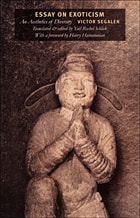
cover of Essay on Exoticism: An Aesthetics of Diversity

Essay on Exoticism

An Aesthetics of Diversity

Victor Segalen

Duke University Press, 2002

The “Other”—source of fear and fascination; emblem of difference demonized and romanticized. Theories of alterity and cultural diversity abound in the contemporary academic landscape. Victor Segalen’s early attempt to theorize the exotic is a crucial reference point for all discussions of alterity, diversity, and ethnicity.
Written over the course of fourteen years between 1904 and 1918, at the height of the age of imperialism, Essay on Exoticism encompasses Segalen’s attempts to define “true Exoticism.” This concept, he hoped, would not only replace nineteenth-century notions of exoticism that he considered tawdry and romantic, but also redirect his contemporaries’ propensity to reduce the exotic to the “colonial.” His critique envisions a mechanism that appreciates cultural difference—which it posits as an aesthetic and ontological value—rather than assimilating it: “Exoticism’s power is nothing other than the ability to conceive otherwise,” he writes.
Segalen’s pioneering work on otherness anticipates and informs much of the current postcolonial critique of colonial discourse. As such Essay on Exoticism is essential reading for both cultural theorists or those with an interest in the politics of difference and diversity.
[more]
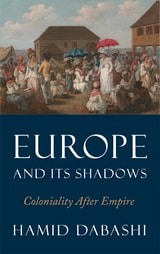
cover of Europe and Its Shadows: Coloniality after Empire

Europe and Its Shadows

Coloniality after Empire

Hamid Dabashi

Pluto Press, 2019

Europe has long imagined itself as the centre of the universe, although its precise geographical, cultural and social terrains have always been amorphous. Exploring the fear and fascination associated with the continent as an allegory, Hamid Dabashi considers Europe to be a historically formed barricade against the world.

Frantz Fanon’s assessment that 'Europe is literally the creation of the Third World' is still true today; but in more than one sense for the colonial has always been embedded in the capital, and the capital within the colonial. As the condition of coloniality shifts, so have the dividing lines between coloniser and colonised, and this shift calls for a reappraisal of our understanding of nationalism, xenophobia and sectarianism as the dangerous indices of the emerging worlds.

As the far-right populists captivate minds across Europe and Brexit upsets the balance of power in the European Union, this book, from a major scholar of postcolonial thought, is a timely and transformative intervention.
[more]
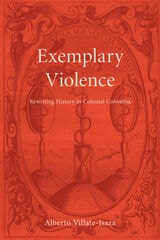
cover of Exemplary Violence: Rewriting History in Colonial Colombia

Exemplary Violence

Rewriting History in Colonial Colombia

Alberto Villate-Isaza

Bucknell University Press, 2021

Exemplary Violence explores the violent colonial history of the New Kingdom of Granada (modern-day Colombia and Venezuela) by examining three seventeenth-century historical accounts—Pedro Simón’s Noticias historiales, Juan Rodríguez Freile’s El carnero, and Lucas Fernández de Piedrahita’s Historia general—each of which reveals the colonizer’s reliance on the threat of violence to sustain order.
[more]