Results by title
126 books match the query 'Communism' and 5 start with e
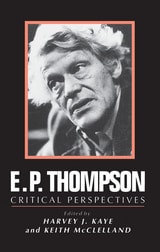
E. P. Thompson
Critical PerspectivesHarvey Kaye
Temple University Press, 1990
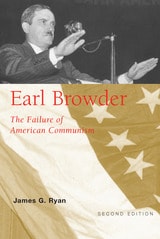
Earl Browder
The Failure of American CommunismJames G. Ryan
University of Alabama Press, 2005
Earl Browder, the preeminent 20th-century Communist party leader in the United States, steered the CPUSA through the critical years of the Great Depression and World War II. A Kansas native and veteran of numerous radical movements, he was peculiarly fitted by circumstance and temperament to head the cause during its heyday.
Serving as a bridge between American Communism’s secret and public worlds, Browder did more than anyone to attempt to explain the Soviet Union’s shifting policies to the American people in a way that would serve the interests of the CPUSA. A proud and loyal follower of Joseph Stalin, Browder nevertheless sought to move the party into the U.S. political mainstream. He used his knowledge of domestic politics to persuade the Communist International to modify Popular Front (1935-1939) tactics for the United States.
Despite his rise in the hierarchy, he possessed an independent streak that ultimately proved his undoing. Imprisonment as he neared age 50 left permanent psychological damage. After being released with the approval of President Franklin D. Roosevelt, Browder lost his perspective and began entertaining delusions of grandeur about his status in American politics and in the world Communist movement. Still, he could never quite bring legitimacy to the CPUSA because he lacked the vision and moral courage to separate himself totally from the Soviet Union. Ryan concludes that Browder was not so much insincere as deluded. His failure contributed to the demise of the popularity of the Communist party in the United States.
In preparation for this book, the author consulted the Browder Papers at Syracuse University and U.S. Government documents, particularly the F.B.I. files. In addition, he traveled to Russia for research in the Soviet Archives when recently opened to Western scholars, including the records of the former Communist International and a collection of American Communist party files, 1919-1944, shipped secretly to Moscow long ago. Indeed, until 1992, the existence of the CPUSA collection was only rumored.
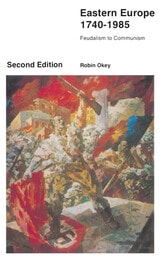
Eastern Europe 1740-1985
Feudalism to CommunismRobin Okey
University of Minnesota Press, 1987
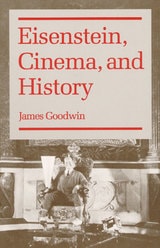
Eisenstein, Cinema, and History
James Goodwin
University of Illinois Press, 1993
stands alone as the maker of a fully historical cinema. James Goodwin treats
issues of revolutionary history and historical representation as central to
an understanding of Eisentein's work, which explores two movements within Soviet
history and consciousness: the Bolshevik Revolution and the Stalinist state.
Goodwin articulates intersections
between Eisentein's ideas and aspects of the thought of Walter Benjamin, Georg
Lukács, Ernst Bloch, and Bertolt Brecht. He also shows how the formal
properties and filmic techniques of each work reveal perspectives on history
. Individual chapters focus on Strike, Battleship Potemkin, October, Old
and New, projects of the 1930s, Alexander Nevsky, and Ivan the
Terrible.
Exit-Voice Dynamics and the Collapse of East Germany
The Crisis of Leninism and the Revolution of 1989Steven Pfaff
Duke University Press, 2006
East Germany was the first domino to fall when the Soviet bloc began to collapse in 1989. Its topple was so swift and unusual that it caught many area specialists and social scientists off guard; they failed to recognize the instability of the Communist regime, much less its fatal vulnerability to popular revolt. In this volume, Steven Pfaff identifies the central mechanisms that propelled the extraordinary and surprisingly bloodless revolution within the German Democratic Republic (GDR). By developing a theory of how exit-voice dynamics affect collective action, Pfaff illuminates the processes that spurred mass demonstrations in the GDR, led to a peaceful surrender of power by the hard-line Leninist elite, and hastened German reunification. While most social scientific explanations of collective action posit that the option for citizens to emigrate—or exit—suppresses the organized voice of collective public protest by providing a lower-cost alternative to resistance, Pfaff argues that a different dynamic unfolded in East Germany. The mass exit of many citizens provided a focal point for protesters, igniting the insurgent voice of the revolution.
Pfaff mines state and party records, police reports, samizdat, Church documents, and dissident manifestoes for his in-depth analysis not only of the genesis of local protest but also of the broader patterns of exit and voice across the entire GDR. Throughout his inquiry, Pfaff compares the East German rebellion with events occurring during the same period in other communist states, particularly Czechoslovakia, China, Poland, and Hungary. He suggests that a trigger from outside the political system—such as exit—is necessary to initiate popular mobilization against regimes with tightly centralized power and coercive surveillance.