Results by title
198 books match the query 'Community' and 3 start with e
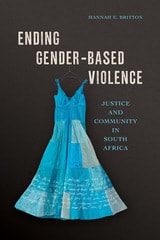
Ending Gender-Based Violence
Justice and Community in South AfricaHannah E. Britton
University of Illinois Press, 2020
Hannah E. Britton examines the reasons gendered violence persists in relationship to social inequalities even after women assume political power. Venturing into South African communities, Britton invites service providers, religious and traditional leaders, police officers, and medical professionals to address gender-based violence in their own words. Britton finds the recent turn toward carceral solutions—with a focus on arrests and prosecutions—fails to address the complexities of the problem and looks at how changing specific community dynamics can defuse interpersonal violence. She also examines how place and space affect the implementation of policy and suggests practical ways policymakers can support street level workers.
Clear-eyed and revealing, Ending Gender-Based Violence offers needed tools for breaking cycles of brutality and inequality around the world.
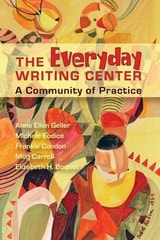
Everyday Writing Center
A Community of PracticeAnne E. Geller, Michele Eodice, Frankie Condon, Meg Carroll, Elizabeth H. Boquet
Utah State University Press, 2007
The Everyday Writing Center challenges some of the most comfortable traditions in its field, and it does so with a commitment and persuasiveness that one seldom sees in scholarly discussion. The book, at its core, is an argument for a new writing center consciousness--one that makes the most of the writing center's unique, and uniquely fluid, identity.
Writing center specialists live with a liminality that has been acknowledged but not fully explored in the literature. Their disciplinary identity is with the English department, but their mission is cross-disciplinary; their research is pedagogical, but they often report to central administration. Their education is in humanities, but their administrative role demands constant number-crunching. This fluid identity explains why Trickster--an icon of spontaneity, shape-shifting, and the creative potential of chaos--has come to be a favorite cultural figure for the authors of this book.
Adapting Lewis Hyde and others, these authors use Trickster to develop a theme of ordinary disruptions ("the everyday") as a source of provocative learning moments that can liberate both student writers and writing center staff. At the same time, the authors parlay Etienne Wenger's concept of "community of practice" into an ethos for a dynamic, learner-centered pedagogy that is especially well-suited to the peculiar teaching situation of the writing center.
Through Trickster, they question not only accepted approaches to writing center pedagogy, but conventional approaches to race, time, leadership, and collaboration as well. They encourage their field to exploit the creative potential in ordinary events that are normally seen as disruptive or defeating, and they challenge traditions in the field that tend to isolate a writing center director from the department and campus.
Yet all is not random, for the authors anchor this high-risk/high-yield approach in their commitment to a version of Wenger's community of practice. Conceiving of themselves, their colleagues, student writers, and student tutors as co-learners engaged together in a dynamic life of learning, the authors find a way to ground the excess and randomness of the everyday, while advancing an ethic of mutual respect and self-challenge.
Committed to testing a region beyond the edge of convention, the authors of The Everyday Writing Center constantly push themselves and their field toward deeper, more significant research, and more reflective, dynamic teaching.
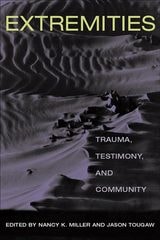
Extremities
Trauma, Testimony, and CommunityEdited by Nancy K. Miller and Jason Tougaw
University of Illinois Press, 2002
How do we come to terms with what can't be forgotten?
How do we bear witness to extreme experiences that challenge the limits of language? This remarkable volume explores the emotional, political, and aesthetic dimensions of testimonies to trauma as they translate private anguish into public space. Nancy K. Miller and Jason Tougaw have assembled a collection of essays that trace the legacy of the Holocaust and subsequent events that have shaped twentieth-century history and still haunt contemporary culture.
Extremities combines personal and scholarly approaches to a wide range of texts that bear witness to shocking and moving accounts of individual trauma: Toni Morrison's Beloved, Sylvia Plath's "Daddy" and "Lady Lazarus," Kathryn Harrison's The Kiss, Tatana Kellner's Holocaust art, Ruth Klüger's powerful memoir Still Alive, and Binjamin Wilkomirski's controversial narrative of concentration camp suffering Fragments. The book grapples with the cultural and social effects of historical crises, including the Montreal Massacre, the Warsaw Ghetto Uprising, and the medical catastrophes of HIV/AIDS and breast cancer.
Developing insights from autobiography, psychoanalysis, feminist theory and gender studies, the authors demonstrate that testimonies of troubling and taboo subjects do more than just add to the culture of confession–-they transform identities and help reimagine the boundaries of community. Extremities offers an original and timely interpretive guide to the growing field of trauma studies. The volume includes essays by Ross Chambers, Sandra M. Gilbert, Susan Gubar, Marianne Hirsch, Wayne Koestenbaum, Eve Kosofsky Sedgwick, and others.