Results by title
87 books match the query 'Comparative' and 7 start with e
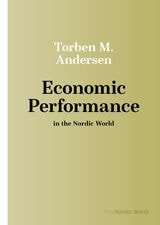
Economic Performance in the Nordic World
Torben M. Andersen
University of Wisconsin Press, 2021
The Nordic countries stand out in international comparisons for having both high living standards and low inequality. The welfare state and public sectors are large and the tax burden is high. How have these countries managed to achieve such favorable economic performance?
Economist Torben M. Andersen shows how the Nordic model rests on two pillars: the social safety net, which offers income compensation to the majority of those unable to support themselves, and the provision of services like education, childcare, and healthcare to all. The Nordic model can be characterized as one of employment, since its financial viability rests on a high labor participation rate with few working poor.
Andersen lays out the structure of the model and highlights factors important for understanding its economic performance. He then looks into specific policy areas based on Denmark's experiences regarding labor market policies (flexicurity), pension systems, and preparation for an aging population; and addresses the challenges arising from new technologies and globalization.
[more]
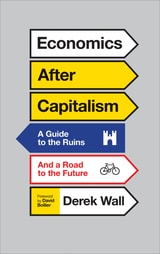
Economics After Capitalism
A Guide to the Ruins and a Road to the FutureDerek Wall
Pluto Press, 2015
'There is no alternative' has been the unofficial mantra of the neoliberal order since its utterance by Margaret Thatcher in the 1980s. However, there is an alternative to our crisis-ridden, austerity-inflicted world - and not just one alternative, but many.
Challenging the arguments for markets, mainstream economics and capitalism from Adam Smith onwards, Economics After Capitalism provides a step-by-step guide to various writers, movements and schools of thought, critical of neoliberal globalisation. These range from Keynesian-inspired reformists such as Geroge Soros and Joseph Stiglitz, critics of inequality like Thomas Piketty and Amaitya Sen, to more radical voices including Naomi Klein, Marxists such as David Harvey, anarchists, and autonomists including Toni Negri and Michael Hardt.
By providing a clear and accessible guide to the economics of anti-capitalism, Derek Wall successfully demonstrates that an open source eco-socialist alternative to rampant climate change, elite rule and financial chaos is not just necessary, but possible.
[more]

Educating in the Divine Image
Gender Issues in Orthodox Jewish Day SchoolsChaya Rosenfeld Gorsetman and Elana Maryles Sztokman
Brandeis University Press, 2013
Although recent scholarship has examined gender issues in Judaism with regard to texts, rituals, and the rabbinate, there has been no full-length examination of the education of Jewish children in day schools. Drawing on studies in education, social science, and psychology, as well as personal interviews, the authors show how traditional (mainly Orthodox) day school education continues to re-inscribe gender inequities and socialize students into unhealthy gender identities and relationships. They address pedagogy, school practices, curricula, and textbooks, as along with single-sex versus coed schooling, dress codes, sex education, Jewish rituals, and gender hierarchies in educational leadership. Drawing a stark picture of the many ways both girls and boys are molded into gender identities, the authors offer concrete resources and suggestions for transforming educational practice.
[more]
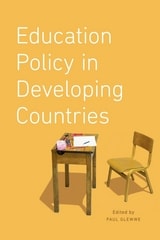
Education Policy in Developing Countries
Edited by Paul Glewwe
University of Chicago Press, 2013
Almost any economist will agree that education plays a key role in determining a country’s economic growth and standard of living, but what we know about education policy in developing countries is remarkably incomplete and scattered over decades and across publications. Education Policy in Developing Countries rights this wrong, taking stock of twenty years of research to assess what we actually know—and what we still need to learn—about effective education policy in the places that need it the most.
Surveying many aspects of education—from administrative structures to the availability of health care to parent and student incentives—the contributors synthesize an impressive diversity of data, paying special attention to the gross imbalances in educational achievement that still exist between developed and developing countries. They draw out clear implications for governmental policy at a variety of levels, conscious of economic realities such as budget constraints, and point to crucial areas where future research is needed. Offering a wealth of insights into one of the best investments a nation can make, Education Policy in Developing Countries is an essential contribution to this most urgent field.
Surveying many aspects of education—from administrative structures to the availability of health care to parent and student incentives—the contributors synthesize an impressive diversity of data, paying special attention to the gross imbalances in educational achievement that still exist between developed and developing countries. They draw out clear implications for governmental policy at a variety of levels, conscious of economic realities such as budget constraints, and point to crucial areas where future research is needed. Offering a wealth of insights into one of the best investments a nation can make, Education Policy in Developing Countries is an essential contribution to this most urgent field.
[more]
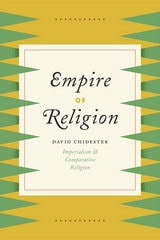
Empire of Religion
Imperialism and Comparative ReligionDavid Chidester
University of Chicago Press, 2014
How is knowledge about religion and religions produced, and how is that knowledge authenticated and circulated? David Chidester seeks to answer these questions in Empire of Religion, documenting and analyzing the emergence of a science of comparative religion in Great Britain during the second half of the nineteenth century and its complex relations to the colonial situation in southern Africa. In the process, Chidester provides a counterhistory of the academic study of religion, an alternative to standard accounts that have failed to link the field of comparative religion with either the power relations or the historical contingencies of the imperial project.
In developing a material history of the study of religion, Chidester documents the importance of African religion, the persistence of the divide between savagery and civilization, and the salience of mediations—imperial, colonial, and indigenous—in which knowledge about religions was produced. He then identifies the recurrence of these mediations in a number of case studies, including Friedrich Max Müller’s dependence on colonial experts, H. Rider Haggard and John Buchan’s fictional accounts of African religion, and W. E. B. Du Bois’s studies of African religion. By reclaiming these theorists for this history, Chidester shows that race, rather than theology, was formative in the emerging study of religion in Europe and North America. Sure to be controversial, Empire of Religion is a major contribution to the field of comparative religious studies.
In developing a material history of the study of religion, Chidester documents the importance of African religion, the persistence of the divide between savagery and civilization, and the salience of mediations—imperial, colonial, and indigenous—in which knowledge about religions was produced. He then identifies the recurrence of these mediations in a number of case studies, including Friedrich Max Müller’s dependence on colonial experts, H. Rider Haggard and John Buchan’s fictional accounts of African religion, and W. E. B. Du Bois’s studies of African religion. By reclaiming these theorists for this history, Chidester shows that race, rather than theology, was formative in the emerging study of religion in Europe and North America. Sure to be controversial, Empire of Religion is a major contribution to the field of comparative religious studies.
[more]
Equality in the Nordic World
Carsten Jensen
University of Wisconsin Press, 2021
By most measures, the Nordic countries regularly rank among the best in terms of equality and business friendliness. Political scientist Carsten Jensen delves into what is exceptional about equality in the region, and outlines “the four equalities” that set it apart: economic, intergenerational, gender, and health.
The four types of equality have their origins in unique political compromises made in the twentieth century. The resulting social market economies of these countries affect their growth and levels of equality even today.
The four types of equality have their origins in unique political compromises made in the twentieth century. The resulting social market economies of these countries affect their growth and levels of equality even today.
[more]
Ethics, Business and Capitalism
Thailand and Indonesia in an Asian PerspectiveEdited by Janet Hunter, Patnaree Srisuphaolarn, Pierre van der Eng, and Julia Yongue
National University of Singapore Press, 2024
Academic analysis of business ethics in Southeast Asia.
Taking cues from the Japanese concept of ethical or stakeholder capitalism, this book demonstrates how the business activities of firms in Thailand and Indonesia are guided by their perceptions of morality in society and their concerns about the environment. The authors explore the likelihood that foreign influences contributed to the development of such management philosophies, for example through the expansion of Japanese subsidiary firms in the 1980s or the spread of foreign articulations of the concept of corporate social responsibility (CSR) since the 2000s. Companies in both countries may exercise a degree of pragmatism in how they develop these activities. As the authors reveal, the perceptions of morality in business that have shaped many entrepreneurs and companies in Thailand and Indonesia are their responses to the dynamic political, social, and economic factors that have formed the business environments of both countries.
Taking cues from the Japanese concept of ethical or stakeholder capitalism, this book demonstrates how the business activities of firms in Thailand and Indonesia are guided by their perceptions of morality in society and their concerns about the environment. The authors explore the likelihood that foreign influences contributed to the development of such management philosophies, for example through the expansion of Japanese subsidiary firms in the 1980s or the spread of foreign articulations of the concept of corporate social responsibility (CSR) since the 2000s. Companies in both countries may exercise a degree of pragmatism in how they develop these activities. As the authors reveal, the perceptions of morality in business that have shaped many entrepreneurs and companies in Thailand and Indonesia are their responses to the dynamic political, social, and economic factors that have formed the business environments of both countries.
[more]