474 books match the query 'Computers' and 29 start with e
cover of E-learning Methodologies: Fundamentals, technologies and applications

E-learning Methodologies

Fundamentals, technologies and applications

Mukta Goyal

The Institution of Engineering and Technology, 2021

E-learning has become an important part of our educational life with the development of e-learning systems and platforms and the need for online and remote learning. ICT and computational intelligence techniques are being used to design more intelligent and adaptive systems. However, the art of designing good real-time e-learning systems is difficult as different aspects of learning need to be considered including challenges such as learning rates, involvement, knowledge, qualifications, as well as networking and security issues. The earlier concepts of standalone integrated virtual e-learning systems have been greatly enhanced with emerging technologies such as cloud computing, mobile computing, big data, Internet of Things (IoT), AI and machine learning, and AR/VT technologies.
[more]
cover of ESC: Sonic Adventure in the Anthropocene

ESC

Sonic Adventure in the Anthropocene

Jacob Smith

University of Michigan Press, 2019

ESC is a work of experimental audio-based scholarship combining sound studies, radio history, and environmental criticism. This unique project is a fully open access, fully digital suite of audiographic essays, presented as a ten-part podcast series, combining spoken commentary, clips from classic radio dramas, excerpts from films and television shows, news reports, and the work of contemporary sound artists. A brief written essay on the ESC website provides a helpful introduction and context for this project.

ESC takes as its point of departure the CBS Radio adventure series Escape (1947–54). The postwar years saw both a decline in popularity for American radio drama, and the dawn of the Anthropocene era, with human beings emerging as the primary force affecting the earth’s systems.

Jacob Smith considers Escape’s adventure stories from an ecocritical perspective, analyzing the geographic, sociopolitical, and ecological details of the stories to reveal how they are steeped in social and environmental history.

The work of contemporary sound artists and field recordists underscores the relevance of sound in these narratives and demonstrates audio’s potential as a key medium for scholarship. ESC features recordings by some of the most prominent sound artists working in this area, including Daniel Blinkhorn, Peter Cusak, David Dunn, JLIAT, Christina Kubisch, Francisco López, Sally Ann McIntyre, Chris Watson, and Jana Winderen.

ESC makes the urgency of our critical ecological moment audible in a new way. The audio essays articulate what it means to live in an Anthropocene era and posit alternative ways of conceptualizing our historical moment. ESC sharpens our ability to listen and respond to our world with greater ecological awareness.

All publication resources for ESC, including the introductory essay, audio materials, and backmatter, are available on 
Fulcrum. The audio materials are also available on Apple Podcasts.

[more]
cover of Early Modern Studies after the Digital Turn

Early Modern Studies after the Digital Turn

Edited by Laura Estill, Diane K. Jakacki, Michael Ullyot

Iter Press, 2016

The essays collected in this volume address the digital humanities’ core tensions: fast and slow; surficial and nuanced; quantitative and qualitative. Scholars design algorithms and projects to process, aggregate, encode, and regularize historical texts and artifacts in order to position them for new and further interpretations. Every essay in this book is concerned with the human-machine dynamic, as it bears on early modern research objects and methods. The interpretive work in these pages and in the online projects discussed orients us toward the extensible future of early modern scholarship after the digital turn.
[more]
cover of Earth Observation Data Analytics Using Machine and Deep Learning: Modern tools, applications and challenges

Earth Observation Data Analytics Using Machine and Deep Learning

Modern tools, applications and challenges

Sanjay Garg

The Institution of Engineering and Technology, 2023

Earth Observation Data Analytics Using Machine and Deep Learning: Modern tools, applications and challenges covers the basic properties, features and models for Earth observation (EO) recorded by very high-resolution (VHR) multispectral, hyperspectral, synthetic aperture radar (SAR), and multi-temporal observations.
[more]
cover of Economic Analysis of the Digital Economy

Economic Analysis of the Digital Economy

Edited by Avi Goldfarb, Shane M. Greenstein, and Catherine E. Tucker

University of Chicago Press, 2015

As the cost of storing, sharing, and analyzing data has decreased, economic activity has become increasingly digital. But while the effects of digital technology and improved digital communication have been explored in a variety of contexts, the impact on economic activity—from consumer and entrepreneurial behavior to the ways in which governments determine policy—is less well understood.
           
Economic Analysis of the Digital Economy explores the economic impact of digitization, with each chapter identifying a promising new area of research. The Internet is one of the key drivers of growth in digital communication, and the first set of chapters discusses basic supply-and-demand factors related to access. Later chapters discuss new opportunities and challenges created by digital technology and describe some of the most pressing policy issues. As digital technologies continue to gain in momentum and importance, it has become clear that digitization has features that do not fit well into traditional economic models. This suggests a need for a better understanding of the impact of digital technology on economic activity, and Economic Analysis of the Digital Economy brings together leading scholars to explore this emerging area of research.

[more]
cover of Edge Computing: Models, technologies and applications

Edge Computing

Models, technologies and applications

Javid Taheri

The Institution of Engineering and Technology, 2020
Cloud computing has evolved as a cost-effective, easy-to-use, elastic and scalable computing paradigm to transform today's business models. 5G, Industrial IoT, Industry 4.0 and China-2050 frameworks and technologies are introducing new challenges that cannot be solved efficiently using current cloud architectures. To handle the collected information from such a vast number of devices and actuators, and address these issues, novel concepts have been proposed to bring cloud-like resources closer to end users at the edge of the network, a technology called edge computing.
[more]
cover of Efficient Processing with Constraint-Logic Grammars Using Grammar

Efficient Processing with Constraint-Logic Grammars Using Grammar

Guido Minnen

CSLI, 2001

The ascendance of communication technologies such as the internet has accentuated the need to improve access, manipulation and translation of written language. One of the main goals of researchers in the field of computational linguistics is to create programs that put to use knowledge of human language in pursuit of technology that can overcome the many obstacles in the interaction between human and computer. In this endeavor, finding automated techniques to parse the complexities of human grammar is a premier problem tackled by human-interface researchers. The intricacy of human grammar poses problems not only of accuracy, but also of efficiency.

This book investigates programs for automatic analysis and production of written human language. These specialized programs use knowledge about the structure and meaning of human language in the form of grammars. Various techniques are proposed which focus on solutions for practical problems in processing of constraint-logic grammars. The solutions are all based on the automatic adaptation or compilation of a grammar rather than a modification of the processing algorithm used. As such they allow the grammar writer to abstract over details of grammar processing and in many cases enable more efficient processing.
[more]
cover of Electronic Literature Communities

Electronic Literature Communities

Scott Rettberg

West Virginia University Press, 2015
This is a diverse collection on the role and function of community in the contemporary practice of electronic literature, with ten essays by thirteen leading authors, providing wide-ranging perspectives and approaches. The collection offers historical narratives of institutions in the field, examples of how particular platforms or genres can inspire community, and stories of how ad hoc communities can form around specific creative projects. These case studies are histories of creative affiliations in electronic literature—snapshots of consensus-based communities in their process of formation—and offer a starting point for broader theoretical analyses of network-based creative community. 
 
[more]
cover of Electronic Literature as a Model of Creativity and Innovation in Practice (ELMCIP): A Report from the HERA Joint Research Project

Electronic Literature as a Model of Creativity and Innovation in Practice (ELMCIP)

A Report from the HERA Joint Research Project

Scott Rettberg

West Virginia University Press, 2014

Electronic Literature as a Model of Creativity and Innovation in Practice maps electronic literature in Europe and is an essential read for scholars and students in the field. ELMCIP is a three-year (2013) collaborative research project funded by Humanities in the European Research Area (HERA) JRP for Creativity and Innovation.

ELMCIP involved seven European partners investigating how creative communities of practitioners form within a transnational and transcultural context in a globalized and distributed communication environment. Focusing on the electronic literature community in Europe as a model of networked creativity and innovation in practice, ELMCIP studies the formation and interactions of that community and furthers electronic literature research and practice in Europe.

This book includes reflective reports by all of the principal investigators of the project. It details the development of a major digital humanities research database and the publication of the first trans-European anthology of electronic literature, and includes a report on electronic literature publishing venues across Europe and consideration of different forms of creative communities develop around genres of digital practice.

[more]
cover of Electronic Monuments

Electronic Monuments

Gregory Ulmer

University of Minnesota Press, 2005

While corporations, governmental groups, and public relations firms debated the best way to memorialize the event of 9/11, sites of commemoration could be seen across the country and especially on the Internet. Greg Ulmer suggests that this reality points us to a new sense of monumentality, one that is collaborative in nature rather than iconic. 

From a do-it-yourself Mount Rushmore to an automated tribute to the devastating annual toll of traffic deaths in the United States, Electronic Monuments describes commemoration as a fundamental experience, joining individual and collective identity, and adapting both to the emerging apparatus of “electracy,” or digital literacy. Concerns about the destruction of civic life caused by the society of the spectacle are refocused on the question of how a collectivity remembers who or what it is. 

Ulmer proposes that the Internet makes it possible for monumentality to become a primary site of self-knowledge, one that supports a new politics, ethics, and dimension of education. The Internet thus holds the promise of bringing citizens back into the political equation as witnesses and monitors. 

Gregory L. Ulmer is professor of English and media studies at the University of Florida, Gainesville.
[more]
cover of Electronic Tribes: The Virtual Worlds of Geeks, Gamers, Shamans, and Scammers

Electronic Tribes

The Virtual Worlds of Geeks, Gamers, Shamans, and Scammers

By Tyrone L. Adams and Stephen A. Smith

University of Texas Press, 2008

Whether people want to play games and download music, engage in social networking and professional collaboration, or view pornography and incite terror, the Internet provides myriad opportunities for people who share common interests to find each other. The contributors to this book argue that these self-selected online groups are best understood as tribes, with many of the same ramifications, both positive and negative, that tribalism has in the non-cyber world.

In Electronic Tribes, the authors of sixteen competitively selected essays provide an up-to-the-minute look at the social uses and occasional abuses of online communication in the new media era. They explore many current Internet subcultures, including MySpace.com, craftster.org, massively multiplayer online role-playing games (MMORPGs) such as World of Warcraft, music downloading, white supremacist and other counterculture groups, and Nigerian e-mail scams. Their research raises compelling questions and some remarkable answers about the real-life social consequences of participating in electronic tribes. Collectively, the contributors to this book capture a profound shift in the way people connect, as communities formed by geographical proximity are giving way to communities—both online and offline—formed around ideas.
[more]
cover of EnTwine: Critical and Creative Teaching with Twine

EnTwine

Critical and Creative Teaching with Twine

Edited by Emily Christina Murphy and Lai-Tze Fan

Amherst College Press, 2026

EnTwine: Critical and Creative Teaching with Twine is the first full-length collection devoted to teaching with the popular, digital story-telling platform Twine. Until now, few scholarly accounts have focused on how disparate communities use, share, and learn about Twine. Contributors to this volume demonstrate how Twine helps to forge communities of practice committed to learning and sharing together, inside and outside of classrooms. The book’s case studies range across humanities, STEM, industry, and activist contexts. Authors from across the world share how they use Twine in teaching—whether creating Twines for students, holding workshops, or using Twine to build communities and preserve the voices of the people who use it. Readers will find practical examples in the Twine Objects featured at the end of each section as well as a wealth of open-access resources hosted in an online repository and connected to the book’s digital version. EnTwine invites readers, teachers, students, and makers of all kinds to learn, adapt, share, and teach with Twine.
[more]
cover of Enabling Technologies for Smart Fog Computing

Enabling Technologies for Smart Fog Computing

Kuldeep Singh Kaswan

The Institution of Engineering and Technology, 2024
Fog computing is a decentralized computing infrastructure in which computing resources are located between the data source and the cloud or any other data centers. The word "fog" refers to its cloud-like properties, which are closer to the "ground", using edge devices that carry out locally computation, storage and communication tasks. An additional benefit is that the processed data is likely to be needed by the same devices that generated the data. By processing locally rather than remotely, the latency between input and response are minimized. This technology has countless application domains such as industrial process control, smart cities, transportation, healthcare and agriculture.
[more]
cover of Encrypted Propaganda: The Democratic Promise and Despotic Peril of Chat Apps

Encrypted Propaganda

The Democratic Promise and Despotic Peril of Chat Apps

Inga Kristina Trauthig and Samuel Woolley

University of Chicago Press, 0

Essential reading on a hard-to-study but dominant communication tool, encrypted messaging apps—WhatsApp, Signal, and their kin—showing their promise and dangers.

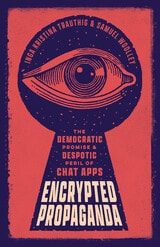
Pundits have long pointed to social media’s power to catalyze or end political movements—and to strengthen or weaken democracies. But this power is shifting from social media platforms (such as Facebook and YouTube) to lesser-studied encrypted messaging apps (such as WhatsApp and Signal). This urgent book explains how these technologies work and how they differ from their predecessors, outlining their strengths and vulnerabilities at a crucial stage in their evolution.

While many Facebook users have at least heard of propaganda and the algorithms used to filter and highlight content on that platform, they are more likely to trust messaging apps as sources of authentic and secure information. Paired with a growing distrust of traditional media, more people are joining large groups on these apps and using them as news sources, even when those groups include relative strangers. This makes these apps particularly vulnerable to political propaganda—and even government espionage.

Security studies scholar Inga Kristina Trauthig and propaganda scholar Samuel Woolley consider both the role of these apps in spreading disinformation and as tools for maintaining free speech and civic discourse in the face of censorship. The same closed nature that makes these apps seem trustworthy has made them particularly difficult to research. And so this qualitative study draws on some 180 interviews with propagandists, activists, influence campaigners, and other users in fourteen countries. The book’s findings and the authors’ recommendations are crucial for understanding the future of online communication and safeguarding democratic speech.
[more]
cover of Energy Optimization and Security in Federated Learning for IoT Environments

Energy Optimization and Security in Federated Learning for IoT Environments

Balamurugan Balusamy

The Institution of Engineering and Technology, 2025
Smart environments such as smart homes and industrial automation have been transformed by the rapid developments in internet of things (IoT) devices and systems. However, the widespread use of these devices poses significant difficulties, particularly in settings with limited energy resources. Due to the significant energy consumption and communication overhead associated with delivering huge amounts of data, traditional machine learning algorithms which rely on centralized cloud servers for training are not always suitable.
[more]
cover of Engineering the Metaverse: Enabling technologies, platforms and use cases

Engineering the Metaverse

Enabling technologies, platforms and use cases

Pethuru Raj

The Institution of Engineering and Technology, 2025
The metaverse offers a new way of interacting with the world via immersive and interactive technologies. It has the potential to change the way we learn, work and play. 3D modelling, artificial intelligence, virtual, augmented, extended and mixed reality (VR/AR/XR/MR), the Internet of Things (IoT), Web 3.0, 5G and 6G communication, digital twins and simulation technologies, edge and cloud computing, blockchain and cybersecurity are seen as the key enabling and supporting technologies and tools for establishing the next generation metaverse environments. Industrial verticals are keen to embrace the flexible paradigm of the metaverse to be more resilient and relevant to their customers and consumers.
[more]
cover of Ethereum for Business: A Plain-English Guide to the Use Cases that Generate Returns from Asset Management to Payments to Supply Chains

Ethereum for Business

A Plain-English Guide to the Use Cases that Generate Returns from Asset Management to Payments to Supply Chains

Paul Brody

Epic Books, 2023

In Ethereum for Business, Paul Brody provides a plain English guide to doing business on the world's largest blockchain. The book covers an overview of Ethereum, business applications on Ethereum, and various advanced topics. Including case studies and examples from the world of Ethereum, Ethereum for Business is readable both linearly and by dipping in and out of chapters.

The book is aimed at business executives who want to understand the potential of blockchain for solving real-world business problems, and readers with technical knowledge who want to understand the business use cases.

Ethereum for Business covers topics such as:

• Basics of blockchain technology and key components on wallets, tokens, and keys.
• Decentralization in digital marketplaces, smart contracts, privacy, scalability, supply chain management, trade finance, payments and asset transfers, and tokenomics.
• Transforming the world of enterprise computing by enabling companies to model and manage assets, real or digital, that exist off-chain.
• A guide for implementation that contains key success metrics for enterprises considering blockchain-based solutions.

[more]
cover of Evolving Predictive Analytics in Healthcare: New AI techniques for real-time interventions

Evolving Predictive Analytics in Healthcare

New AI techniques for real-time interventions

Abhishek Kumar

The Institution of Engineering and Technology, 2022
A major use of practical predictive analytics in medicine has been in the diagnosis of current diseases, particularly through medical imaging. Now there is sufficient improvement in AI, IoT and data analytics to deal with real time problems with an increased focus on early prediction using machine learning and deep learning algorithms. With the power of artificial intelligence alongside the internet of 'medical' things, these algorithms can input the characteristics/data of their patients and get predictions of future diagnoses, classifications, treatment and costs.
[more]
cover of Excavating the Memory Palace: Arts of Visualization from the Agora to the Computer

Excavating the Memory Palace

Arts of Visualization from the Agora to the Computer

Seth Long

University of Chicago Press, 2020

With the prevalence of smartphones, massive data storage, and search engines, we might think of today as the height of the information age. In reality, every era has faced its own challenges of storing, organizing, and accessing information. While they lacked digital devices, our ancestors, when faced with information overload, utilized some of the same techniques that underlie our modern interfaces: they visualized and spatialized data, tying it to the emotional and sensory spaces of memory, thereby turning their minds into a visual interface for accessing information.

In Excavating the Memory Palace, Seth David Long mines the history of Europe’s arts of memory to find the origins of today’s data visualizations, unearthing how ancient constructions of cognitive pathways paved the way for modern technological interfaces. Looking to techniques like the memory palace, he finds the ways that information has been tied to sensory and visual experience, turning raw data into lucid knowledge. From the icons of smart phone screens to massive network graphs, Long shows us the ancestry of the cyberscape and unveils the history of memory as a creative act.
 
[more]
cover of Experimental Games: Critique, Play, and Design in the Age of Gamification

Experimental Games

Critique, Play, and Design in the Age of Gamification

Patrick Jagoda

University of Chicago Press, 2020

In our unprecedentedly networked world, games have come to occupy an important space in many of our everyday lives. Digital games alone engage an estimated 2.5 billion people worldwide as of 2020, and other forms of gaming, such as board games, role playing, escape rooms, and puzzles, command an ever-expanding audience. At the same time, “gamification”—the application of game mechanics to traditionally nongame spheres, such as personal health and fitness, shopping, habit tracking, and more—has imposed unprecedented levels of competition, repetition, and quantification on daily life.
 
Drawing from his own experience as a game designer, Patrick Jagoda argues that games need not be synonymous with gamification. He studies experimental games that intervene in the neoliberal project from the inside out, examining a broad variety of mainstream and independent games, including StarCraft, Candy Crush Saga, Stardew Valley, Dys4ia, Braid, and Undertale. Beyond a diagnosis of gamification, Jagoda imagines ways that games can be experimental—not only in the sense of problem solving, but also the more nuanced notion of problem making that embraces the complexities of our digital present. The result is a game-changing book on the sociopolitical potential of this form of mass entertainment.

[more]
cover of Experimenting the Human: Art, Music, and the Contemporary Posthuman

Experimenting the Human

Art, Music, and the Contemporary Posthuman

G Douglas Barrett

University of Chicago Press, 2023

An engaging argument about what experimental music can tell us about being human.

In Experimenting the Human, G Douglas Barrett argues that experimental music speaks to the contemporary posthuman, a condition in which science and technology decenter human agency amid the uneven temporality of postwar global capitalism. Time moves forward for some during this period, while it seems to stand still or even move backward for others. Some say we’re already posthuman, while others endure the extended consequences of never having been considered fully human in the first place. Experimental music reflects on this state, Barrett contends, through its interdisciplinary involvements in postwar science, technology, and art movements.

Rather than pursuing the human's beyond, experimental music addresses the social and technological conditions that support such a pursuit. Barrett locates this tendency of experimentalism throughout its historical entanglements with cybernetics, and in his intimate analysis of Alvin Lucier’s neurofeedback music, Pamela Z’s BodySynth performances, Nam June Paik’s musical robotics, Pauline Oliveros’s experiments with radio astronomy, and work by Laetitia Sonami, Yasunao Tone, and Jerry Hunt. Through a unique meeting of music studies, media theory, and art history, Experimenting the Human provides fresh insights into what it means to be human.

 
[more]
cover of Explainable Artificial Intelligence (XAI) for Next Generation Cybersecurity: Concepts, challenges and applications

Explainable Artificial Intelligence (XAI) for Next Generation Cybersecurity

Concepts, challenges and applications

Farhan Ullah

The Institution of Engineering and Technology, 2025
As AI technologies progress and influence more facets of our lives, the requirement for openness and interpretability becomes increasingly important. Explainable AI (XAI) has the potential to be a paradigm shift in the next generation of AI systems. XAI strives to make AI algorithms and methods understandable by tackling trust, bias, compliance, and accountability challenges. XAI improves model disclosure, produces intrinsically interpretable deep learning approaches, offers real-time rationales, and promotes legitimate AI practice. These advances assist in the development of a more ethically sound AI ecosystem.
[more]
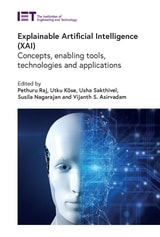
cover of Explainable Artificial Intelligence (XAI): Concepts, enabling tools, technologies and applications

Explainable Artificial Intelligence (XAI)

Concepts, enabling tools, technologies and applications

Pethuru Raj

The Institution of Engineering and Technology, 2023

The world is keen to leverage multi-faceted AI techniques and tools to deploy and deliver the next generation of business and IT applications. Resource-intensive gadgets, machines, instruments, appliances, and equipment spread across a variety of environments are empowered with AI competencies. Connected products are collectively or individually enabled to be intelligent in their operations, offering and output.
[more]
cover of Explainable Artificial Intelligence for Trustworthy Internet of Things

Explainable Artificial Intelligence for Trustworthy Internet of Things

Mohamed Abdel-Basset

The Institution of Engineering and Technology, 2024

A major challenge for machine learning solutions is that their efficiency in real-world applications is constrained by the current lack of ability of the machine to explain its decisions and activities to human users. Biases based on race, gender, age or location have been a long-standing risk in training AI models. Furthermore, AI model performance can degrade because production data differs from training data.
[more]
cover of Exploring Digital Cultural Heritage: Access, Use, Value and Sustainability

Exploring Digital Cultural Heritage

Access, Use, Value and Sustainability

Edited by Eirini Goudarouli, Anna-Maria Sichani, and Jane Winters

University of London Press, 2026

An accessible starting point for those interested in the past, present, and future of digital cultural heritage.

The digitization of cultural heritage has reshaped humanities research and professional practice, though its full impact is still emerging. As more cultural heritage becomes born-digital, new archives and collections introduce complexity, challenges, and shared methods across sectors. Exploring Digital Cultural Heritage examines interpretations, contexts, and uses across four themes—access, use and reuse, value(s), and sustainability—spanning digitized and born-digital materials. Drawing on case studies and practical examples, it provides an overview of the concepts, processes, and technologies shaping digital cultural heritage, as well as its future challenges and directions.

[more]
cover of Exploring Intelligent Healthcare with Quantum Computing

Exploring Intelligent Healthcare with Quantum Computing

Abhishek Kumar

The Institution of Engineering and Technology, 2024

Classical computers encode information in binary bits that can either be 0s or 1s. In a quantum computer, the basic unit of memory is a quantum bit or qubit. These qubits play a similar role in terms of storing information, but use physical systems, such as the spin of an electron or the orientation of a photon, to do so. In situations where there are a large number of possible feature combinations, quantum computers can consider them simultaneously, speeding up the data processing time.
[more]
cover of Exploring Logical Dynamics

Exploring Logical Dynamics

Johan van Benthem

CSLI, 1996
This book is an exploration of current trends in logical theories of information flow across various fields, such as belief revision in computer science or dynamic semantics in linguistics. It provides one mathematical perspective encompassing all of these. This framework generates a new agenda of questions concerning dynamic inference and dynamic operators. The result is a mathematical theory of process models, simulations between these, and modal languages over them, which is developed in quite some detail. New results include theorems on expressive completeness, representation of styles of inference, and new kinds of decidable remodeling for standard logics. This theory is also confronted with practice in computer science, linguistics and philosophy.
[more]
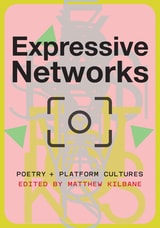
cover of Expressive Networks: Poetry and Platform Cultures

Expressive Networks

Poetry and Platform Cultures

Edited by Matthew Kilbane

Amherst College Press, 2025

Expressive Networks convenes an urgent conversation on digital media and the social life of contemporary poetry. Tracing how poems circulate through online spaces and how capitalized platforms have come to pattern the reading and writing of poetry, contributors emphasize both the expressivist cast of digital literary culture and the deep-running ambivalence that characterizes aesthetic and critical responses to platformed cultural production. The volume features chapters on Pan- African spoken word programs, Singaporean Facebook groups, decolonial hemispheric networks, and Japanese media-critical poetries as well as platforms such as Twitter/X, Instagram, and Amazon.

Though contributors write from a variety of methodological positions and address themselves to a range of archives, they share the primary conviction that the impact of Web 2.0 on literary practice is far-reaching, far from self-evident, and far more variegated and unpredictable than easy summations of social media’s influence suggest. Expressive Networks asks after poetry’s present and future by examining what poems themselves express about the social make-up of networked platforms.

Edited by Matthew Kilbane with contributions from Cameron Awkward-Rich, Micah Bateman, Andrew Campana, Sumita Chakraborty, Scott Challener, C.R. Grimmer, Tess McNulty, Michael Nardone, Seth Perlow, Anna Preus, Susanna Sacks, Carly Schnitzler, Melanie Walsh, and Samuel Caleb Wee.

[more]
cover of eTrust: Forming Relationships in the Online World

eTrust

Forming Relationships in the Online World

Karen S. Cook

Russell Sage Foundation, 2009

There is one thing that moves online consumers to click "add to cart," that allows sellers to accept certain forms of online payment, and that makes online product reviews meaningful: trust. Without trust, online interactions can't advance. But how is trust among strangers established on the Internet? What role does reputation play in the formation of online trust? In eTrust, editors Karen Cook, Chris Snijders, Vincent Buskens, and Coye Cheshire explore the unmapped territory where trust, reputation, and online relationships intersect, with major implications for online commerce and social networking. eTrust uses experimental studies and field research to examine how trust in anonymous online exchanges can create or diminish cooperation between people. The first part of the volume looks at how feedback affects online auctions using trust experiments. Gary Bolton and Axel Ockenfels find that the availability of feedback leads to more trust among one-time buyers, while Davide Barrera and Vincent Buskens demonstrate that, in investment transactions, the buyer's own experience guides decision making about future transactions with sellers. The field studies in Part II of the book examine the degree to which reputation facilitates trust in online exchanges. Andreas Diekmann, Ben Jann, and David Wyder identify a "reputation premium" in mobile phone auctions, which not only drives future transactions between buyers and sellers but also payment modes and starting bids. Chris Snijders and Jeroen Weesie shift focus to the market for online programmers, where tough competition among programmers allows buyers to shop around. The book's third section reveals how the quality and quantity of available information influences actual marketplace participants. Sonja Utz finds that even when unforeseen accidents hinder transactions—lost packages, computer crashes—the seller is still less likely to overcome repercussions from the negative feedback of dissatisfied buyers. So much of our lives are becoming enmeshed with the Internet, where ordinary social cues and reputational networks that support trust in the real world simply don't apply. eTrust breaks new ground by articulating the conditions under which trust can evolve and grow online, providing both theoretical and practical insights for anyone interested in how online relationships influence our decisions. A Volume in the Russell Sage Foundation Series on Trust
[more]