Results by title
69 books match the query 'Conduct of life' and 3 start with e
Ethical Communication
Moral Stances in Human DialogueClifford G. Christians and John C. Merrill
University of Missouri Press, 2009
Proponents of professional ethics recognize the importance of theory but also know that the field of ethics is best understood through real-world applications. This book introduces students and practitioners to important ethical concepts through the lives of major thinkers ranging from Aristotle to Ayn Rand, John Stuart Mill to the Dalai Lama.
Some two dozen contributors approach media ethics from five perspectives—altruistic, egoistic, autonomous, legalist, and communitarian—and use real people as examples to convey ethical concepts as something more than mere abstractions. Readers see how Confucius represents group loyalty; Gandhi, nonviolent action; Mother Teresa, the spirit of sacrifice. Each profile provides biographical material, the individual’s basic ethical position and contribution, and insight into how his or her moral teachings can help the modern communicator. The roster of thinkers is gender inclusive, ethnically diverse, and spans a broad range of time and geography to challenge the misperception that moral theory is dominated by Western males.
These profiles challenge us not to give up on moral thinking in our day but to take seriously the abundance of good ideas in ethics that the human race provides. They speak to real-life struggles by applying to such trials the lasting quality of foundational thought. Many of the root values to which they appeal are cross-cultural, even universal.
Exemplifying these five ethical perspectives through more than two dozen mentors provides today’s communicators with a solid grounding of key ideas for improving discussion and attaining social progress in their lives and work. These profiles convey the diversity of means to personal and social betterment through worthwhile ideas that truly make ethics come alive.
[more]
Ethical Excellence
Philosophers, Psychologists, and Real-Life Exemplars Show Us How to Achieve ItHeidi M. Giebel
Catholic University of America Press, 2021
Why do some people achieve ethical excellence while others fail? For example, how did Gloria Lewis overcome a lifetime of difficulty and go on to found a non-profit focused on feeding the homeless while Danny Starrett, despite a seemingly ideal childhood, became a rapist and murderer? Why did some Germans rescue their Jewish neighbors while others stood by?
One recent study found that four personal variables, taken together, differentiated Nazi-era bystanders from rescuers with startling 96.1% accuracy: social responsibility, altruistic moral reasoning, empathic concern, and risk-taking—traits related to ethical excellences (virtues) like justice, benevolence, and courage. Drawing from the combined wisdom of classical Socratic and Confucian philosophy, recent work in psychology, and the lived experience of recognized moral heroes, the book focuses on how each of us can work toward ethical excellence, becoming more like Lewis and neighbor-rescuers than like Starrett and Nazi-era bystanders.
The ancient Socratic and Confucian philosophical traditions offer surprisingly sophisticated advice regarding moral education. Because research in psychology helps us assess the feasibility of cultivating virtue in ourselves and those we influence, Ethical Excellence focuses on combining sound philosophical analysis of ethical virtue and related concepts with relevant empirical research on how these concepts are manifested and developed in everyday practice. Willpower, for example, contributes to development of temperance or moderation, grit relates to perseverance, and empathy is connected to benevolence.
Finally, the study of ethically exceptional people—moral heroes or exemplars—serves as living proof that ethical excellence is possible, and exemplars can provide inspiration to attempt it ourselves and guidance regarding how to do so successfully. Relevant stories and excerpts from the author’s own interviews with award-winning ethical exemplars complement the use of philosophical virtue theory and psychological research on virtue-relevant practice. Together, these three approaches—philosophy, psychology, and biography—help to triangulate” ethical excellence and its achievement, presenting a much clearer and more complete picture than we can get from any one of these methods alone.
[more]
Everything to Gain
Making the Most of the Rest of Your LifeJimmy Carter
University of Arkansas Press, 1995
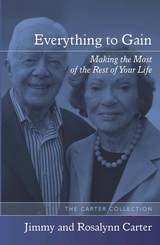
Everything to Gain, first published in 1987, is the warm account of Jimmy and Rosalynn Carter’s life after their years in the White House. They discuss their marriage and health issues, their work with Habitat for Humanity and the Carter Center, and much more.
[more]