Results by title
95 books match the query 'Crimes against' and 4 start with e
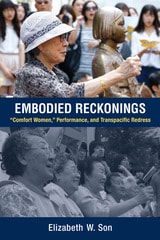
Embodied Reckonings
“Comfort Women,” Performance, and Transpacific RedressElizabeth W. Son
University of Michigan Press, 2018
Based on extensive archival and ethnographic research, the study argues for the central role of performance in how Korean survivors, activists, and artists have redressed the histories—and erasures—of this sexual violence. Merging cultural studies and performance theory with a transnational, feminist analysis, the book illuminates the actions of ordinary people, thus offering ways of reconceptualizing legal and political understandings of redress that tend to concentrate on institutionalized forms of state-based remediation.
Everyday Psychokillers
A History for Girls, A NovelLucy Corin
University of Alabama Press, 2004
In Everyday Psychokillers spectacular violence is the idiom of everyday life, a lurid extravaganza in which all those around the narrator seem vicarious participants. And at its center are the interchangeable young girls, thrilling to know themselves the object of so much desire and terror.
The narrative interweaves history, myth, rumor, and news with the experiences of a young girl living in the flatness of South Florida. Like Grace Paley's narrators, she is pensive and eager, hungry for experience but restrained. Into the sphere of her regard come a Ted Bundy reject, the God Osiris, a Caribbean slave turned pirate, a circus performer living in a box, broken horses, a Seminole chief in a swamp, and a murderous babysitter. What these preposterously commonplace figures all know is that murder is identity: "Of course what matters really is the psychokiller, what he's done, what he threatens to do. Of course to be the lucky one you have to be abducted in the first place. Without him, you wouldn't exist."
Everyday Psychokillers reaches to the edge of the psychoanalytical and jolts the reader back to daily life. The reader becomes the killer, the watcher, the person on the verge, hiding behind an everyday face.
Everything I Never Wanted to Know
Christine Hume
The Ohio State University Press, 2023
In Everything I Never Wanted to Know, Christine Hume confronts the stigma and vulnerability of women’s bodies in the US. She explores bodily autonomy and sexual assault alongside the National Sex Offender Registry in order to invoke not solutions but a willingness to complicate our ideas of justice and defend every human’s right to be treated like a member of the community. Feminist autobiography threads into historical narrative and cultural criticism about the Victorian-era Frozen Charlotte doll; the Nylon Riots of the 1940s; the movie Halloween; Larry Nassar, who practiced in Hume’s home state of Michigan; and other material. In these reflections on sexuality, gender, criminality, and violence, Hume asks readers to reconsider what we have collectively normalized and how we are each complicit, writing through the darkness of what we don’t want to see, what we’d rather not believe, and what some of us have long tried to forget.
Exterminate Them
Written Accounts of the Murder, Rape, and Enslavement of Native Americans during the California Gold RushClifford E. Trafzer
Michigan State University Press, 1999
Popular media depict miners as a rough-and-tumble lot who diligently worked the placers along scenic rushing rivers while living in roaring mining camps in the foothills of the Sierra Nevada Mountains. Trafzer and Hyer destroy this mythic image by offering a collection of original newspaper articles that describe in detail the murder, rape, and enslavement perpetrated by those who participated in the infamous gold rush. "It is a mercy to the Red Devils," wrote an editor of the Chico Courier, "to exterminate them." Newspaper accounts of the era depict both the barbarity and the nobility in human nature, but while some protested the inhumane treatment of Native Americans, they were not able to end the violence. Native Americans fought back, resisting the invasion, but they could not stop the tide of white miners and settlers. They became "strangers in a stolen land."