Results by title
190 books match the query 'Critical theory' and 7 start with e
Ecologies of a Storied Planet in the Anthropocene
Serpil Oppermann
West Virginia University Press, 2023
Ecologies of a Storied Planet in the Anthropocene is a tour de force. With transdisciplinarity and theoretical lucidity, it rethinks the Anthropocene from a material ecocritical perspective, envisioning innovative modes of knowledge for deeper understandings of Anthropocene ecologies. Focusing on nonhuman agencies, Serpil Oppermann shows in fascinating detail how to better imagine an ecological future on our storied planet that has suffered enormously from an anthropocentric mindset.
Elemental Ecocriticism
Thinking with Earth, Air, Water, and FireJeffrey Jerome Cohen
University of Minnesota Press, 2015
For centuries it was believed that all matter was composed of four elements: earth, air, water, and fire in promiscuous combination, bound by love and pulled apart by strife. Elemental theory offered a mode of understanding materiality that did not center the cosmos around the human. Outgrown as a science, the elements are now what we build our houses against. Their renunciation has fostered only estrangement from the material world.
The essays collected in Elemental Ecocriticism show how elemental materiality precipitates new engagements with the ecological. Here the classical elements reveal the vitality of supposedly inert substances (mud, water, earth, air), chemical processes (fire), and natural phenomena, as well as the promise in the abandoned and the unreal (ether, phlogiston, spontaneous generation).
Decentering the human, this volume provides important correctives to the idea of the material world as mere resource. Three response essays meditate on the connections of this collaborative project to the framing of modern-day ecological concerns. A renewed intimacy with the elemental holds the potential of a more dynamic environmental ethics and the possibility of a reinvigorated materialism.
Elemental Powers
Ernst Jünger, Critical Theory, and the Idea of Natural HistoryAndrew McCann
Northwestern University Press, 2027
Examining the conflicted legacy of Ernst Jünger’s thought and its relationship to critical theory
In the 1920s, Ernst Jünger’s journalistic advocacy of a militaristic, antidemocratic nationalism played a central role in the rise of German fascism. At the same time, Jünger developed an increasingly acute account of how the mobilizing force of industrial technology embodied a will to power that, on the one hand, anticipated an authoritarian state but, on the other, assumed a planetary perspective that made national identifications redundant. What he called the Gestalt of the worker expresses the “elemental powers” that, he believed, mark the limits of Enlightenment conceptions of historical progress.
Today, Jünger appears in intellectual history primarily as a representative of protofascist decisionism, reactionary modernism, or the so-called conservative revolution. Andrew McCann puts these aspects of Jünger’s early work into dialogue with the posthistorical orientation that he developed after the Second World War, in order to offer a fresh reading that demonstrates how Jünger’s obsession with the transience of cultural and historical forms displays deep structural affinities with the idea of natural history developed by Walter Benjamin and Theodor Adorno. By tracing this thread in intellectual history, McCann charts the currents of influence and confluence between what are usually understood as sharply polarized political positions and the conceptual postures that accompany them: immanence and transcendence, reason and myth, class and nation, relations of production and the forces of nature.

Enacting Decolonization
Political Subjectivity in Contemporary Arab ThoughtYasmeen Daifallah
Duke University Press, 2027
Energy Culture
Art and Theory on Oil and BeyondImre Szeman
West Virginia University Press, 2019
Energy Culture is a provocative book about oil’s firm grip on our politics and everyday lives. It brings together essays and artwork produced in a collaborative environment to stimulate new ways of thinking and to achieve a more just and sustainable world.
The original work collected in Energy Culture creatively engages energy as a social form through lively arguments and artistic research organized around three vectors of inquiry. The first maps how fossil fuels became, and continue to be, embedded in North American society, from the ideology of tar sands reclamation projects to dreams of fiber optic cables running through the Northwest Passage. The second comprises creative and artistic responses to the dominance of fossil fuels in everyday life and to the challenge of realizing new energy cultures. The final section addresses the conceptual and political challenges posed by energy transition and calls into question established views on energy. Its contributions caution against solar capitalism, explore the politics of sabotage, and imagine an energy efficient transportation system called “the switch.” Imbued with a sense of urgency and hope, Energy Culture exposes the deep imbrications of energy and culture while pointing provocatively to ways of thinking and living otherwise.
Engaging Mbembe
Sindre Bandstad and Bjørn Enge Bertelsen, editors. Foreword by Arjun Appadurai.
Duke University Press, 2027
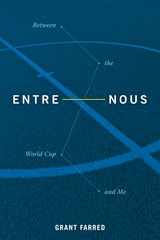
Entre Nous
Between the World Cup and MeGrant Farred
Duke University Press, 2019