Results by title
476 books match the query 'Criticism' and 17 start with e
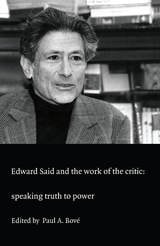
Edward Said and the Work of the Critic
Speaking Truth to PowerPaul A. Bové, ed.
Duke University Press, 2000
In two separate interviews, Said himself comments on a variety of topics, among them the response of the American Jewish community to his political efforts in the Middle East. Yet even as the Palestinian struggle finds a central place in his work, it is essential—as the contributors demonstrate—to see that this struggle rests on and gives power to his general "critique of colonizers" and is not simply the outgrowth of a local nationalism. Perhaps more than any other person in the United States, Said has changed how the U.S. media and American intellectuals must think about and represent Palestinians, Islam, and the Middle East. Most importantly, this change arises not as a result of political action but out of a potent humanism—a breadth of knowledge and insight that has nourished many fields of inquiry. Originally a special issue of boundary 2, the book includes new articles on minority culture and on orientalism in music, as well as an interview with Said by Jacqueline Rose.
Supporting the claim that the last third of the twentieth century can be called the "Age of Said," this collection will enlighten and engage students in virtually any field of humanistic study.
Contributors. Jonathan Arac, Paul A. Bové, Terry Cochran, Barbara Harlow, Kojin Karatani, Rashid I. Khalidi, Sabu Kohsu, Ralph Locke, Mustapha Marrouchi, Jim Merod, W. J. T. Mitchell, Aamir R. Mufti, Jacqueline Rose, Edward W. Said, Gayatri Chakravorty Spivak, Lindsay Waters
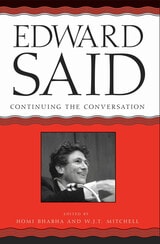
Edward Said
Continuing the ConversationEdited by Homi K. Bhabha and W. J. T. Mitchell
University of Chicago Press, 2005
The essays, imagining and recalling the cadences of Said's conversation, take various forms, including elaborations on his ideas, applications of his thought to new problems, and recollections of the indescribable electricity that made conversation with him intense and memorable. This lively, personal tone is a direct result of editors Homi Bhabha and W. J. T. Mitchell urging contributors to write in the spirit of a conversation interrupted, a call on hold, a letter waiting for a reply, a question hanging in the air. This is a work of immense imaginative and intellectual force and compelling candor, honoring Said's legacy as an activist intellectual.
This collection includes essays by Lila Abu-Lughod, Daniel Barenboim, Akeel Bilgrami, Paul Bové, Timothy Brennan, Noam Chomsky, Ranajit Guha, Harry Harootunian, Saree Makdisi, Aamir Mufti, Roger Owen, Gyan Prakash, Dan Rabinowitz, Jacqueline Rose, and Gayatri Spivak.
Elemental Ecocriticism
Thinking with Earth, Air, Water, and FireJeffrey Jerome Cohen
University of Minnesota Press, 2015
For centuries it was believed that all matter was composed of four elements: earth, air, water, and fire in promiscuous combination, bound by love and pulled apart by strife. Elemental theory offered a mode of understanding materiality that did not center the cosmos around the human. Outgrown as a science, the elements are now what we build our houses against. Their renunciation has fostered only estrangement from the material world.
The essays collected in Elemental Ecocriticism show how elemental materiality precipitates new engagements with the ecological. Here the classical elements reveal the vitality of supposedly inert substances (mud, water, earth, air), chemical processes (fire), and natural phenomena, as well as the promise in the abandoned and the unreal (ether, phlogiston, spontaneous generation).
Decentering the human, this volume provides important correctives to the idea of the material world as mere resource. Three response essays meditate on the connections of this collaborative project to the framing of modern-day ecological concerns. A renewed intimacy with the elemental holds the potential of a more dynamic environmental ethics and the possibility of a reinvigorated materialism.
Empire Burlesque
The Fate of Critical Culture in Global AmericaDaniel T. O Hara
Duke University Press, 2003
Empire Burlesque presents several interrelated analyses through readings of a range of writers and cultural figures including Henry James, Freud, Said, De Man, Derrida, and Cordwainer Smith (an academic, spy, and classic 1950s and 1960s science fiction writer). It describes the debilitating effects of globalization on the university in general and the field of literary studies in particular, it critiques literary studies’ embrace of globalization theory in the name of a blind and vacant modernization, and it meditates on the ways critical reading and writing can facilitate an imaginative alternative to institutionalized practices of modernization. Drawing on Lacanian psychoanalytical theory, it diagnoses contemporary American Studies as typically driven by the mindless abjection and transference of professional identities.
A provocative commentary on contemporary cultural criticism, Empire Burlesque will inform debates on the American university across the humanities, particularly among those in literary criticism, cultural studies, and American studies.
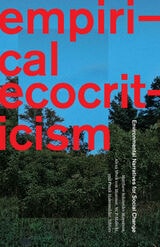
Empirical Ecocriticism
Environmental Narratives for Social ChangeMatthew Schneider-Mayerson
University of Minnesota Press, 2023
Finalist for the 2025 ASLE Ecocritical Book Award
A groundbreaking book that combines the environmental humanities and social sciences to study the impact of environmental stories
There is a growing consensus that environmental narratives can help catalyze the social change necessary to address today’s environmental crises; however, surprisingly little is known about their impact and effectiveness. In Empirical Ecocriticism, Matthew Schneider-Mayerson, Alexa Weik von Mossner, W. P. Malecki, and Frank Hakemulder combine an environmental humanities perspective with empirical methods derived from the social sciences to study the influence of environmental stories on our affects, attitudes, and actions.
Empirical Ecocriticism provides an approachable introduction to this growing field’s main methods and demonstrates their potential through case studies on topics ranging from the impact of climate fiction on readers’ willingness to engage in activism to the political empowerment that results from participating in environmental theater. Part manifesto, part toolkit, part proof of concept, and part dialogue, this introductory volume is divided into three sections: methods, case studies, and reflections. International in scope, it points toward a novel and fruitful synthesis of the environmental humanities and social sciences.
Contributors: Matthew Ballew, Yale U; Helena Bilandzic, U of Augsburg; Rebecca Dirksen, Indiana U; Greg Garrard, UBC Okanagan; Matthew H. Goldberg, Yale U; Abel Gustafson, U of Cincinnati; David I. Hanauer, Indiana U of Pennsylvania; Ursula K. Heise, UCLA; Jeremy Jimenez, SUNY Cortland; Anthony Leiserowitz, Yale U; David M. Markowitz, U of Oregon; Marcus Mayorga; Jessica Gall Myrick, Penn State U; Mary Beth Oliver, Penn State U; Yan Pang, Point Park U; Mark Pedelty, U of Minnesota; Seth A. Rosenthal, Yale U; Elja Roy, U of Memphis; Nicolai Skiveren, Aarhus U; Paul Slovic, U of Oregon; Scott Slovic, U of Idaho; Nicolette Sopcak, U of Alberta; Paul Sopcak, MacEwan U; Sara Warner, Cornell U.

Encounters with Kenneth Burke
William H. Rueckert
University of Illinois Press, 1994
1963 study, Kenneth Burke and the Drama of Human Relations, is often
credited with bringing the field of Burke studies into existence. Here, Rueckert
has gathered his "encounters" with Burke over the past thirty years--brieft
talks, position papers, rethinking and reformation of earlier ideas, and detailed
analyses of individual texts--into one volume that offers readers the best of
Burkean criticism.
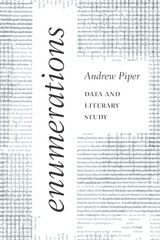
Enumerations
Data and Literary StudyAndrew Piper
University of Chicago Press, 2018
In Enumerations, Andrew Piper answers that question across a variety of domains fundamental to the study of literature. He focuses on the elementary particles of literature, from the role of punctuation in poetry, the matter of plot in novels, the study of topoi, and the behavior of characters, to the nature of fictional language and the shape of a poet’s career. How does quantity affect our understanding of these categories? What happens when we look at 3,388,230 punctuation marks, 1.4 billion words, or 650,000 fictional characters? Does this change how we think about poetry, the novel, fictionality, character, the commonplace, or the writer’s career? In the course of answering such questions, Piper introduces readers to the analytical building blocks of computational text analysis and brings them to bear on fundamental concerns of literary scholarship. This book will be essential reading for anyone interested in Digital Humanities and the future of literary study.
Epistolary Responses
The Letter in Twentieth-Century American Fiction and CriticismAnne Bower
University of Alabama Press, 1996
Epistolary Responses explores the transformative nature of epistolary fiction and criticism in letter form from a largely feminist perspective. While most scholarly work to date has focused on 17th- and 18th-century manifestations of this genre, Bower's study concentrates on epistolary fiction by contemporary American writers published between 1912 and 1988. The novels discussed, all featuring women letter writers, include: Lee Smith's Fair and Tender Ladies, John Barth's LETTERS, Alice Walker's The Color Purple, John Updike's S., Jean Webster's Daddy-Long-Legs, Upton Sinclair's Another Pamela, and Ana Castillo's The Mixquiahuala Letters.
Bower explores the influence letters have on the act of writing and writing as act, their encoded desire for reply, their incompleteness as units of narrative information, their play on ideas of absence and presence, their apparently personal and private nature, and their foregrounding of the writer's agency and authority, all of which make letters a most useful genre both for novelists and for scholars. Several of the book's "fiction" chapters include a letter from the author of the text (sometimes a critic) that complements and supplements Bower's analysis. The final part of the book explores how seven scholars--men and women--have applied letters to their own critical writing, finding that this formal move allows them to question issues of public and private discourse, the authority of signature, and the "feminine" location.
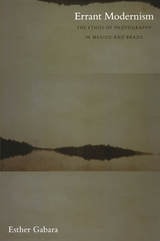
Errant Modernism
The Ethos of Photography in Mexico and BrazilEsther Gabara
Duke University Press, 2008
Gabara argues that Brazilian and Mexican modernists deliberately made photography err: they made this privileged medium of modern representation simultaneously wander and work against its apparent perfection. They flouted the conventions of mainstream modernism so that their aesthetics registered an ethical dimension. Their photographic modernism strayed, dragging along the baggage of modernity lived in a postcolonial site. Through their “errant modernism,” avant-garde writers and photographers critiqued the colonial history of Latin America and its twentieth-century formations.

Essays in Ancient Philosophy
Michael Frede
University of Minnesota Press, 1987
Essays in Ancient Philosophy was first published in 1987. Minnesota Archive Editions uses digital technology to make long-unavailable books once again accessible, and are published unaltered from the original University of Minnesota Press editions.
To understand ancient philosophy "in its concrete, complex detail," Michael Frede says, "one has also to look at all the other histories to which it is tied by an intricate web of casual connections which run both ways." Frede's distinctive approach to the history of ancient philosophy is closely tied to his specific interests within the field - the Hellenistic philosophers and those of late antiquity, who are the primary subjects of this book. Long ignored or even maligned, the Stoics and Skeptics, medical philosophers, and grammarians are extremely interesting once their actual views are reconstructed and it is possible to recognize their ties to earlier and later philosophical thought. Refusing to study them as paradigms of achievement, or to seek purely philosophical explanations for their views, Frede draws instead upon those "other histories"—of religion, social structure, law and politics—to illuminate their work and to show how it was interpreted and transformed by succeeding generations.
Everything You Always Wanted to Know about Literature but Were Afraid to Ask Žižek
SIC 10Russell Sbriglia, editor
Duke University Press, 2017
Exiles in the City
Hannah Arendt and Edward W. Said in CounterpointWilliam V. Spanos
The Ohio State University Press, 2012
Expanding Fields of Architectural Discourse and Practice
Curated Works from the P.E.A.R. JournalEdited by Matthew Butcher and Megan O'Shea
University College London, 2020
The book features contributions by architectural practitioners, design researchers, artists, architectural theorists, historians, journalists, curators, and even a paleobiologist, all of whom contributed to the journal. Here, they provide a unique presentation of architectural discourse and practice that seeks to test new ground while forming distinct relationships to recent, and more longstanding, historical legacies.
Experience and Value
Essays on John Dewey & Pragmatic NaturalismS. Morris Eames. Edited by Elizabeth R. Eames and Richard W. Field
Southern Illinois University Press, 2002
Experience and Value: Essays on John Dewey and Pragmatic Naturalism brings together twelve philosophical essays spanning the career of noted Dewey scholar, S. Morris Eames. The volume includes both critiques and interpretations of important issues in John Dewey’s value theory as well as the application of Eames’s pragmatic naturalism in addressing contemporary problems in social theory, education, and religion.
The collection begins with a discussion of the underlying principles of Dewey’s pragmatic naturalism, including the concepts of nature, experience, and philosophic method. Essays “Experience and Philosophical Method in John Dewey” and “Primary Experience in the Philosophy of John Dewey” develop what Eames believed to be a central theme in Dewey’s thought and provide a theoretical framework for subsequent discussion.
The volume continues with specific applications of this framework in the areas of value theory, moral theory, social philosophy, and the philosophy of religion. Eames’s analysis of value exposes the connection between the immediately felt values of experience and the more sophisticated judgments of value that are the product of reflection. From this basis in moral theory, Eames considers the derivation of judgments of obligation from judgments of fact. This discussion provides a grounding for a consideration of contemporary social issues directed by naturalistic and scientific principles.
In the third section, with regard to educational theory, Eames considers possible resolutions of the current dichotomy between the factual worldview of science and the humanistic worldview of the liberal arts. The comprehensive article, “Dewey’s Views of Truth, Beauty, and Goodness,” connects the essays of the first and second sections and explores the placement of Dewey’s value theory with respect to morals and aesthetics. With “Creativity and Democracy,” in the fourth section, Eames also considers the concept of democracy from the standpoint of current and historical issues faced by society. This article hints at a major project of Eames’s intellectual life—the theory of democracy.
The volume concludes with a discussion of the difficulty of maintaining the values of religious experience in a scientifically and technologically sophisticated world, the very topic that first brought Eames to philosophy—the meaning of religion and the religious life. Suggested solutions are offered in “The Lost Individual and Religious Unity.”
Experience and Value: Essays on John Dewey and Pragmatic Naturalism illuminates Eames’ life of inquiry, a life that included moral, social, aesthetic, and religious dimensions of value—all suffused with the influence of John Dewey.

Experiments in the Dark
Visualizing Capital Art Studio, ZanzibarPamila Gupta
University of Michigan Press, 2027
What kind of history are photographs? Experiments in the Dark explores this question through the lens of a twentieth-century East African Indian Ocean photo studio collection, Capital Arts Studio (CAS), and its proprietors Ranchhod and Rohit Oza in Stone Town, Zanzibar. Pamila Gupta gathers and reads a range of photographs and genres from the studio, exploring how they relate to Zanzibar’s vibrant visual cultures during the Omani sultanate, British colonial, and postrevolution periods. Gupta’s reading of this little-known photographic archive brings the work into a broader historical context of the Indian Ocean in a visual archive that has endured despite the forces of history.
Through a blend of archival reconstruction and curation, personal reflection, and interviews with Rohit Oza, the son of the studio’s founder Ranchhod Oza, Gupta focuses on the construction and curation of the CAS collection and what this archive can tell us about the South Asian and Goan diasporas, the wider Indian Ocean world, African fashion, urban lives, and image making in Zanzibar from 1930 to 2024.
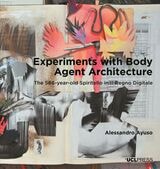
Experiments with Body Agent Architecture
The 586-year-old Spiritello in Il Regno DigitaleAlessandro Ayuso
University College London, 2022
Experiments with Body Agent Architecture proposes the notion of body agents: non-ideal, animate, and highly specific figures integrated with design to enact particular notions of embodied subjectivity in architecture. Body agents present opportunities for architects to increase imaginative and empathic qualities in their designs.
Beginning with narrative writing from the viewpoint of a body agent who finds himself uncomfortably inhabiting a digital milieu, the book combines speculative historical fiction and original design experiments. It focuses on the process of creating multimedia design experiments, moving from the design of the body itself as an original prosthetic to architectural proposals emanating from the body.
A fragmented history of the figure in architecture is charted and woven into the designs, with chapters examining Michelangelo’s enigmatic figures in his drawings for the New Sacristy in the early sixteenth century, Gian Lorenzo Bernini’s physically ephemeral putti adorning chapels and churches in the seventeenth century, and Austrian artist-architect Walter Pichler’s personal and prescient figures of the twentieth century.
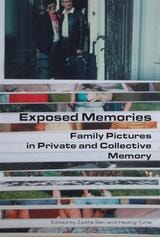
Exposed Memories
Family Pictures in Private and Collective MemoryHedvig Turai
Central European University Press, 2010