281 books match the query 'Criticism, interpretation, etc' and 11 start with e
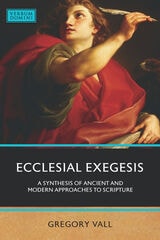
cover of Ecclesial Exegesis: A Synthesis of Ancient and Modern Approaches to Scripture

Ecclesial Exegesis

A Synthesis of Ancient and Modern Approaches to Scripture

Gregory Vall

Catholic University of America Press, 2022
There is broad support today for the idea that biblical scholarship ought to be informed by the faith of the Church and serve the life of the Church. In a word, it should be ecclesial. There is far less agreement, however, when one asks how this goal is to be achieved and what ecclesial exegesis ought to look like. In 1988, Joseph Ratzinger put forth his “Method C” proposal, calling for the development of a new exegetical and hermeneutical synthesis. This would be neither a retreat to the patristic-medieval approach (Method A) nor the continued hegemony of the historical-critical approach (Method B). The latter must be purified of its positivism through a transformational encounter with the former, so that the gifts of both might be released for the life of the Church. Such a synthesis, Ratzinger claimed, would require the philosophical, theological, exegetical, and hermeneutical work of “at least a whole generation” of scholars. Gregory Vall has devoted over thirty years to the development of ecclesial exegesis, and the present volume represents the mature fruit of his labor. Over against those who treat Dei Verbum as Vatican II’s endorsement of the historical-critical method, he demonstrates that the dogmatic constitution actually points to something very much like Ratzinger’s Method C. Employing a dialogic movement between the inductive-exegetical and the deductive-dogmatic, Vall offers nine studies that bring to the surface issues such as the relationship between Old Testament and New Testament, literal sense and spiritual sense, and Scripture and Tradition. While Vall brings theological knowledge and hermeneutical skill to the quest for Method C, he also provides a great deal of valuable exegesis of both testaments. Ecclesial Exegesis is not simply another book of theory. It demonstrates how Method C can be done.
[more]
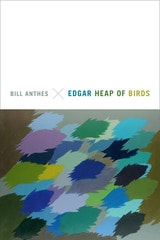
cover of Edgar Heap of Birds

Edgar Heap of Birds

Bill Anthes

Duke University Press, 2015
For over three decades, contemporary Native American artist Hock E Aye Vi Edgar Heap of Birds has pursued a disciplined practice in multiple media, having shown his paintings, drawings, prints, and text-based conceptual art throughout numerous national and international galleries and public spaces. In the first book-length study of this important artist, Bill Anthes analyzes Heap of Birds's art and politics in relation to the international contemporary art scene, Native American history, and settler colonialism. Foregrounding how Heap of Birds roots his practice in Cheyenne spirituality and an indigenous way of seeing and being in the world, Anthes describes how Heap of Birds likens his art to "sharp rocks"—weapons delivering trenchant critiques of the loss of land, life, and autonomy endured by Native Americans. Whether appearing as interventions in public spaces or in a gallery, Heap of Birds's carefully honed artworks pose questions about time, modernity, identity, power, and the meaning and value of contemporary art in a global culture. 
 
[more]
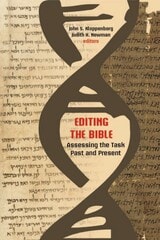
cover of Editing the Bible: Assessing the Task Past and Present

Editing the Bible

Assessing the Task Past and Present

John S. Kloppenborg

SBL Press, 2012

The Bible is likely the most-edited book in history, yet the task of editing the Hebrew, Aramaic, and Greek texts of the Bible is fraught with difficulties. The dearth of Hebrew manuscripts of the Jewish Scriptures and the substantial differences among those witnesses creates difficulties in determining which text ought to be printed as the text of the Jewish Scriptures. For the New Testament, it is not the dearth of manuscripts but the overwhelming number of manuscripts—almost six thousand Greek manuscripts and many more in other languages—that presents challenges for sorting and analyzing such a large, multivariant data set. This volume, representing experts in the editing of the Hebrew Bible and the New Testament, discusses both current achievements and future challenges in creating modern editions of the biblical texts in their original languages. The contributors are Kristin De Troyer, Michael W. Holmes, John S. Kloppenborg, Sarianna Metso, Judith H. Newman, Holger Strutwolf, Eibert Tigchelaar, David Trobisch, Eugene Ulrich, John Van Seters, Klaus Wachtel, and Ryan Wettlaufer.
[more]
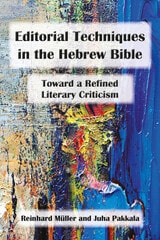
cover of Editorial Techniques in the Hebrew Bible: Toward a Refined Literary Criticism

Editorial Techniques in the Hebrew Bible

Toward a Refined Literary Criticism

Reinhard Müller

SBL Press, 2022

Editorial Techniques in the Hebrew Bible: Toward a Refined Literary Criticism presents and applies a model for understanding and reconstructing the diachronic development of the Hebrew Bible through historical criticism (or the historical-critical method). Reinhard Müller and Juha Pakkala refine the methodologies of literary and redaction criticism through a systematic investigation of the evidence of additions, omissions, replacements, and transpositions that are documented by divergent ancient textual traditions. At stake is not only historical criticism but also the Hebrew Bible as a historical source, for historical criticism has been and continues to be the only method to unwind those scribal changes that left no traces in textual variants.
[more]
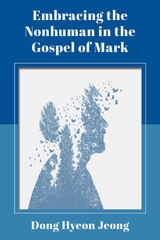
cover of Embracing the Nonhuman in the Gospel of Mark

Embracing the Nonhuman in the Gospel of Mark

Dong Hyeon Jeong

SBL Press, 2023
In Embracing the Nonhuman in the Gospel of Mark, Dong Hyeon Jeong approaches the Gospel of Mark through the lens of nonhuman studies with an eye toward ecological consciousness. Drawing on the fields of nonhuman studies and postcolonial ecocriticism, Jeong disrupts nthropocentric readings of Mark by engaging animality, vegetality, and animacy theories in light of (colonized) ethnicity. His intersectional reading of Mark highlights the importance of engaging nonhuman biblical interpretation while being sensitive to the issue of racism arising from animalizing the other. By doing so, this book reimagines the Markan Jesus as the colonized messiah who embraces the nonhuman. Jeong encourages readers to consider the interconnectedness of humans, animals, and the environment, while also addressing issues of power, oppression, and marginalization.
[more]
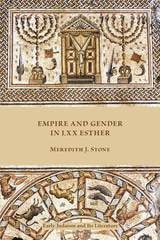
cover of Empire and Gender in LXX Esther

Empire and Gender in LXX Esther

Meredith J. Stone

SBL Press, 2018

A new perspective on essential aspects of Esther’s plot and characters for students and scholars

Empire and Gender in LXX Esther foregrounds and highlights empire as the central lens in this provocative new reading of Esther. This book provides a unique synchronic reading of LXX Esther with the Additions, allowing the presence and negotiation of imperial power to be further illuminated throughout the story’s plot. Stone explores and demonstrates how performances of gender are inextricably intertwined with the exertion and negotiation of imperial power portrayed in LXX Esther and offers examples of connections to the range of imperial power experienced by Jewish people during the late Second Temple period.

Features:

  • An exploration of the tenets and methodology of imperial-critical approaches
  • Focused attention to the final form of LXX Esther
  • Construction of early audiences for LXX Esther in first-century BCE Ptolemaic Alexandria and Hasmonean Judea
[more]
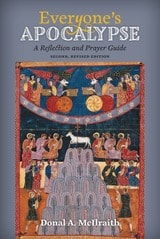
cover of Everyone's Apocalypse: A Reflection Guide, 2nd Edition

Everyone's Apocalypse

A Reflection Guide, 2nd Edition

Donal A. McIlraith

Saint Paul Seminary Press, 2024
Everyone’s Apocalypse attempts to respond to the request of Dei Verbum 22 that “Easy access to Sacred Scripture should be provided for all the faithful.” In this easy-to-read introduction for beginners, modern scholarship and the Church’s tradition meet to help readers understand and pray through this demanding part of God’s Word. Following Ugo Vanni’s proved structure, the two parts of the Apocalypse (chapters 1–3 and 4–22) are presented in seven chapters. The opening two chapters show John’s vision of the Risen Jesus as Son of Man and his words to the seven churches of Asia Minor. Chapter three presents the vital section, full of worship, of the throne vision of God as creator and of Jesus, slaughtered and risen, as redeemer. The opening of the seven seals by the Lamb, the four horsemen, the Risen Jesus, the destruction wrought by the seven trumpets, the three signs of the Woman, the Dragon, and the seven angels with the seven bowls of wrath are dealt with in the next three chapters. The final chapter outlines the climax of the book. Harlot Babylon, the evil city, is judged and falls and, following the intervention of the bridegroom Lamb and the removal of God’s enemies, the marriage of the Lamb reaches its fulfillment when the prepared wife becomes the possessed bride. In the imagery of this text, the kingdom has come. Uniquely, this book reads the entire Apocalypse in a nuptial manner. This is a love story. Jesus, the lover, following the pattern of Jewish marriage in the first century, helps his espoused wife, the seven churches, to persevere in their nuptial response of love to him, their first love. After coming through the tribulation, they finally become his beloved, possessed Bride, filled with glory. This eschatological union of love is humankind’s destiny.
[more]
cover of Exegetical Epistles

Exegetical Epistles

Thomas P. Jerome

Catholic University of America Press, 2023
The Nicene and Post-Nicene Fathers series of the 19th century rendered into English many of Jerome’s treatises and letters while bypassing his biblical commentaries as well as some of his most important exegetical letters. This omission, which was not helpful to scholarship, was probably due to the great length of these works. Although the problem was partly remedied by some new English translations of the 20th century, the present volume fills a significant lacuna by translating into English the Scriptural exegesis that Jerome conveyed in his relatively unknown epistles, many of which were composed in response to queries he had received from various correspondents. Many of these letters are presented here for the first time in English. Based on the Hilberg edition, this volume contains new translations, introduced and annotated, of Jerome’s Epistles 18-21, 25-30, 34-37, 42, 53, 55-56, 59, 64-65, 72-74, 78, 85, 106, 112, 119-121, 129, 130, and 140. Two newly translated letters from the famous exchange with Augustine over the meaning of Galatians 2:11-14 are included (Epp. 56 and 112), as well as a new rendering of Ep. 130 to Demetrias (which technically is not an “exegetical” letter but does present important information about the Pelagian controversy). Overall, this collection hopes to serve as a useful introduction to Jerome’s approach to biblical interpretation, of both the Old and the New Testament. Some letters focus on the historical meaning of Pauline and Gospel texts, while others contain allegorical expositions of Old Testament passages. Jerome’s competence as a Hebrew scholar will become evident to the reader of this volume as well as his thorough acquaintance with the antecedent Greek and Latin Christian exegetical traditions.
[more]
cover of Experientia, Volume 2: Linking Text and Experience

Experientia, Volume 2

Linking Text and Experience

Colleen Shantz

SBL Press, 2012

This collection of essays continues the investigation of religious experience in early Judaism and early Christianity begun in Experientia, Volume 1, by addressing one of the traditional objections to the study of experience in antiquity. The authors address the relationship between the surviving evidence, which is textual, and the religious experiences that precede or ensue from those texts. Drawing on insights from anthropology, sociology, social memory theory, neuroscience, and cognitive science, they explore a range of religious phenomena including worship, the act of public reading, ritual, ecstasy, mystical ascent, and the transformation of gender and of emotions. Through careful and theoretically informed work, the authors demonstrate the possibility of moving from written documents to assess the lived experiences that are linked to them. The contributors are István Czachesz, Frances Flannery, Robin Griffith-Jones, Angela Kim Harkins, Bert Jan Lietaert Peerbolte, John R. Levison, Carol A. Newsom, Rollin A. Ramsaran, Colleen Shantz, Leif E. Vaage, and Rodney A. Werline.
[more]
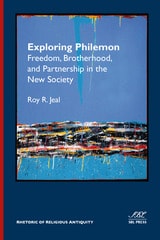
cover of Exploring Philemon: Freedom, Brotherhood, and Partnership in the New Society

Exploring Philemon

Freedom, Brotherhood, and Partnership in the New Society

Roy R. Jeal

SBL Press, 2015

A new, sociorhetorical interpretation of the Letter to Philemon

Exploring Philemon shows how this letter entered the world of the ancient Mediterranean and the early church with a dramatic and powerful rhetorical force by analyzing the range of textures interwoven with each other to produce a profound effect on an early Christian (Philemon) and on the church that met in his home. It demonstrates that many striking and subtle features work together to present a rhetorical argument that the new Christian society must be one of freedom, brotherhood, and partnership not just for the powerful, but for all.

Features:

  • An analysis of the visual imagery of the letter
  • Application of up-to-date rhetorical, sensory-aesthetic, and intertextual interpretive methods
  • Use of Social and cultural, ideological, and theological strategies
[more]
cover of Exploring Sublime Rhetoric in Biblical Literature

Exploring Sublime Rhetoric in Biblical Literature

Roy R. Jeal

SBL Press, 2024

In scholarly study of the New Testament and early Christian rhetoric, one key element is often overlooked: the sublime. To address this omission, contributors to this volume explore how the awe-inspiring, dislocating, and sometimes horrifying language that characterizes sublime rhetoric exerts cognitive, emotional, and physiological force on its audiences, transporting them to new realities as they go along. The essays lay a foundation for scholars and students to identify and interpret sublime rhetoric in biblical literature. Contributors include Murray J. Evans, Alan P. R. Gregory, Christopher T. Holmes, Roy R. Jeal, Harry O. Maier, Erika Mae Olbricht, Thomas H. Olbricht†, Vernon K. Robbins, and Jonathan Thiessen.
[more]