Results by title
289 books match the query 'Dance' and 6 start with e
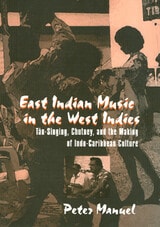
East Indian Music
Peter Manuel
Temple University Press, 2000
In recent decades, however, tan-singing has been declining, regarded as quaint and crude by younger generations raised on MTV, Hindi film music, and disco. At the same time, Indo-Caribbeans have been participating in their countries' economic, political, and cultural lives to a far greater extent than previously. Accompanying this participation has been a lively cultural revival, encompassing both an enhanced assertion of Indianness and a spirit of innovative syncretism. One of the most well-known products of this process is chutney, a dynamic music and dance phenomenon that is simultaneously a folk revival and a pop hybrid. In Trinidad, it has also been the vehicle for a controversial form of female empowerment and an agent of a new, more inclusive, conception of national identity.
Thus, East Indian Music in the West Indies is a portrait of a diaspora community in motion. It documents the social and cultural development of a people "without history," a people who have sometimes been dismissed as foreigners who merely perpetuate the culture of the homeland rather than becoming "truly" Caribbean. Professor Manuel shows how inaccurate this characterization is. On the one hand, in the form of tan-singing, it examines the distinctiveness of traditional Indo-Caribbean musical culture. On the other, in the form of chutney, it examines the new assertiveness and syncretism of Indo-Caribbean popular music.
Students of Indo-Caribbean music and curious world-music fans alike will be fascinated by Professor Manuel's guided tour through the complex and exciting world of Indo-Caribbean musical culture.
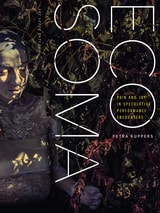
Eco Soma
Pain and Joy in Speculative Performance EncountersPetra Kuppers
University of Minnesota Press, 2022
Modeling a disability culture perspective on performance practice toward socially just futures
In Eco Soma, Petra Kuppers asks readers to be alert to their own embodied responses to art practice and to pay attention to themselves as active participants in a shared sociocultural world. Reading contemporary performance encounters and artful engagements, this book models a disability culture sensitivity to living in a shared world, oriented toward more socially just futures.
Eco soma methods mix and merge realities on the edges of lived experience and site-specific performance. Kuppers invites us to become moths, sprout gills, listen to our heart’s drum, and take starships into crip time. And fantasy is central to these engagements: feeling/sensing monsters, catastrophes, golden lines, heartbeats, injured sharks, dotted salamanders, kissing mammoths, and more. Kuppers illuminates ecopoetic disability culture perspectives, contending that disabled people and their co-conspirators make art to live in a changing world, in contact with feminist, queer, trans, racialized, and Indigenous art projects. By offering new ways to think, frame, and feel “environments,” Kuppers focuses on art-based methods of envisioning change and argues that disability can offer imaginative ways toward living well and with agency in change, unrest, and challenge.
Traditional somatics teach us how to fine-tune our introspective senses and to open up the world of our own bodies, while eco soma methods extend that attention toward the creative possibilities of the reach between self, others, and the land. Eco Soma proposes an art/life method of sensory tuning to the inside and the outside simultaneously, a method that allows for a wider opening toward ethical cohabitation with human and more-than-human others.
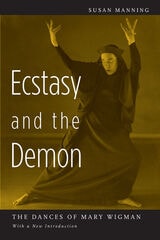
Ecstasy and the Demon
The Dances of Mary WigmanSusan Manning
University of Minnesota Press, 2006
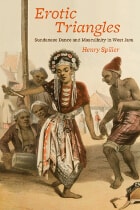
Erotic Triangles
Sundanese Dance and Masculinity in West JavaHenry Spiller
University of Chicago Press, 2010
In West Java, Indonesia, all it takes is a woman’s voice and a drum beat to make a man get up and dance. Every day, men there—be they students, pedicab drivers, civil servants, or businessmen—breach ordinary standards of decorum and succumb to the rhythm at village ceremonies, weddings, political rallies, and nightclubs. The music the men dance to varies from traditional gong ensembles to the contemporary pop known as dangdut, but they consistently dance with great enthusiasm. In Erotic Triangles, Henry Spiller draws on decades of ethnographic research to explore the reasons behind this phenomenon, arguing that Sundanese men use dance to explore and enact contradictions in their gender identities.
Framing the three crucial elements of Sundanese dance—the female entertainer, the drumming, and men’s sense of freedom—as a triangle, Spiller connects them to a range of other theoretical perspectives, drawing on thinkers from Eve Kosofsky Sedgwick, Lévi-Strauss, and Freud to Euclid. By granting men permission to literally perform their masculinity, Spiller ultimately concludes, dance provides a crucial space for both reinforcing and resisting orthodox gender ideologies.
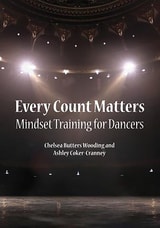
Every Count Matters
Mindset Training for DancersChelsea Butters Wooding
FiT Publishing, 2019
Regardless of physical talent, all dancers face struggles. The outcome depends largely on the dancer’s mindset. Authors Chelsea Butters Wooding and Ashley Coker-Cranney combine their similar backgrounds in dance with their expertise as mental performance consultants to cultivate an adaptive mindset and positive perspective to elevate a dancer’s performance as well as perspective.
Every Count Matters is unique in its appeal and relevance to every dancer, regardless of skill or style. The authors have designed strategies that can be applied at any level, in any setting. This unique approach balances theory and application, provides a foundational knowledge for mindset and mental skills training, as well as specific strategies and tips that can be immediately integrated into the dancer’s daily routine. Each lesson can be applied to new challenges as they arise, and work together to allow the dancer to overcome obstacles to reaching their full potential.
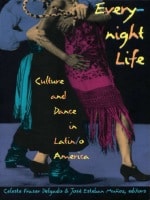
Everynight Life
Culture and Dance in Latin/o AmericaCeleste Fraser Delgado and José Esteban Muñoz, eds.
Duke University Press, 1997
This anthology looks at many modes of dance—including salsa, merengue, cumbia, rumba, mambo, tango, samba, and norteño—as models for the interplay of cultural memory and regional conflict. Barbara Browning’s essay on capoeira, for instance, demonstrates how dance has been used as a literal form of resistance, while José Piedra explores the meanings conveyed by women of color dancing the rumba. Pieces such as Gustavo Perez Fírmat’s "I Came, I Saw, I Conga’d" and Jorge Salessi’s "Medics, Crooks, and Tango Queens" illustrate the lively scope of this volume’s subject matter.
Contributors. Barbara Browning, Celeste Fraser Delgado, Jane C. Desmond, Mayra Santos Febres, Juan Carlos Quintero Herencia, Josh Kun, Ana M. López, José Esteban Muñoz, José Piedra, Gustavo Perez Fírmat, Augusto C. Puleo, David Román, Jorge Salessi, Alberto Sandoval