Results by title
105 books match the query 'Deconstruction' and 3 start with e

Emerging Trends in Continental Philosophy
Edited by Todd May
University of Chicago Press, 2010
From Kant to Kierkegaard, from Hegel to Heidegger, continental philosophers have indelibly shaped the trajectory of Western thought since the eighteenth century. Although much has been written about these monumental thinkers, students and scholars lack a definitive guide to the entire scope of the continental tradition. The most comprehensive reference work to date, this eight-volume History of Continental Philosophy will both encapsulate the subject and reorient our understanding of it. Beginning with an overview of Kant’s philosophy and its initial reception, the History traces the evolution of continental philosophy through major figures as well as movements such as existentialism, phenomenology, hermeneutics, and poststructuralism. The final volume outlines the current state of the field, bringing the work of both historical and modern thinkers to bear on such contemporary topics as feminism, globalization, and the environment. Throughout, the volumes examine important philosophical figures and developments in their historical, political, and cultural contexts.
The first reference of its kind, A History of Continental Philosophy has been written and edited by internationally recognized experts with a commitment to explaining complex thinkers, texts, and movements in rigorous yet jargon-free essays suitable for both undergraduates and seasoned specialists. These volumes also elucidate ongoing debates about the nature of continental and analytic philosophy, surveying the distinctive, sometimes overlapping characteristics and approaches of each tradition. Featuring helpful overviews of major topics and plotting road maps to their underlying contexts, A History of Continental Philosophy is destined to be the resource of first and last resort for students and scholars alike.
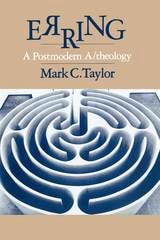
Erring
A Postmodern A/theologyMark C. Taylor
University of Chicago Press, 1984
"Many have felt the need for a study which would explicate in coherent and accessible fashion the principal tenets of deconstruction, with particular attention to their theological implications. This need the author has addressed in a most impressive manner. The book's effect upon contemporary discussion is apt to be, and deserves to be, far-reaching."—Walter Lowe, Journal of Religion
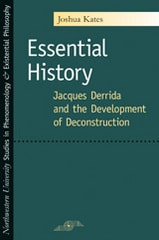
Essential History
Jacques Derrida and the Development of DeconstructionJoshua Kates
Northwestern University Press, 2005
A fundamental reinterpretation of Derrida's project and the works for which he is best known, Kates's study fashions a new manner of working with the French thinker that respects the radical singularity of his thought as well as the often different aims of those he reads. Such a view is in fact "essential" if Derrida studies are to remain a vital field of scholarly inquiry, and if the humanities, more generally, are to have access to a replenishing source of living theoretical concerns.