429 books match the query 'Development' and 25 start with e
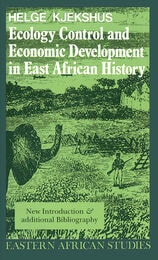
cover of Ecology Control and Economic Development in East African History: The Case of Tanganyika, 1850–1950

Ecology Control and Economic Development in East African History

The Case of Tanganyika, 1850–1950

Helge Kjekshus

Ohio University Press, 1995

This pioneering book was one of the first to place the history of East Africa within the context of the environment. It has been used continuously for student teaching. It is now reissued with an introduction placing it within the debate that has developed on the subject; there is also an updated bibliography.

The book puts people at the centre of events. It thus serves as a modification to nationalist history with its emphasis on leaders. It presents environmental factors that had been underestimated; for instance, it points to the critical importance of the rinderpest outbreak.

Helge Kjekshus provides evidence to suggest that the nineteenth century was a period of relative prosperity with well-developed trade. He questions the view that warfare was pervasive and that the slave trade led to depopulation. He points to a balance between man and the environment.

This book is reissued at the same time as the first publication of Custodians of the Land: Ecology and Culture in the History of Tanzania edited by Gregory Maddox, James I. Giblin and Isaria N. Kimambo. The footnotes in that book point to the importance of the work of Helge Kjekshus.
[more]
cover of Economic Analysis and Infrastructure Investment

Economic Analysis and Infrastructure Investment

Edited by Edward L. Glaeser and James M. Poterba

University of Chicago Press, 2021

Policy makers often call for increased spending on infrastructure, which can encompass a broad range of investments, from roads and bridges to digital networks that will expand access to high-speed broadband. Some point to the near-term macroeconomic benefits, such as job creation, associated with infrastructure spending; others point to the long-term effects of such spending on productivity and economic growth. 

Economic Analysis and Infrastructure Investment explores the links between infrastructure investment and economic outcomes, analyzing key economic issues in the funding and management of infrastructure projects. It includes new research on the short-run stimulus effects of infrastructure spending, develops new estimates of the stock of US infrastructure capital, and explores incentive aspects of public-private partnerships with particular attention to their allocation of risk. The volume provides a reference for researchers seeking to study infrastructure issues and for policymakers tasked with determining the appropriate level and allocation of infrastructure spending.
[more]
cover of Economic Development: The History of an Idea

Economic Development

The History of an Idea

H. W. Arndt

University of Chicago Press, 1989

"Economic Development makes an important contribution of the literature on economic development, especially as it incorporates ideas on a theme that informs our concern for social justice, individual and social freedom, identify, and community."—Winston E. Langley, Annals of the American Academy of Political and Social Science
[more]
cover of Economic Organizations and Social Systems

Economic Organizations and Social Systems

Robert A. Solo

University of Michigan Press, 2000
Robert A. Solo’s landmark work, Economic Organizations and Social Systems, presents a sweeping re-examination of the foundations of economic theory and the paradigms that shape the teaching and practice of economics. Written originally outside the confines of the neoclassical tradition, Solo’s analysis seeks to break from convention and provide readers with a new paradigm—one that places the cognitive, cultural, historical, psychological, and political dimensions at the heart of economic understanding.This expanded edition, featuring a new preface, calls for a transformation in economics: a shift away from narrow models toward a holistic social science capable of addressing the complexities of modern economies. Solo offers a comparative analysis of three distinctive forms of economic organization: decentralized market-driven systems, organizational market-negotiated systems (such as large corporations and unions), and centralized politically-directed systems (drawing especially on the former Soviet Union). Each is assessed for efficiency, incentive structures, justice in income distribution, the quality of the social environment, and—critically—their capacity for technological development.The book goes beyond technical analysis, exploring how national economies are built from multiple, interdependent components: the enterprise, political, household, and institutional sectors. The third part delves deeply into the roles of culture, ideology, and cognition in shaping economic change, using the Russian Revolution and the developmental challenges of the Third World as major case studies.Incisively argued and widely praised on publication, Solo’s work stands as both a critique of prevailing economic orthodoxy and a blueprint for integrating economics within the broader social realities of our time—a vital resource for economists, social scientists, and all seeking to understand or reform economic thought and practice.
[more]
cover of Economic Policy Making in Mexico: Factors Underlying the 1982 Crisis

Economic Policy Making in Mexico

Factors Underlying the 1982 Crisis

Robert Looney

Duke University Press, 1985
This volume argues that the Mexican crisis of August 1982, in which the country was left facing the prospect of national default and zero economic growth, was not only the result of some fundamental flaws in the country's economy, but is more accurately characterized as a cash flow problem—in the author's words, "a case of illiquidity rather than insolvency." Based on a thorough analysis of the Mexican economy, the book assesses the effectiveness of the various economic programs of the de la Madrid presidency in dealing with the nation's problems.
[more]
cover of Economic Policy Reform: The Second Stage

Economic Policy Reform

The Second Stage

Edited by Anne O. Krueger

University of Chicago Press, 2000

In the 1980s, the formerly planned markets of the Soviet Union and Eastern Europe and the developing nations of Latin America and East Asia embarked upon unprecedented efforts to alter their economic regimes. These first-stage reforms involved a major reconceptualization of the principal elements of the economy, private property, and trade. But in the wake of these reforms, the need for second-stage reforms—the implementation of more structural changes—arose; without the development of new regulatory agencies, tax reform initiatives, adjustments to trade policies, and enhancements in education, labor, and telecommunications, the prospects for economic growth engendered during the first-stage reforms might not be realized.

Economic Policy Reform: The Second Stage provides an incisive overview of the context of these crucial second-stage reforms with a thorough examination of the issues confronting the policymakers involved. Edited by Anne O. Krueger, it features studies from distinguished experts in various fields of economics. Each chapter of this book addresses a key issue in economic policy, examines the progress of reforms in the markets considered, and then explores what research might further aid leaders as they embark on fundamental changes.

Both a handbook for economists and practitioners and a theoretical exploration of the most significant challenges currently facing the economic world, this new book will be indispensable to anyone involved in the global economic scene.

Contributors:
Vittorio Corbo
Cimon Cowan
Sebastian Edwards
Stephan Haggard
Michael Kremer
Steven Matusz
Frederic S. Mishkin
Jonathan Morduch
Roger G. Noll
Miguel A. Savastano
T. Paul Shultz
Mary M. Shirley
T.N. Srinivasan
Joseph E. Stiglitz
Vito Tanzi
David Tarr
Aaron Tornell
[more]
cover of Economic Policy Reforms and the Indian Economy

Economic Policy Reforms and the Indian Economy

Edited by Anne O. Krueger

University of Chicago Press, 2002

India is the second most populous country in the world and also one of the poorest. From the late 1940s to 1980, India's per capita income grew at an average annual rate of only two percent. Expansionist economic reforms during the 1980s boosted economic growth but also unfortunately resulted in high inflation and a balance of payments crisis. As a consequence, in 1991 the government announced sweeping new changes in economic policies.

Economic Policy Reforms and the Indian Economy evaluates the effects of those changes and identifies areas of the Indian economy still in urgent need of reform. After an overview of Indian economic policies and development since independence, papers focus on the country's fiscal situation, the environment for private economic activity, education, the reservation of certain activities for small-scale industry, and determinants of differentials in rates of growth across the different Indian states. Contributors include respected academic specialists on India and policy reform, high-level Indian administrators, and present and past policymakers.

[more]
cover of Economic Reform in China: Problems and Prospects

Economic Reform in China

Problems and Prospects

James A. Dorn and Wang Xi

University of Chicago Press, 1990

In this volume, distinguished Chinese and Western scholars provide a detailed examination of the problems associated with China's transition to a market-oriented system. A variety of reform proposals, aimed at resolving the contradictions inherent in piecemeal reform, are discussed along with the chances for future liberalization.

These clearly written and insightful essays address the roots of China's crisis. The authors focus on institutional changes necessary for a spontaneous market order and point to the close relation between economic reform and political-constitutional reform. Topics include the speed and degree of the transition, whether ownership reform must precede price reform, how inflation can be avoided, steps to depoliticize economic life, how to create an environment conducive to foreign trade and investment, and how to institute basic constitutional change and open China to the outside world.

The revolutionary changes now shaking the foundations of socialism and central planning in the Soviet Union and Eastern and Central Europe are sure to have an impact on China's future. Despite their seriousness, the events of Tiananmen Square may constitute only a temporary detour on the road toward a private market order. The essays in this volume help lay a rational framework for understanding China's present problems and for discussing the prospects for future reform.
[more]
cover of Economic Reforms in Chile: From Dictatorship to Democracy

Economic Reforms in Chile

From Dictatorship to Democracy

Ricardo Ffrench-Davis

University of Michigan Press, 2002

Articulate and provocative, Richardo Ffrench-Davis offers the most comprehensive and timely assessment available of Chilean economic reform, from the military dictatorship of Pinochet in the 1970s up to the "reforms of reforms" made by the democratic governments in the 1990s.
Written in accessible and readable prose, Economic Reforms in Chile begins with an overview of the Chilean economy during the last fifty years. This historical time frame is divided into three periods of economic reform. The first period covers the Pinochet regime, during which the more orthodox neoliberalism was implemented. The second period includes the Pinochet dictatorship, during which economic policy shifted toward pragmatism, particularly in the areas of trade and finance; it also includes the crisis of 1982 and its effects. The third period begins in 1990 with the return to democratic elections and the significant reforms to prior reforms. This section also examines the search for growth-with-equity, success in investment and growth performance, macroeconomic sustainability, and the reduction of poverty. Ffrench-Davis addresses several "paradoxes," or results that defy the expectations of policymakers, in order to analyze the significance of comprehensive macroeconomic equilibrium and its implications for sustainable stability, growth, and equity.
Economic Reforms in Chile will be of interest to economists, political scientists, and policymakers involved with the economies of emerging and developing countries.
Ricardo Ffrench-Davis is Principal Regional Advisor, ECLAC, Santiago, and Professor of Economics, University of Chile.

[more]
cover of Economic and Monetary Sovereignty in 21st Century Africa

Economic and Monetary Sovereignty in 21st Century Africa

Maha Ben Gadha

Pluto Press, 2021

Over forty years after the formal end of colonialism, suffocating ties to Western financial systems continue to prevent African countries from achieving any meaningful monetary sovereignty.

Economic and Monetary Sovereignty in 21st Century Africa traces the recent history of African monetary and financial dependencies, looking at the ways African nations are resisting colonial legacies. Using a comparative, multi-disciplinary approach, this book uncovers what went wrong after the Pan-African approaches that defined the early stages of independence, and how most African economies fell into the firm grip of the IMF, World Bank, and the EU’s strict neoliberal policies.

This collection is the first to offer a wide-ranging, comparative and historical look at how African societies have attempted to increase their policy influence and move beyond neoliberal orthodoxy and US-dollar dependency. Economic and Monetary Sovereignty in 21st Century Africa is essential reading for anyone interested in the African quest for self-determination in a turbulent world of recurring economic and financial crises.
[more]
cover of Economics and Politics of World Sugar Policies

Economics and Politics of World Sugar Policies

Stephen V. Marks and Keith E. Maskus, Editors

University of Michigan Press, 1993
Around the world, markets for producing and consuming sugar and related sweeteners are heavily distorted by trade barriers, output controls, price supports, and government subsidies. These policies have significant and identifiable impacts on the economic well-being of different groups in various countries. The net effect of these global distortions is to damage world welfare at the same time that the various national policies reduce economic well-being in the countries that impose them. Sugar policy is the perfect example of how the political imperatives of support for agricultural interests dominate considerations of national welfare or international relations. The contributors provide rigorous analyses of world sugar markets and the distortions caused by policies tn the major countries. They employ several numerical modeling techniques to describe and assess the impacts of world sugar programs. These calculations are buttressed by complementary discussions of the political and economic rationales underlying sugar protection and support. The contributions to The Economics and Politics of World Sugar Policies combine survey evidence with new modeling results from econometric approaches and applied equilibrium simulations to provide new assessments of the current state of world sugar markets. Several original results are presented that shed new light on the impacts of sugar protection. This book should be of considerable interest to agricultural economists, trade-policy analysts, and specialists in international relations and development economics. It is highly relevant for understanding both the economics of agricultural protection and the politics of farm support.
[more]
cover of Economics of Forestry and Rural Development: An Empirical Introduction from Asia

Economics of Forestry and Rural Development

An Empirical Introduction from Asia

William F. Hyde and Gregory S. Amacher, and Colleagues

University of Michigan Press, 2000
Economic development and forest use, with special emphasis on understanding the components of forest degradation and exploitation in developing countries, are the focus of this book. Contributors, mostly from South or Southeast Asia, examine deforestation and tenurial rights, linkages between migration, poverty, and resource exploitation, technology diffusion among poor-subsistence households, fuelwood and energy collection pressures on open-access resources, government and public investments, and household models of labor choice and its impact on resources. Emphasis is on empirical investigation of these problems, though some conceptual material related to resource exploitation, rent distributions, and household economics is presented. The book is the first to study household resource rent models within a developing-country forestry context. The empirical models are motivated by specifying and formally testing linkages between labor, time, and other input decisions. The book also is the first self-contained study using data from several countries to study a common set of problems such as forest use pressure, the relationship between forest exploitation, household allocation of time, and rents, the adoption of technologies to mitigate exploitation of forest resources, and the importance of population pressure and spatial aspects of deforestation. The book fills a niche by bringing rigorous economic theories and hypothesis testing to social aspects of resource use. It will be of interest to a range of professionals, from academic economists working in forestry and development to resource policy professionals at international development agencies, especially those struggling with developing incentives to reduce forest degradation.
[more]
cover of Economics of Research and Innovation in Agriculture

Economics of Research and Innovation in Agriculture

Edited by Petra Moser

University of Chicago Press, 2021

Feeding the world’s growing population is a critical policy challenge for the twenty-first century. With constraints on water, arable land, and other natural resources, agricultural innovation is a promising path to meeting the nutrient needs for future generations. At the same time, potential increases in the variability of the world’s climate may intensify the need for developing new crops that can tolerate extreme weather. Despite the key role for scientific breakthroughs, there is an active discussion on the returns to public and private spending in agricultural R&D, and many of the world’s wealthier countries have scaled back the share of GDP that they devote to agricultural R&D. Dwindling public support leaves universities, which historically have been a major source of agricultural innovation, increasingly dependent on industry funding, with uncertain effects on the nature and direction of agricultural research. All of these factors create an urgent need for systematic empirical evidence on the forces that drive research and innovation in agriculture. This book aims to provide such evidence through economic analyses of the sources of agricultural innovation, the challenges of measuring agricultural productivity, the role of universities and their interactions with industry, and emerging mechanisms that can fund agricultural R&D. 
[more]
cover of Education in the Development of Tanzania, 1919–1990

Education in the Development of Tanzania, 1919–1990

Lene Buchert

Ohio University Press, 1994

Deals with the realities of education in a debt-ridden African country trying to cope with the pressures of externally imposed educational budgets.

[more]
cover of Empire State-Building: War and Welfare in Kenya, 1925–1952

Empire State-Building

War and Welfare in Kenya, 1925–1952

Joanna Lewis

Ohio University Press, 2001

This history of administrative thought and practice in colonial Kenya looks at the ways in which white people tried to engineer social change.

It asks four questions:
- Why was Kenya’s welfare operation so idiosyncratic and spartan compared with that of other British colonies?
- Why did a transformation from social welfare to community development produce further neglect of the very poor?
- Why was there no equivalent to the French tradition of community medicine?
- If there was a transformatory element of colonial rule that sought to address poverty, where and why did it fall down?

The answers offer revealing insight into the dynamics of rule in the late colonial period in Kenya.
[more]
cover of Enabling Technologies for Sustainable Smart Cities: Design, development and management

Enabling Technologies for Sustainable Smart Cities

Design, development and management

Mohammad A. Matin

The Institution of Engineering and Technology, 2025

As populations rise and cities draw ever-larger populations, smart cities are emerging around the world to cater for the need for sustainable urban development. The exploration of recent advances in information and communication technology (ICT), sensing and energy engineering offers promising enablers for creating, implementing, and promoting sustainable development strategies to address the challenges of this expanding urbanization.
[more]
cover of Entrepreneurial Goals: Development and Africapitalism in Ghanaian Soccer Academies

Entrepreneurial Goals

Development and Africapitalism in Ghanaian Soccer Academies

Itamar Dubinsky

University of Wisconsin Press, 2022

The idea that the African private sector will generate economic prosperity and social wealth—an objective many governments and foreign charitable organizations have failed to achieve—continues to attract attention in business and policy circles. Yet little research has actually been conducted on Africapitalist endeavors. With the immense popularity of sports and the many aspirations they foster, the successes and shortcomings of soccer academies have kicked their way into the spotlight. Entrepreneurial Goals breaks away from studies that focus on the international relations consequences of soccer ventures, which are often rebuked as extended forms of European colonialism and exploitation of local talent, and instead centers Ghanaian establishments and the opportunities they create for local development within their surrounding communities.

Itamar Dubinsky’s extensive ethnographic research offers an innovative theoretical approach by assessing three institutions—Mandela Soccer Academy, Kumasi Sports Academy, and Unistar Soccer Academy—through an Africapitalist prism. He demonstrates that these business endeavors, when viewed from the perspective of local interests, realize many of the educational, financial, and community building ambitions of the region. This pioneering examination of locally owned academies in Ghana reflects Dubinsky’s aim of illuminating the entrepreneurs and programs whose success passes to participating youth and their families, while also exposing the contradictions of for-profit development initiatives that purport to reap collective social benefits.

[more]
cover of Environmentality: Technologies of Government and the Making of Subjects

Environmentality

Technologies of Government and the Making of Subjects

Arun Agrawal

Duke University Press, 2005

In Kumaon in northern India, villagers set hundreds of forest fires in the early 1920s, protesting the colonial British state’s regulations to protect the environment. Yet by the 1990s, they had begun to conserve their forests carefully. In his innovative historical and political study, Arun Agrawal analyzes this striking transformation. He describes and explains the emergence of environmental identities and changes in state-locality relations and shows how the two are related. In so doing, he demonstrates that scholarship on common property, political ecology, and feminist environmentalism can be combined—in an approach he calls environmentality—to better understand changes in conservation efforts. Such an understanding is relevant far beyond Kumaon: local populations in more than fifty countries are engaged in similar efforts to protect their environmental resources.

Agrawal brings environment and development studies, new institutional economics, and Foucauldian theories of power and subjectivity to bear on his ethnographical and historical research. He visited nearly forty villages in Kumaon, where he assessed the state of village forests, interviewed hundreds of Kumaonis, and examined local records. Drawing on his extensive fieldwork and archival research, he shows how decentralization strategies change relations between states and localities, community decision makers and common residents, and individuals and the environment. In exploring these changes and their significance, Agrawal establishes that theories of environmental politics are enriched by attention to the interconnections between power, knowledge, institutions, and subjectivities.

[more]
cover of Environments For Student Growth And Development: Library

Environments For Student Growth And Development

Library

Lisa Hinchliffe

Assoc of College & Research Libraries, 2012
[more]
cover of Essential History: Jacques Derrida and the Development of Deconstruction

Essential History

Jacques Derrida and the Development of Deconstruction

Joshua Kates

Northwestern University Press, 2005

However widely—and differently—Jacques Derrida may be viewed as a "foundational" French thinker, the most basic questions concerning his work still remain unanswered: Is Derrida a friend of reason, or philosophy, or rather the most radical of skeptics? Are language-related themes--writing, semiosis--his central concern, or does he really write about something else? And does his thought form a system of its own, or does it primarily consist of commentaries on individual texts? This book seeks to address these questions by returning to what it claims is essential history: the development of Derrida's core thought through his engagement with Husserlian phenomenology. Joshua Kates recasts what has come to be known as the Derrida/Husserl debate, by approaching Derrida's thought historically, through its development. Based on this developmental work, Essential History culminates by offering discrete interpretations of Derrida's two book-length 1967 texts, interpretations that elucidate the until now largely opaque relation of Derrida's interest in language to his focus on philosophical concerns.

A fundamental reinterpretation of Derrida's project and the works for which he is best known, Kates's study fashions a new manner of working with the French thinker that respects the radical singularity of his thought as well as the often different aims of those he reads. Such a view is in fact "essential" if Derrida studies are to remain a vital field of scholarly inquiry, and if the humanities, more generally, are to have access to a replenishing source of living theoretical concerns.

[more]
cover of Ethics of Environment and Development: Global Challenge, International Response

Ethics of Environment and Development

Global Challenge, International Response

J. Ronald Engel

University of Arizona Press, 1990
How can we make ethical decisions about our environment in the face of increasingly conflicting needs and opinions? This collection of essays offers a wide range of viewpoints representing many of the world's cultural and religious traditions to help readers better make such determinations for themselves. The authors seek to clarify the ethical principles surrounding the concept of "sustainable development." They provide a synoptic overview of the contemporary moral challenge of sustainable development and the similarities and differences in its interpretation throughout the world. In bringing together contributions by authorities in environmental ethics and developmental ethics, and by those who are addressing these questions from the perspectives of religion and humanistic philosophy, the book develops the concept of sustainability as the ethical approach to reconciling the needs of environmental conservation with economic development.
[more]
cover of Ethics, Business and Capitalism: Thailand and Indonesia in an Asian Perspective

Ethics, Business and Capitalism

Thailand and Indonesia in an Asian Perspective

Edited by Janet Hunter, Patnaree Srisuphaolarn, Pierre van der Eng, and Julia Yongue

National University of Singapore Press, 2024

Academic analysis of business ethics in Southeast Asia. 

Taking cues from the Japanese concept of ethical or stakeholder capitalism, this book demonstrates how the business activities of firms in Thailand and Indonesia are guided by their perceptions of morality in society and their concerns about the environment. The authors explore the likelihood that foreign influences contributed to the development of such management philosophies, for example through the expansion of Japanese subsidiary firms in the 1980s or the spread of foreign articulations of the concept of corporate social responsibility (CSR) since the 2000s. Companies in both countries may exercise a degree of pragmatism in how they develop these activities. As the authors reveal, the perceptions of morality in business that have shaped many entrepreneurs and companies in Thailand and Indonesia are their responses to the dynamic political, social, and economic factors that have formed the business environments of both countries.
[more]
cover of Evolutionary Concepts in Contemporary Economics

Evolutionary Concepts in Contemporary Economics

Richard W. England, Editor

University of Michigan Press, 1994

A view of new work in economics taking an evolutionary approach.
[more]
cover of Expanding historical counsciousness: the development of the Holocaust Educational Foundation

Expanding historical counsciousness

the development of the Holocaust Educational Foundation

Anita. Weiner

Northwestern University Press, 2003

[more]
cover of Exploring Degrowth: A Critical Guide

Exploring Degrowth

A Critical Guide

Vincent Liegey

Pluto Press, 2020

A sense of urgency pervades global environmentalism, and the degrowth movement is bursting into the mainstream. As climate catastrophe looms closer, people are eager to learn what degrowth is about, and whether we can save the planet by changing how we live. This book is an introduction to the movement.

As politicians and corporations obsess over growth objectives, the degrowth movement demands that we must slow down the economy by transforming our economies, our politics and our cultures to live within the Earth's limits.

This book navigates the practice and strategies of the movement, looking at its strengths and weaknesses. Covering horizontal democracy, local economies and the reduction of work, it shows us why degrowth is a compelling and realistic project.
[more]