230 books match the query 'Doctrines' and 12 start with e
cover of Early Syriac Theology

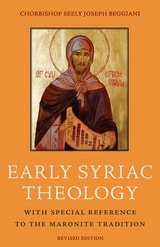
Early Syriac Theology

Chorbishop Seely Joseph Beggiani

Catholic University of America Press, 2014
Presents the insights of St. Ephrem and Jacob of Serugh, two of the earliest representatives of the theological world-view of the Syriac church.
[more]
cover of Eastern Catholic Theology in Action: Essays in Liturgy, Ecclesiology, and Ecumenism

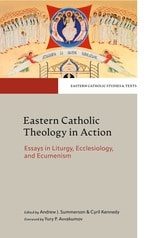
Eastern Catholic Theology in Action

Essays in Liturgy, Ecclesiology, and Ecumenism

Andrew J. Summerson

Catholic University of America Press, 2024
The Second Vatican Council urged Eastern Catholics to cultivate their share of divine revelation for the benefit of the entire Catholic Church. Yet, more than 50 years later, the Eastern Catholic Churches frequently remain on the margins, both in the theological academy and in the life of the Church more broadly. In an effort to remedy this situation, at least in part, this volume offers a scholarly reflection on the unique patrimony of the Eastern Catholic Churches, divided according to the categories of Liturgy, Theology, Spirituality, Discipline, and Culture. In so doing, it both follows the categories used to define a Church sui iuris in the Code of Canon Law for the Eastern Churches, and builds on the legacy of the Rev. Peter Galadza, to whom the volume is dedicated. On one hand, the volume and its essays are intentionally introductory, revealing the worlds of Eastern Catholicism and the variety of theological approaches that take place there. Emerging in part from the experience of teaching and preaching by scholars of Eastern Christianity, who are frequently asked for a basic introduction to Eastern Catholic theology, and have little to offer in response, these essays gather an international group of scholars engaging in critical, theological reflection from an Eastern Catholic perspective. This approach is rounded out by contributions from Roman Catholic, Orthodox, and Protestant scholars, who articulate their own reception and appreciation of the Eastern Catholic theological heritage.  At the same time, however, several of the essays in this volume relate the history and current reality of Eastern Catholicism to the Orthodox and Roman Catholic Churches, yet without ignoring how frequently Eastern Catholics live, worship, and theologize without self-conscious regard for their unique ecclesial situation. Indeed, these authors show, Eastern Catholic theology can be unself-consciously grounded in the patristic tradition, and Eastern Catholics can simply “do” theology, without worrying about ecclesial politics. Readers will thus find here the best of both worlds: both an introduction to the unique and frequently ignored patrimony of the Eastern Catholic Churches, and a series of essays that avoids the all-to-common pitfall of reducing these traditions to a parody of other Churches, Eastern or Western. Instead, by engaging with the sources of the Christian tradition – as Eastern Catholics, yes, but first and foremost as Christians – the authors reveal how much their tradition can offer the Catholic Church as a whole.
[more]
cover of Ecclesial Exegesis: A Synthesis of Ancient and Modern Approaches to Scripture

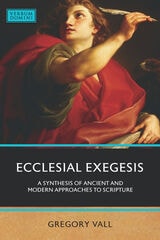
Ecclesial Exegesis

A Synthesis of Ancient and Modern Approaches to Scripture

Gregory Vall

Catholic University of America Press, 2022
There is broad support today for the idea that biblical scholarship ought to be informed by the faith of the Church and serve the life of the Church. In a word, it should be ecclesial. There is far less agreement, however, when one asks how this goal is to be achieved and what ecclesial exegesis ought to look like. In 1988, Joseph Ratzinger put forth his “Method C” proposal, calling for the development of a new exegetical and hermeneutical synthesis. This would be neither a retreat to the patristic-medieval approach (Method A) nor the continued hegemony of the historical-critical approach (Method B). The latter must be purified of its positivism through a transformational encounter with the former, so that the gifts of both might be released for the life of the Church. Such a synthesis, Ratzinger claimed, would require the philosophical, theological, exegetical, and hermeneutical work of “at least a whole generation” of scholars. Gregory Vall has devoted over thirty years to the development of ecclesial exegesis, and the present volume represents the mature fruit of his labor. Over against those who treat Dei Verbum as Vatican II’s endorsement of the historical-critical method, he demonstrates that the dogmatic constitution actually points to something very much like Ratzinger’s Method C. Employing a dialogic movement between the inductive-exegetical and the deductive-dogmatic, Vall offers nine studies that bring to the surface issues such as the relationship between Old Testament and New Testament, literal sense and spiritual sense, and Scripture and Tradition. While Vall brings theological knowledge and hermeneutical skill to the quest for Method C, he also provides a great deal of valuable exegesis of both testaments. Ecclesial Exegesis is not simply another book of theory. It demonstrates how Method C can be done.
[more]
cover of Ecclesiology

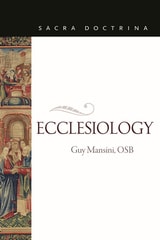
Ecclesiology

Guy Mansini, OSB

Catholic University of America Press, 2021
The first part of the book explains the antecedent probability both of revelation and of God’s institution of a church. It is ecclesiology in the mode of fundamental theology. The second part rounds up what Scripture and Tradition teach about the Church under the heads of the People of God, the Temple of the Holy Spirit, the Bride of Christ, and the Body of Christ. The chapters present this thematic material under each head as a unified whole, across the Testaments, with each chapter keyed to one of the “marks” of the Church: the catholicity of the people of God, the apostolicity of the ministers of the messianic temple, the holiness of the Bride of Christ, and the unity of the Body of Christ. This already organizes things in a proto-systematic frame. The third part of the book gives systematic exploration, in reverse order, to the unity of the Church, with attention to non-Catholic ecclesial communities and churches, to the holiness of the Church, objective and subjective, to the apostolicity of the Church and her mediation of revealed truth and grace, and to the catholicity of the Church, with attention to non-Christian religions. The center of the book, on the definition of the Church as the sacrament of communion, renders recent French Dominican ecclesiology in a form more accessible to undergraduates and seminarians, rooting it in the New Testament teachings on communion and mysterion. The book concludes with a strenuous argument for the necessity of the Church and her mission of evangelization. Thus, the trajectory of the book is from the naturally knowable antecedent probability of the Church to its revealed necessity.
[more]
cover of Edith Stein: Philosopher and Mystic

Edith Stein

Philosopher and Mystic

Josephine Koeppel O.C.D.

University of Scranton Press, 2007

The twentieth anniversary of the beatification of Edith Stein (1891–1942), the accomplished Jewish philosopher who made a spiritual journey from atheism to agnosticism before eventually converting to Catholicism, will be celebrated in 2007. In Edith Stein: Philosopher and Mystic, Josephine Koeppel chronicles the life of this influential saint from her secular youth and entrance into a German monastery to her tragic death at Auschwitz. This accessible work will reward readers of all faiths interested in the life of a remarkable woman who changed the modern conception of sainthood.
 

[more]
cover of Envisioning Scripture: Joseph Smith’s Revelations in Their Early American Contexts

Envisioning Scripture

Joseph Smith’s Revelations in Their Early American Contexts

Colby Townsend

Signature Books, 2022

The first fifty years of United States history was a period of seemingly endless possibility. With the birth of a new country during the age of revolutions came new religions, new literary genres, new political parties, temperance and abolitionist societies, and the expansion of print and marketing networks that would dramatically change the course of the century. Envisioning Scripture: Joseph Smith’s Revelations in Their Early American Contexts brings together ten essays from leading scholars on the history of early American religion and print culture. Covering issues of gender, race, prophecy, education, scripture, real and narrative time, authority and power, and apocalypticism, the essays invite the reader—scholar, student, etc.—to expand their knowledge of early Mormon history by grasping more fully the American contexts that Mormonism grew out of. 

Contributors include Catherine A. Brekus, William Davis, Elizabeth Fenton, Kathleen Flake, Paul Gutjahr, Jared Hickman, Susan Juster, Seth Perry, Laura Thiemann Scales, and Roberto A. Valdeón.
[more]
cover of Erasmus's Life of Origen

Erasmus's Life of Origen

Thomas P. Scheck

Catholic University of America Press, 2016
Erasmus of Rotterdam (1466-1536) hailed Origen of Alexandria (185-254) as a holy priest, a gifted homilist, a heroic Christian, and a celebrated exegete and theologian of the ancient Church. In this book Thomas Scheck presents one of the fruits of Erasmus's endeavors in the field of patristic studies (a particularly neglected field of scholarship within Erasmus studies) by providing the first English translation, annotated and thoroughly introduced, of Erasmus' final work, the Prefaces to his Edition of Origen's writings (1536). Originally published posthumously two months after Erasmus's death, the work surveys Origen of Alexandria's life, writings, preaching, and contribution to the Catholic Church. The staggering depth and breadth of Erasmus's learning are exhibited here, as well as the maturity of his theological reflections, which in many ways anticipate the irenicism of the Second Vatican Council with respect to Origen. Erasmus presents Origen as a marvelous doctor of the ancient Church who made a tremendous contribution to the Catholic exegetical tradition and who lived a saintly life.
[more]
cover of Eschatology: Death and the Eternal Life (Second Edition)

Eschatology

Death and the Eternal Life (Second Edition)

Joseph Ratzinger

Catholic University of America Press, 2007
Originally published in English in 1988, Joseph Ratzinger's Eschatology remains internationally recognized as a leading text on the "last things"—heaven and hell, purgatory and judgment, death and the immortality of the soul. This highly anticipated second edition includes a new preface by Joseph Ratzinger/Pope Benedict XVI and a supplement to the bibliography by theologian Peter A. Casarella. Eschatology presents a balanced perspective of the doctrine at the center of Christian belief—the Church's faith in eternal life. Recognizing the task of contemporary eschatology as "to marry perspectives, so that person and community, present and future, are seen in their unity," Joseph Ratzinger brings together recent emphasis on the theology of hope for the future with the more traditional elements of the doctrine. His book has proven to be as timeless as it is timely.

[more]
cover of Eternal Life and Human Happiness in Heaven: Philosophical Problems, Thomistic Solutions

Eternal Life and Human Happiness in Heaven

Philosophical Problems, Thomistic Solutions

Christopher M. Brown

Catholic University of America Press, 2021

Eternal Life and Human Happiness in Heaven treats four apparent problems concerning eternal life in order to clarify our thinking about perfect human happiness in heaven. The teachings of St. Thomas Aquinas provide the basis for solutions to these four problems about eternal life insofar as his teachings call into question common contemporary theological or philosophical presuppositions about God, human persons, and the nature of heaven itself. Indeed, these Thomistic solutions often require us to think very differently from our contemporaries. But thinking differently with St. Thomas is worth it: for the Thomistic solutions to these apparent problems are more satisfying, on both theological and philosophical grounds, than a number of contemporary theological and philosophical approaches. Christopher Brown deploys his argument in four sections. The first section lays out, in three chapters, four apparent problems concerning eternal life—Is heaven a mystical or social reality? Is heaven other-worldly or this-worldly? Is heaven static or dynamic? Won’t human persons eventually get bored in heaven? Brown then explains how and why some important contemporary Christian theologians and philosophers resolve these problems, and notes serious problems with each of these contemporary solutions. The second section explains, in five chapters, St. Thomas’ significant distinction between the essential reward of the saints in heaven and the accidental reward, and treats in detail his account of that in which the essential reward consists, namely, the beatific vision and the proper accidents of the vision (delight, joy, and charity). The third section treats, in five chapters, St. Thomas’ views on the multifaceted accidental reward in heaven, where the accidental reward includes, among other things, glorified human embodiment, participation in the communion of the saints, and the joy experienced by the saints in sensing God’s “new heavens and new earth.” Finally, section four argues, in four chapters, that St. Thomas’ views allow for powerful solutions to the four apparent problems about eternal life examined in the first section. These solutions are powerful because, not only are they consistent with authoritative, Catholic Christian Tradition, but they do not raise any of the significant theological or philosophical problems that attend the contemporary theological and philosophical solutions examined in the first section.
[more]
cover of Eucharistic Presence: A Study in the Theology of Disclosure

Eucharistic Presence

A Study in the Theology of Disclosure

Robert Sokolowski

Catholic University of America Press, 1994
[more]
cover of Expanding the Palace of Torah: Orthodoxy and Feminism

Expanding the Palace of Torah

Orthodoxy and Feminism

Tamar Ross

Brandeis University Press, 2004

Expanding the Palace of Torah offers a broad philosophical overview of the challenges the women’s revolution poses to Orthodox Judaism, as well as Orthodox Judaism’s response to those challenges. Writing as an insider—herself an Orthodox Jew—Tamar Ross confronts the radical feminist critique of Judaism as a religion deeply entrenched in patriarchy. Surprisingly, very little work has been done in this area, beyond exploring the leeway for ad hoc solutions to practical problems as they arise on the halakhic plane. In exposing the largely male-focused thrust of the rabbinic tradition and its biblical grounding, she sees this critique as posing a potential threat to the theological heart of traditional Judaism—the belief in divine revelation.

This new edition brings this acclaimed and classic text back into print with a new essay by Tamar Ross which examines new developments in feminist thought since the book was first published in 2004.
[more]
cover of Exposé of Polygamy: A Lady's Life Among the Mormons

Exposé of Polygamy

A Lady's Life Among the Mormons

Fanny Stenhouse

Utah State University Press, 2008

After the 1872 publication of Exposé,Fanny Stenhouse became a celebrity in the cultural wars between Mormons and much of America. An English convert, she had grown disillusioned with the Mormon Church and polygamy, which her husband practiced before associating with a circle of dissident Utah intellectuals and merchants. Stenhouse’s critique of plural marriage, Brigham Young, and Mormonism was also a sympathetic look at Utah’s people and honest recounting of her life. She later created a new edition, titled "Tell It All," which ensured her notoriety in Utah and popularity elsewhere but turned her thoughtful memoir into a more polemical, true exposé of Polygamy. Since 1874, it has stayed in print, in multiple, varying editions. The original book, meanwhile, is less known, though more readable. Tracing the literary history of Stenhouse’s important piece of Americana, Linda DeSimone rescues an important autobiographical and historical record from the baggage notoriety brought to it.

[more]