Results by title
808 books match the query 'Drama' and 27 start with e
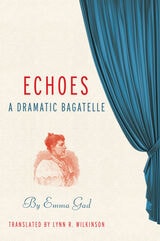
Echoes
A Dramatic BagatelleEmma Gad, Translated by Lynn R. Wilkinson
University of Wisconsin Press, 2021
Although it was labeled a “bagatelle,” Echoes, like most of Gad’s other plays, is quite funny. The play brings together three individuals in the out-of-the-way cottage of an old servant. Countess Clara takes refuge with Maren, her former nursemaid, during a sudden downpour and is soon joined by Niels, her former tutor, who claims to be passing by on his way to a church, where he hopes to find important historical documents. During Clara’s conversations with the two, it comes out that she is considering marriage to a count who lives nearby, even though she finds him and his way of life unattractive, and that she and Niels had been in love years before.
Gad’s graceful dialogue manages to touch on questions hotly debated in the last decades of the nineteenth century, such as the ability of individuals to break with the past or with outmoded or repressive conventions, while also making audiences laugh. Despite the play’s lighthearted wittiness, Echoes is an inventive example of turn-of-the-century avant-garde theater.
Eclipse of Action
Tragedy and Political EconomyRichard Halpern
University of Chicago Press, 2017
Since Aristotle, tragedy has been seen as uniquely exhibiting the importance of action for human happiness. Beginning with Adam Smith, however, political economy has claimed that the source of happiness is primarily production. Eclipse of Action examines the tense relations between action and production, doing and making, in playwrights from Aeschylus, Marlowe, Shakespeare, and Milton to Beckett, Arthur Miller, and Sarah Kane. Richard Halpern places these figures in conversation with works by Aristotle, Smith, Hegel, Marx, Hannah Arendt, Georges Bataille, and others in order to trace the long history of the ways in which economic thought and tragic drama interact.
Edges of Loss
From Modern Drama to Postmodern TheoryMark Pizzato
University of Michigan Press, 1998
Edward III
William Shakespeare
Arizona Center for Medieval and Renaissance Studies, 2022
Written after England’s victory over the Spanish Armada in 1588, Edward III follows the exploits of King Edward III and his son Edward, the Black Prince of Wales. England dominates on the battlefield as the play explores questions of kinghood and chivalry through the actions of King Edward and his son. Octavio Solis’s translation of the play provides all of the complexity and richness of the original while renewing the allusions and metaphors lost through time.
This translation of Edward III was written as part of the Oregon Shakespeare Festival’s Play On! project, which commissioned new translations of thirty-nine Shakespeare plays. These translations present work from “The Bard” in language accessible to modern audiences while never losing the beauty of Shakespeare’s verse. Enlisting the talents of a diverse group of contemporary playwrights, screenwriters, and dramaturges from diverse backgrounds, this project reenvisions Shakespeare for the twenty-first century. These volumes make these works available for the first time in print—a new First Folio for a new era.
Effects Of The Nation
Mexican Art In Age Of Globalizationedited by Carl Good and John V. Waldron
Temple University Press, 2001
Mexico is a particularly apt focus, partly because of the vitality of its culture, partly because of its changing political identity, and partly because of the impact of borders and borderlessness on its national character. The ten essays collected here look at a wide range of aesthetic productions -- especially literature and the visual arts -- that give context to how art and society interact.
Steering a careful course between the nostalgia of nationalism and the insensitivity of globalism, these essays examine modernism and postmodernism in the Mexican setting. Individually, they explore the incorporation of historical icons, of vanguardism, and of international influence. From Diego Rivera to Elena Garro, from the Tlateloco massacre to the Chiapas rebellion, from mass-market fiction to the film Aliens, the contributors view the many sides of Mexican life as relevant to the creation of a constantly shifting national culture. Taken together, the essays look both backward and forward at the evolving effect of the Mexican nation.

Eight Dramas of Calderón
Pedro Calderón de la Barca
University of Illinois Press, 1919
Drawing on a diverse array of ethnographic contexts, including the sexual rituals of the Ba-Thong of South Africa and evidence drawn from aboriginal Australian, Eskimo, and traditional Chinese social systems, Caillois analyzes the role of the forbidden in the social cohesion of the group. He examines the character of the sacred in the light of specific instances of taboos and transgressions, exploring wide differences in attitudes toward diet and sex and extreme behaviors associated with the sacred, such as rapture and paroxysm. He also discusses the festival--an exuberant explosion following a period of strict repression--and compares its functions with those of modern war.
A classic study of one of the most fundamental aspects of human social and spiritual life, Man and the Sacred--presented here in Meyer Barash's superb English translation--is a companion volume to Caillois's Man, Play and Games.
Eight Plays for Children
The New Generation Play ProjectEdited by Coleman A. Jennings
University of Texas Press, 1999
The New Generation Play Project was a daring experiment in American children's theatre. Begun in 1989 by a consortium that included the Seattle Children's Theatre, The Children's Theatre Company of Minneapolis, Stage One: The Louisville Children's Theatre, and the Honolulu Theatre for Youth, the NGPP raised half a million dollars to commission major American dramatists to create new works for young people and to produce these plays over a several-year period.
This book provides the full text of the plays produced through the NGPP:
- Constance Congdon, Beauty and the Beast
- Velina Hasu Houston, Hula Heart
- Tina Howe, East of the Sun and West of the Moon
- Len Jenkin, The Invisible Man
- Mark Medoff, Kringle's Window
- Eric Overmyer, Duke Kahanamoku vs. The Surfnappers
- Michael Weller, Dogbrain
- Y York, The Witch of Blackbird Pond
In his introduction, Coleman Jennings describes the work of the NGPP, some of the controversies surrounding its selection of playwrights who do not ordinarily write for young audiences, as well as the playwrights' reactions to the project, and the critical reception of the plays. Suzan Zeder, one of the nation's leading playwrights for family audiences, supplies the foreword.

Eight Plays
Performance TextsArthur Schnitzler
Northwestern University Press, 2007
The volume includes Schnitzler's popular Roundelay (La Ronde) and Anatol, as well as rarely translated works like Professor Bernhardi and Hour of Realizing. There are also additional scenes and an alternate ending to Anatol that are seldom found in translation or even in German versions of the play. With conscientious attention to the rhythms of speech and respect for the completeness of the works, these translations offer new possibilities for bringing Schnitzler's works to the contemporary stage and new insights for anyone interested in drama, literature, or history.

Eight Twentieth-Century Russian Plays
Timothy Langen and Justin Weir
Northwestern University Press, 2000
Included in this volume:
Sacred Blood, by Zinaida Gippius; The Unknown Woman, by Alexander Blok; Vladimir Mayakovsky, by Vladimir Mayakosky; The Case of the Entry Room, by Victor Ardov; Squaring the Circle, by Valentin Kataev; Elizaveta Bam, by Daniil Kharms; Grain, by Vladimir Kirshon; and The Guests, by Leonid Zorin.

El Conde don Pero Vélez y don Sancho el Deseado
Comedia en Tres ActosRichard Olmsted
University of Minnesota Press, 1944

Embodied Memory
Theatre Of George TabonAnat Feinberg
University of Iowa Press, 1999
Making use of invaluable archival material, Feinberg's biographical account is followed by a study of Tabori's experimental theatre work. As did prominent avant-gardists such as Grotowski or Chaikin, Tabori sought to open up new vistas in an otherwise mainstream theatre system. Feinberg pays special attention to Tabori's theatrical innovations, most movingly found in his Holocaust plays. There Feinberg shows the ways in which Tabori's theatre becomes a locus of remembrance (Gedächtnisort) and of unique, engaging memory-work (Erinnerungsarbeit).
Encounter with the Plumed Serpent
Drama and Power in the Heart of MesoamericaMaarten Jansen
University Press of Colorado, 2007
By analyzing and cross-referencing the codices, which have been fragmented and dispersed in far-flung archives, the authors attempt to reconstruct Mixtec history. Their synthesis here builds on long examination of the ancient manuscripts. Adding useful interpretation and commentary, Jansen and Pérez Jiménez synthesize the large body of surviving documents into the first unified narrative of Mixtec sacred history.
Archaeologists and other scholars as well as readers with an interest in Mesoamerican cultures will find this lavishly illustrated volume a compelling and fascinating history and a major step forward in knowledge of the Mixtec.
Encounters on Contested Lands
Indigenous Performances of Sovereignty and Nationhood in QuébecJulie Burelle
Northwestern University Press, 2019
Winner, 2020 Ann Saddlemyer Award
Finalist, ATHE Outstanding Book Award for 2020
Mention Spéciale, Société québécoise d'études théâtrale
In Encounters on Contested Lands, Julie Burelle employs a performance studies lens to examine how instances of Indigenous self-representation in Québec challenge the national and identity discourses of the French Québécois de souche—the French-speaking descendants of white European settlers who understand themselves to be settlers no more but rather colonized and rightfully belonging to the territory of Québec.
Analyzing a wide variety of performances, Burelle brings together the theater of Alexis Martin and the film L'Empreinte, which repositions the French Québécois de souche as métis, with protest marches led by Innu activists; the Indigenous company Ondinnok's theater of repatriation; the films of Yves Sioui Durand, Alanis Obomsawin, and the Wapikoni Mobile project; and the visual work of Nadia Myre. These performances, Burelle argues, challenge received definitions of sovereignty and articulate new ones while proposing to the province and, more specifically, to the French Québécois de souche, that there are alternative ways to imagine Québec's future and remember its past.
The performances insist on Québec's contested nature and reframe it as animated by competing sovereignties. Together they reveal how the "colonial present tense" and "tense colonial present" operate in conjunction as they work to imagine an alternative future predicated on decolonization. Encounters on Contested Lands engages with theater and performance studies while making unique and needed contributions to Québec and Canadian studies, as well as to Indigenous and settler-colonial studies.
Encuentro
Latinx Performance for the New American TheaterEdited by Trevor Boffone, Teresa Marrero, and Chantal Rodriguez
Northwestern University Press, 2019
Playwrights Ruben C. Gonzalez, José Torres-Tama, Rickerby Hinds, Mariana Carreño King, Javier Antonio González, and Evelina Fernández exhibit a wide range of aesthetic approaches, dramatic structures, and themes, ranging from marriage, gentrification, racial and gendered violence, migration, and the ever-present politics of the U.S.–Mexico border. There is power in the communal experience of creating, witnessing, and participating in theater festivals. This anthology is a testament to that power and seeks to document the historic festival as well as to make these works available to a wider audience.
Encuentro: Latinx Performance for the New American Theater addresses interests of general audiences committed to the performing arts; scholars and students of Latinx, gender, and ethnic studies; university, college, and high school theater programs; and regional theaters looking to diversify their programming.
English Theatrical Anecdotes, 1660-1800
Heather Ladd
University of Delaware Press, 2022

English Women Staging Islam, 1696-1707
Delarivier Manley and Mary Pix
Iter Press, 2012
Entertaining the Nation
American Drama in the Eighteenth and Nineteenth CenturiesTice L. Miller
Southern Illinois University Press, 2007
In this survey of eighteenth- and nineteenth-century American drama, Tice L. Miller examines American plays written before a canon was established in American dramatic literature and provides analyses central to the culture that produced them. Entertaining the Nation: American Drama in the Eighteenth and Nineteenth Centuries evaluates plays in the early years of the republic, reveals shifts in taste from the classical to the contemporary in the 1840s and 1850s, and considers the increasing influence of realism at the end of the nineteenth century.
Miller explores the relationship between American drama and societal issues during this period. While never completely shedding its English roots, says Miller, the American drama addressed issues important on this side of the Atlantic such as egalitarianism, republicanism, immigration, slavery, the West, Wall Street, and the Civil War.
In considering the theme of egalitarianism, the volume notes Alexis de Tocqueville’s observation in 1831 that equality was more important to Americans than liberty. Also addressed is the Yankee character, which became a staple in American comedy for much of the nineteenth century.
Miller analyzes several English plays and notes how David Garrick’s reforms in London were carried over to the colonies. Garrick faced an increasingly middle-class public, offers Miller, and had to make adjustments to plays and to his repertory to draw an audience.
The volumealso looks at the shift in drama that paralleled the one in political power from the aristocrats who founded the nation to Jacksonian democrats. Miller traces how the proliferation of newspapers developed a demand for plays that reflected contemporary society and details how playwrights scrambled to put those symbols of the outside world on stage to appeal to the public. Steamships and trains, slavery and adaptations of Uncle Tom’s Cabin, and French influences are presented as popular subjects during that time.
Entertaining the Nation effectively outlines the civilizing force of drama in the establishment and development of the nation, ameliorating differences among the various theatergoing classes, and provides a microcosm of the changes on and off the stage in America during these two centuries.

Ermione
Dramma per musica in Two Acts by Andrea Leone TottolaGioachino Rossini
University of Chicago Press, 1996
This critical edition is the first publication of Ermione in full score.
The originality and power of Rossini's score lie in the musical realization of the four principal characters in Tottola's libretto—four survivors of the Trojan war—based on Racine's tragedy Andromaque. Rossini's Ermione was one of the most fully developed characters in nineteenth-century opera. The work's musical structure also was unconventional for its day. All the solo numbers involve other characters, and there is only one scene for a single protagonist.

Eugene O'Neill's America
Desire Under DemocracyJohn Patrick Diggins
University of Chicago Press, 2007
In the face of seemingly relentless American optimism, Eugene O’Neill's plays reveal an America many would like to ignore, a place of seething resentments, aching desires, and family tragedy, where failure and disappointment are the norm and the American dream a chimera. Though derided by critics during his lifetime, his works resonated with audiences, won him the Nobel Prize and four Pulitzer, and continue to grip theatergoers today. Now noted historian John Patrick Diggins offers a masterly biography that both traces O’Neill’s tumultuous life and explains the forceful ideas that form the heart of his unflinching works.
Diggins paints a richly detailed portrait of the playwright’s life, from his Irish roots and his early years at sea to his relationships with his troubled mother and brother. Here we see O’Neill as a young Greenwich Village radical, a ravenous autodidact who attempted to understand the disjunction between the sunny public face of American life and the rage that he knew was simmering beneath. According to Diggins, O’Neill mined this disjunction like no other American writer. His characters burn with longing for an idealized future composed of equal parts material success and individual freedom, but repeatedly they fall back to earth, pulled by the tendrils of family and the insatiability of desire. Drawing on thinkers from Emerson to Nietzsche, O’Neill viewed this endlessly frustrated desire as the problematic core of American democracy, simultaneously driving and undermining American ideals of progress, success, and individual freedom.
Melding a penetrating assessment of O’Neill’s works and thought with a sensitive re-creation of his life, Eugene O’Neill’s America offers a striking new view of America’s greatest playwright—and a new picture of American democracy itself.
Euripides I
Alcestis, Medea, The Children of Heracles, HippolytusEdited and Translated by Mark Griffith, Glenn W. Most, David Grene, and Richmond Lattimore
University of Chicago Press, 2013
Euripides I contains the plays “Alcestis,” translated by Richmond Lattimore; “Medea,” translated by Oliver Taplin; “The Children of Heracles,” translated by Mark Griffith; and “Hippolytus,” translated by David Grene.
Many years ago, the University of Chicago Press undertook a momentous project: a new translation of the Greek tragedies that would be the ultimate resource for teachers, students, and readers. They succeeded. Under the expert management of eminent classicists David Grene and Richmond Lattimore, those translations combined accuracy, poetic immediacy, and clarity of presentation to render the surviving masterpieces of Aeschylus, Sophocles, and Euripides in an English so lively and compelling that they remain the standard translations. The updated third editions of these classic works were designed to ensure that our Greek tragedies remain the leading English-language versions throughout the twenty-first century.
In this highly anticipated third edition, Mark Griffith and Glenn W. Most have carefully updated the translations to bring them even closer to the ancient Greek while retaining the vibrancy for which our English versions are famous. This edition also includes brand-new translations of Euripides’ Medea, The Children of Heracles, Andromache, and Iphigenia among the Taurians, fragments of lost plays by Aeschylus, and the surviving portion of Sophocles’s satyr-drama The Trackers. New introductions for each play offer essential information about its first production, plot, and reception in antiquity and beyond. In addition, each volume includes an introduction to the life and work of its tragedian, as well as notes addressing textual uncertainties and a glossary of names and places mentioned in the plays.
In addition to the new content, the volumes have been reorganized both within and between volumes to reflect the most up-to-date scholarship on the order in which the plays were originally written. The result is a set of handsome paperbacks destined to introduce new generations of readers to these foundational works of Western drama, art, and life.
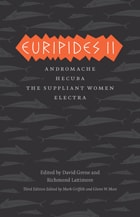
Euripides II
Andromache, Hecuba, The Suppliant Women, ElectraEdited and Translated by Mark Griffith, Glenn W. Most, David Grene, and Richmond Lattimore
University of Chicago Press, 2013
Euripides II contains the plays “Andromache,” translated by Deborah Roberts; “Hecuba,” translated by William Arrowsmith; “The Suppliant Women,” translated by Frank William Jones; and “Electra,” translated by Emily Townsend Vermeule.
Many years ago, the University of Chicago Press undertook a momentous project: a new translation of the Greek tragedies that would be the ultimate resource for teachers, students, and readers. They succeeded. Under the expert management of eminent classicists David Grene and Richmond Lattimore, those translations combined accuracy, poetic immediacy, and clarity of presentation to render the surviving masterpieces of Aeschylus, Sophocles, and Euripides in an English so lively and compelling that they remain the standard translations. The updated third editions of these classic works were designed to ensure that our Greek tragedies remain the leading English-language versions throughout the twenty-first century.
In this highly anticipated third edition, Mark Griffith and Glenn W. Most have carefully updated the translations to bring them even closer to the ancient Greek while retaining the vibrancy for which our English versions are famous. This edition also includes brand-new translations of Euripides’ Medea, The Children of Heracles, Andromache, and Iphigenia among the Taurians, fragments of lost plays by Aeschylus, and the surviving portion of Sophocles’s satyr-drama The Trackers. New introductions for each play offer essential information about its first production, plot, and reception in antiquity and beyond. In addition, each volume includes an introduction to the life and work of its tragedian, as well as notes addressing textual uncertainties and a glossary of names and places mentioned in the plays.
In addition to the new content, the volumes have been reorganized both within and between volumes to reflect the most up-to-date scholarship on the order in which the plays were originally written. The result is a set of handsome paperbacks destined to introduce new generations of readers to these foundational works of Western drama, art, and life.
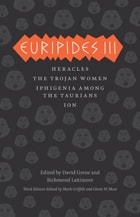
Euripides III
Heracles, The Trojan Women, Iphigenia among the Taurians, IonEdited and Translated by Mark Griffith, Glenn W. Most, David Grene, and Richmond Lattimore
University of Chicago Press, 2013
Euripides III contains the plays “Heracles,” translated by William Arrowsmith; “The Trojan Women,” translated by Richmond Lattimore; “Iphigenia among the Taurians,” translated by Anne Carson; and “Ion,” translated by Ronald Frederick Willetts.
Many years ago, the University of Chicago Press undertook a momentous project: a new translation of the Greek tragedies that would be the ultimate resource for teachers, students, and readers. They succeeded. Under the expert management of eminent classicists David Grene and Richmond Lattimore, those translations combined accuracy, poetic immediacy, and clarity of presentation to render the surviving masterpieces of Aeschylus, Sophocles, and Euripides in an English so lively and compelling that they remain the standard translations. The updated third editions of these classic works were designed to ensure that our Greek tragedies remain the leading English-language versions throughout the twenty-first century.
In this highly anticipated third edition, Mark Griffith and Glenn W. Most have carefully updated the translations to bring them even closer to the ancient Greek while retaining the vibrancy for which our English versions are famous. This edition also includes brand-new translations of Euripides’ Medea, The Children of Heracles, Andromache, and Iphigenia among the Taurians, fragments of lost plays by Aeschylus, and the surviving portion of Sophocles’s satyr-drama The Trackers. New introductions for each play offer essential information about its first production, plot, and reception in antiquity and beyond. In addition, each volume includes an introduction to the life and work of its tragedian, as well as notes addressing textual uncertainties and a glossary of names and places mentioned in the plays.
In addition to the new content, the volumes have been reorganized both within and between volumes to reflect the most up-to-date scholarship on the order in which the plays were originally written. The result is a set of handsome paperbacks destined to introduce new generations of readers to these foundational works of Western drama, art, and life.
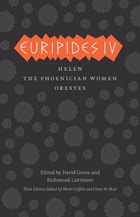
Euripides IV
Helen, The Phoenician Women, OrestesEdited and Translated by Mark Griffith, Glenn W. Most, David Grene, and Richmond Lattimore
University of Chicago Press, 2013
Euripides IV contains the plays “Helen,” translated by Richmond Lattimore; “The Phoenician Women,” translated by Elizabeth Wyckoff; and “Orestes,” translated by William Arrowsmith.
Many years ago, the University of Chicago Press undertook a momentous project: a new translation of the Greek tragedies that would be the ultimate resource for teachers, students, and readers. They succeeded. Under the expert management of eminent classicists David Grene and Richmond Lattimore, those translations combined accuracy, poetic immediacy, and clarity of presentation to render the surviving masterpieces of Aeschylus, Sophocles, and Euripides in an English so lively and compelling that they remain the standard translations. The updated third editions of these classic works were designed to ensure that our Greek tragedies remain the leading English-language versions throughout the twenty-first century.
In this highly anticipated third edition, Mark Griffith and Glenn W. Most have carefully updated the translations to bring them even closer to the ancient Greek while retaining the vibrancy for which our English versions are famous. This edition also includes brand-new translations of Euripides’ Medea, The Children of Heracles, Andromache, and Iphigenia among the Taurians, fragments of lost plays by Aeschylus, and the surviving portion of Sophocles’s satyr-drama The Trackers. New introductions for each play offer essential information about its first production, plot, and reception in antiquity and beyond. In addition, each volume includes an introduction to the life and work of its tragedian, as well as notes addressing textual uncertainties and a glossary of names and places mentioned in the plays.
In addition to the new content, the volumes have been reorganized both within and between volumes to reflect the most up-to-date scholarship on the order in which the plays were originally written. The result is a set of handsome paperbacks destined to introduce new generations of readers to these foundational works of Western drama, art, and life.
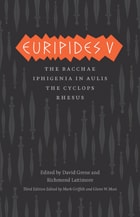
Euripides V
Bacchae, Iphigenia in Aulis, The Cyclops, RhesusEdited and Translated by Mark Griffith, Glenn W. Most, David Grene, and Richmond Lattimore
University of Chicago Press, 2013
Euripides V includes the plays “The Bacchae,” translated by William Arrowsmith; “Iphigenia in Aulis,” translated by Charles R. Walker; “The Cyclops,” translated by William Arrowsmith; and “Rhesus,” translated by Richmond Lattimore.
Many years ago, the University of Chicago Press undertook a momentous project: a new translation of the Greek tragedies that would be the ultimate resource for teachers, students, and readers. They succeeded. Under the expert management of eminent classicists David Grene and Richmond Lattimore, those translations combined accuracy, poetic immediacy, and clarity of presentation to render the surviving masterpieces of Aeschylus, Sophocles, and Euripides in an English so lively and compelling that they remain the standard translations. The updated third editions of these classic works were designed to ensure that our Greek tragedies remain the leading English-language versions throughout the twenty-first century.
In this highly anticipated third edition, Mark Griffith and Glenn W. Most have carefully updated the translations to bring them even closer to the ancient Greek while retaining the vibrancy for which our English versions are famous. This edition also includes brand-new translations of Euripides’ Medea, The Children of Heracles, Andromache, and Iphigenia among the Taurians, fragments of lost plays by Aeschylus, and the surviving portion of Sophocles’s satyr-drama The Trackers. New introductions for each play offer essential information about its first production, plot, and reception in antiquity and beyond. In addition, each volume includes an introduction to the life and work of its tragedian, as well as notes addressing textual uncertainties and a glossary of names and places mentioned in the plays.
In addition to the new content, the volumes have been reorganized both within and between volumes to reflect the most up-to-date scholarship on the order in which the plays were originally written. The result is a set of handsome paperbacks destined to introduce new generations of readers to these foundational works of Western drama, art, and life.
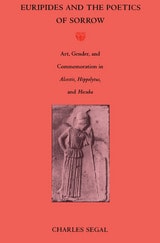
Euripides and the Poetics of Sorrow
Art, Gender, and Commemoration in Alcestis, Hippolytus, and HecubaCharles Segal
Duke University Press, 1993
Alcestis, Hippolytus, and Hecuba, the three early plays interpreted here, are linked by common themes of violence, death, lamentation and mourning, and by their implicit definitions of male and female roles. Segal shows how these plays draw on ancient traditions of poetic and ritual commemoration, particularly epic song, and at the same time refashion these traditions into new forms. In place of the epic muse of martial glory, Euripides, Segal argues, evokes a muse of sorrows who transforms the suffering of individuals into a "common grief for all the citizens," a community of shared feeling in the theater.
Like his predecessors in tragedy, Euripides believes death, more than any other event, exposes the deepest truth of human nature. Segal examines the revealing final moments in Alcestis, Hippolytus, and Hecuba, and discusses the playwright's use of these deaths--especially those of women--to question traditional values and the familiar definitions of male heroism. Focusing on gender, the affective dimension of tragedy, and ritual mourning and commemoration, Segal develops and extends his earlier work on Greek drama. The result deepens our understanding of Euripides' art and of tragedy itself.

Evita, Inevitably
Performing Argentina's Female Icons Before and After Eva PerónJean Graham-Jones
University of Michigan Press, 2014

Exit Strategy
A PlayIke Holter
Northwestern University Press, 2018
Drawing from the headlines, Exit Strategy is set in Chicago and tells the story of a fictional public high school slated for closure at the end of the year. Despite funding cuts, bureaucrats run amok, apathy, and a rodent infestation, a small, multiracial group of teachers launch a last-minute effort to save the school, and put their careers, futures, and safety in the hands of a fast-talking administrator who may be in over his head. The tenuous situation also raises fears and anxieties among students, and within the volcanic neighborhood that is home to the school.
Holter has said that Exit Strategy was inspired by the 2013 mass closure of forty-nine Chicago public schools, which displaced nearly 12,000 children—the majority of directly impacted students were African American and Latinx. Hailed as "riveting," "sharp," and "richly metaphoric" by critics, the play indicts how we educate our children in big American cities, and shows why gaps between haves and have-nots continue to grow.
Exit Strategy is one of seven plays in Ike Holter's cycle of works set in Chicago or Chicago-inspired neighborhoods.