Results by title
104 books match the query 'Earth' and 12 start with e
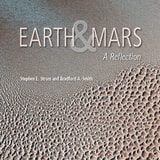
Earth and Mars
A ReflectionStephen E. Strom and Bradford A. Smith
University of Arizona Press, 2015
Earth and Mars is a fusion of art and science, a blend of images and essays celebrating the successful creation of our life-sustaining planet and the beauty and mystery of Mars. Through images of terrestrial landscapes and photographs selected from recent NASA and European Space Agency missions to Mars, Earth and Mars reveals the profound beauty resulting from the action of volcanism, wind, and water. The accompanying text provides a context for appreciating the role of these elemental forces in shaping the surfaces of each planet, as well as the divergent evolutionary paths that led to an Earth that is teeming with life, and Mars that is seemingly lifeless.
Earth and Mars inspires reflection on the extraordinarily delicate balance of forces that has resulted in our good fortune: to be alive and sentient on a bountiful blue world.
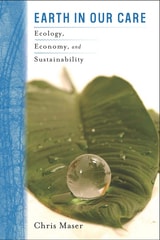
Earth in Our Care
Ecology, Economy, and SustainabilityMaser, Chris
Rutgers University Press, 2009
So writes Chris Maser in this compelling study of three interactive spheres of the ecosystem: atmosphere (air), litho-hydrosphere (rock that comprises the restless continents and the water that surrounds them), and biosphere (all life sandwiched in between).
Rich in detail and insightful analogies, Earth in Our Care addresses key issues including land-use policies, ecological restoration, forest management, local living, and sustainability thinking. Exploring our interconnectedness with the Earth, Maser examines today's problems and, more importantly, provides solutions for the future.
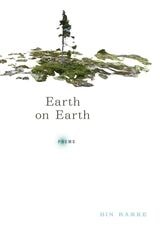
Earth on Earth
Bin Ramke
Omnidawn, 2021
A kind of translation of the thousand-year-old poem “Earth Took of Earth,” this book is an attempt to restate in personal, emotional terms a sense of both the danger of and the consolation given by earth itself. Many of these poems arose during a collaboration with the ecologist-ceramicist Mia Mulvey: her work with earth, clay often extruded through digitally guided machinery, echoes Ramke’s attempts to understand damages done to and celebrate the facts of earth—for instance, that geosmin, the scent of wet soil, is so powerfully recognizable even in trace amounts. The title of this book is also a play on the phrase “heaven on earth,” turning this idea around and encouraging us to instead turn our hopes toward earth on earth.
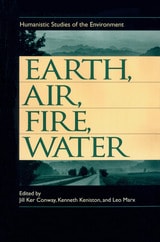
Earth, Air, Fire, Water
Humanistic Studies of the EnvironmentJill Ker Conway
University of Massachusetts Press, 1999
Written in a clear, accessible style with a general audience in mind, the essays in this volume offer fresh approaches to thinking about environmental issues. When we consider the forms of environmental decline most urgently in need of attention—eroding soils, shrinking forests, expanding deserts, acid rain, ozone depletion, air pollution, poisoned water supplies, the loss of biological diversity—it may seem logical that scientists should be the people mobilized to tackle these problems. Yet to devise effective solutions for today's environmental threats, we must situate them within their larger historical, societal, and cultural settings. Amelioration does not require exclusively scientific knowledge, but also changes based upon law and public policy, on institutional structures and practices, on habits of consumption, and on countless other facets of daily life. Earth, Air, Fire, Water seeks to redirect our thinking about environmental issues by locating them in the behavior of human beings—in the institutions, beliefs, and practices that mediate between people and that obscure but beautiful nonhuman world we refer to as “nature.” The book opens with a section on the elements and the ways humans have understood them in the past. There follows a section devoted to social institutions and the ways in which we can learn from current and past efforts to study the interaction between people and nature. The concluding section analyzes the culture of modernity and the ways in which the human imagination has changed in response to the arrival of modern technology. In addition to the editors, contributors include Gregory Nagy, Donald Worster, Stephen J. Pyne, John F. Richards, Richard White, Terence Turner, Barbara Epstein, Oleg N. Yanitsky, Bina Agarwal, Anton Struchkov, Yaakov Garb, and Louis Menand.
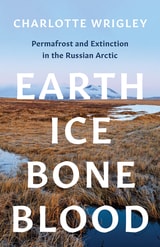
Earth, Ice, Bone, Blood
Permafrost and Extinction in the Russian ArcticCharlotte Wrigley
University of Minnesota Press, 2023
Exploring one of the greatest potential contributors to climate change—thawing permafrost—and the anxiety of extinction on an increasingly hostile planet
Climate scientists point to permafrost as a “ticking time bomb” for the planet, and from the Arctic, apocalyptic narratives proliferate on the devastating effects permafrost thaw poses to human survival. In Earth, Ice, Bone, Blood, Charlotte Wrigley considers how permafrost—and its disappearance—redefines extinction to be a lack of continuity, both material and social, and something that affects not only life on earth but nonlife, too.
Earth, Ice, Bone, Blood approaches the topic of thawing permafrost and the wild new economies and mitigation strategies forming in the far north through a study of the Sakha Republic, Russia’s largest region, and its capital city Yakutsk, which is the coldest city in the world and built on permafrost. Wrigley examines people who are creating commerce out of thawing permafrost, including scientists wishing to recreate the prehistoric “Mammoth steppe” ecosystem by eventually rewilding resurrected woolly mammoths, Indigenous people who forage the tundra for exposed mammoth bodies to sell their tusks, and government officials hoping to keep their city standing as the ground collapses under it. Warming begets thawing begets economic activity— and as a result, permafrost becomes discontinuous, both as land and as a social category, in ways that have implications for the entire planet. Discontinuity, Wrigley shows, eventually evolves into extinction.
Offering a new way of defining extinction through the concept of “discontinuity,” Earth, Ice, Bone, Blood presents a meditative and story-focused engagement with permafrost as more than just frozen ground.
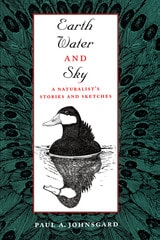
Earth, Water, and Sky
A Naturalist's Stories and SketchesBy Paul A. Johnsgard
University of Texas Press, 1999
"As I write this, I am sitting in a cabin at Cedar Point Biological Station in southwestern Nebraska.... The glorious elemental mixture of earth, water, and sky around me is the home of nearly three hundred species of birds, and comprises one of my favorite places in the world. Here no radio stations blare out the most recent results of meaningless sports events ... no traffic noises confound the senses. Instead the wind is the unquestioned dominating summer influence. The prairie grasses bend willingly and gracefully before it, and the leaves of the cottonwood trees convert its breezes into soft music."
Paul Johnsgard is one of America's most prominent ornithologists and a world authority on waterfowl behavior. In these popularly written, often lyrical essays, he describes some of his most fascinating encounters with birds, from watching the annual mating displays of prairie-chickens on a hilltop in Pawnee County, Nebraska, to attempting to solve some of the mysteries surrounding Australia's nearly flightless musk duck.
Reflecting his worldwide interests and travels, the birds Johnsgard describes inhabit many parts of the globe. Grouping the birds by the element they frequent most—earth, water, or sky—he weaves a wealth of accurate natural history into personal stories drawn from a lifetime of avian observation. And, as a bonus, Johnsgard's lovely pen-and-ink drawings illustrate each species he describes.
Ecological Governance
Toward a New Social Contract with the EarthBruce Jennings
West Virginia University Press, 2016
As our economic and natural systems continue on their collision course, Bruce Jennings asks whether we have the political capacity to avoid large-scale environmental disaster. Can liberal democracy, he wonders, respond in time to ecological challenges that require dramatic changes in the way we approach the natural world? Must a more effective governance be less democratic and more autocratic? Or can a new form of grassroots ecological democracy save us from ourselves and the false promises of material consumption run amok?
Ecological Governance is an ethicist’s reckoning with how our political culture, broadly construed, must change in response to climate change. Jennings argues that during the Anthropocene era a social contract of consumption has been forged. Under it people have given political and economic control to elites in exchange for the promise of economic growth. In a new political economy of the future, the terms of the consumptive contract cannot be met without severe ecological damage. We will need a new guiding vision and collective aim, a new social contract of ecological trusteeship and responsibility.
Elemental Ecocriticism
Thinking with Earth, Air, Water, and FireJeffrey Jerome Cohen
University of Minnesota Press, 2015
For centuries it was believed that all matter was composed of four elements: earth, air, water, and fire in promiscuous combination, bound by love and pulled apart by strife. Elemental theory offered a mode of understanding materiality that did not center the cosmos around the human. Outgrown as a science, the elements are now what we build our houses against. Their renunciation has fostered only estrangement from the material world.
The essays collected in Elemental Ecocriticism show how elemental materiality precipitates new engagements with the ecological. Here the classical elements reveal the vitality of supposedly inert substances (mud, water, earth, air), chemical processes (fire), and natural phenomena, as well as the promise in the abandoned and the unreal (ether, phlogiston, spontaneous generation).
Decentering the human, this volume provides important correctives to the idea of the material world as mere resource. Three response essays meditate on the connections of this collaborative project to the framing of modern-day ecological concerns. A renewed intimacy with the elemental holds the potential of a more dynamic environmental ethics and the possibility of a reinvigorated materialism.
Emergence of Life on Earth
A Historical and Scientific OverviewFry, Iris
Rutgers University Press, 2000
Topics include:
- Aristotle and the Greek atomists' conceptions of the organism
- Alexander Oparin and J.B.S. Haldane's 1920s breakthrough papers
- Possible life on Mars?
Emergence of Life on Earth
A Historical and Scientific OverviewFry, Iris
Rutgers University Press, 2000
--Michael Ruse, author of Mystery of Mysteries: Is Evolution a Social Construction?
"Fry has fashioned a masterful account of the history, philosophy, and science of the origin of life and the possibility of extraterrestrial life. Her story weaves profound Western ideas of who we are and where we came from, from Aristotle to Gould, from Kant to NASA."
--Woodruff Sullivan, University of Washington
"A rich source for the specialist and thought-provoking reading for the lay person."
--Gunter Wachtershauser, University of Regensburg, Germany
How did life emerge on Earth? Is there life on other worlds? These questions, until recently confined to the pages of speculative essays and tabloid headlines, are now the subject of legitimate scientific research. This book presents a unique perspective--a combined historical, scientific, and philosophical anaylsis, which does justice to the complex nature of the subject. The book's first part offers an overview of the main ideas on the origin of life as they developed from antiquity until the twentieth century. The second, more detailed part of the book examines contemporary theories and major debates within the origin-of-life scientific community.
Topics include:
- Aristotle and the Greek atomists' conceptions of the organism
- Alexander Oparin and J.B.S. Haldane's 1920s breakthrough papers
- Possible life on Mars?
Ends of the Earth
PoemsKate Partridge
University of Alaska Press, 2017
While the poems turn an inquisitive, contemporary lens to the subject of Alaska, elements throughout the book are influenced by twentieth-century writers like Elizabeth Bishop and Marianne Moore. The manuscript also combines personal experience with collaged material from the Epic of Gilgamesh, Walt Whitman's notebooks, and other classic sources, to investigate the ideas of love, isolation, and location. Through humor and observation, Partridge takes a new look at what it means to live in urban Alaska and the world at large.
Every River on Earth
Writing from Appalachian OhioNeil Carpathios
Ohio University Press, 2015
Every River on Earth: Writing from Appalachian Ohio includes some of the best regional poetry, fiction, and creative nonfiction from forty contemporary writers, both established and up-and-coming. The wide range of material from authors such as David Baker, Don Bogen, Michelle Burke, Richard Hague, Donald Ray Pollock, and others, offers the reader a window into daily life in the region. The people, the landscape, the struggles, and the deepest undercurrents of what it means to be from and of a place are revealed in these original, deeply moving, and sometimes shocking pieces.
The book is divided into four sections: Family & Folks, The Land, The Grind, and Home & Away, each of which explores a different aspect of the place that these authors call home. The sections work together beautifully to capture what it means to live, to love, and to die in this particular slice of Appalachia. The writing is accessible and often emotionally raw; Every River on Earth invites all types of readers and conveys a profound appreciation of the region’s character.
The authors also offer personal statements about their writing, allowing the reader an intimate insight into their processes, aesthetics, and inspirations. What is it to be an Appalachian? What is it to be an Appalachian in Ohio? This book vividly paints that picture.
Every River on Earth
David Lee Garrison
I look out the window and see
through the neighbor’s window
to an Amish buggy
where three children are peeping back,
and in their eyes I see the darkness
of plowed earth hiding seed.
Wind pokes the land in winter,
trying to waken it,
and in the melting snow
I see rainbows and in them
every river on earth. I see all the way
to the ocean, where sand and stones
embrace each falling wave
and reach back to gather it in.