162 books match the query 'Economics & Trade' and 12 start with e
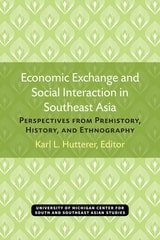
cover of Economic Exchange and Social Interaction in Southeast Asia: Perspectives from Prehistory, History, and Ethnography

Economic Exchange and Social Interaction in Southeast Asia

Perspectives from Prehistory, History, and Ethnography

Karl L. Hutterer, Editor

University of Michigan Press, 1978

Economic behavior is governed by two major sets of boundary conditions: environmental and technological factors on the one hand, and conditions of social organization on the other hand. Indeed, social scientists are often particularly interested in the framework of exchange relationships: exchange of goods, services, personnel, and information. Economic exchanges lend concrete manifestations to social relations that themselves may transcend the economic realm and that otherwise are often difficult to trace.
Yet in social science research in Southeast Asia, the area of economic studies has lagged behind, despite the great study potential represented by the tremendous diversity of its physical and human environment. Economic Exchange and Social Interaction in Southeast Asia attempts to take advantage of that opportunity. As a number of the contributions to this volume show, many if not most of the systems organized on very different levels of integration interact with each other. Taken as a whole, they provide evidence of the incredible diversity of economic and social systems that may be investigated in Southeast Asia.

 
[more]
cover of Economic Interdependence and International Conflict: New Perspectives on an Enduring Debate

Economic Interdependence and International Conflict

New Perspectives on an Enduring Debate

Edward D. Mansfield and Brian M. Pollins, Editors

University of Michigan Press, 2003

The claim that open trade promotes peace has sparked heated debate among scholars and policymakers for centuries. Until recently, however, this claim remained untested and largely unexplored. Economic Interdependence and International Conflict clarifies the state of current knowledge about the effects of foreign commerce on political-military relations and identifies the avenues of new research needed to improve our understanding of this relationship. The contributions to this volume offer crucial insights into the political economy of national security, the causes of war, and the politics of global economic relations.
Edward D. Mansfield is Hum Rosen Professor of Political Science and Co-Director of the Christopher H. Browne Center for International Politics at the University of Pennsylvania.
Brian M. Pollins is Associate Professor of Political Science at Ohio State University and a Research Fellow at the Mershon Center.
[more]
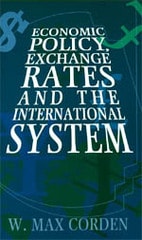
cover of Economic Policy, Exchange Rates, and the International System

Economic Policy, Exchange Rates, and the International System

W. Max Corden

University of Chicago Press, 1994

An ambitious successor to W. Max Corden's highly acclaimed Inflation,
Exchange Rates, and the World Economy, this book addresses topics in
international macroeconomics that have come to the forefront of economic
policy debates in recent years. Covering exchange rate policy, the
European Monetary System, protection and competition, and the
international "non-system" since the collapse of Bretton Woods, Corden
provides a probing analysis of significant economic trends associated
with the increasing integration of the world capital market.

Beginning with essays on exchange rate policy, the current account, and
external effects of fiscal policy, Corden lays out the foundations of
balance-of-payments theory in relation to wage rates, income
distribution, and inflation. Chapters on the European Monetary System
focus on monetary integration and look skeptically at European proposals
to move toward monetary union. Other topical essays discuss the
"competitiveness" problem and the relation between protection and
macroeconomic policy.

Corden summarizes and clarifies a vast range of work on the coordination
of macroeconomic policies and critically reviews various proposals for
reforming the international monetary system.
[more]
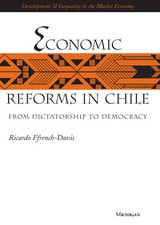
cover of Economic Reforms in Chile: From Dictatorship to Democracy

Economic Reforms in Chile

From Dictatorship to Democracy

Ricardo Ffrench-Davis

University of Michigan Press, 2002

Articulate and provocative, Richardo Ffrench-Davis offers the most comprehensive and timely assessment available of Chilean economic reform, from the military dictatorship of Pinochet in the 1970s up to the "reforms of reforms" made by the democratic governments in the 1990s.
Written in accessible and readable prose, Economic Reforms in Chile begins with an overview of the Chilean economy during the last fifty years. This historical time frame is divided into three periods of economic reform. The first period covers the Pinochet regime, during which the more orthodox neoliberalism was implemented. The second period includes the Pinochet dictatorship, during which economic policy shifted toward pragmatism, particularly in the areas of trade and finance; it also includes the crisis of 1982 and its effects. The third period begins in 1990 with the return to democratic elections and the significant reforms to prior reforms. This section also examines the search for growth-with-equity, success in investment and growth performance, macroeconomic sustainability, and the reduction of poverty. Ffrench-Davis addresses several "paradoxes," or results that defy the expectations of policymakers, in order to analyze the significance of comprehensive macroeconomic equilibrium and its implications for sustainable stability, growth, and equity.
Economic Reforms in Chile will be of interest to economists, political scientists, and policymakers involved with the economies of emerging and developing countries.
Ricardo Ffrench-Davis is Principal Regional Advisor, ECLAC, Santiago, and Professor of Economics, University of Chile.
[more]
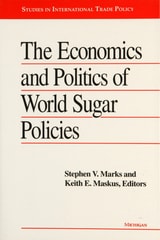
cover of Economics and Politics of World Sugar Policies

Economics and Politics of World Sugar Policies

Stephen V. Marks and Keith E. Maskus, Editors

University of Michigan Press, 1993
Around the world, markets for producing and consuming sugar and related sweeteners are heavily distorted by trade barriers, output controls, price supports, and government subsidies. These policies have significant and identifiable impacts on the economic well-being of different groups in various countries. The net effect of these global distortions is to damage world welfare at the same time that the various national policies reduce economic well-being in the countries that impose them. Sugar policy is the perfect example of how the political imperatives of support for agricultural interests dominate considerations of national welfare or international relations. The contributors provide rigorous analyses of world sugar markets and the distortions caused by policies tn the major countries. They employ several numerical modeling techniques to describe and assess the impacts of world sugar programs. These calculations are buttressed by complementary discussions of the political and economic rationales underlying sugar protection and support. The contributions to The Economics and Politics of World Sugar Policies combine survey evidence with new modeling results from econometric approaches and applied equilibrium simulations to provide new assessments of the current state of world sugar markets. Several original results are presented that shed new light on the impacts of sugar protection. This book should be of considerable interest to agricultural economists, trade-policy analysts, and specialists in international relations and development economics. It is highly relevant for understanding both the economics of agricultural protection and the politics of farm support.
[more]
cover of Economics of Forestry and Rural Development: An Empirical Introduction from Asia

Economics of Forestry and Rural Development

An Empirical Introduction from Asia

William F. Hyde and Gregory S. Amacher, and Colleagues

University of Michigan Press, 2000
Economic development and forest use, with special emphasis on understanding the components of forest degradation and exploitation in developing countries, are the focus of this book. Contributors, mostly from South or Southeast Asia, examine deforestation and tenurial rights, linkages between migration, poverty, and resource exploitation, technology diffusion among poor-subsistence households, fuelwood and energy collection pressures on open-access resources, government and public investments, and household models of labor choice and its impact on resources. Emphasis is on empirical investigation of these problems, though some conceptual material related to resource exploitation, rent distributions, and household economics is presented. The book is the first to study household resource rent models within a developing-country forestry context. The empirical models are motivated by specifying and formally testing linkages between labor, time, and other input decisions. The book also is the first self-contained study using data from several countries to study a common set of problems such as forest use pressure, the relationship between forest exploitation, household allocation of time, and rents, the adoption of technologies to mitigate exploitation of forest resources, and the importance of population pressure and spatial aspects of deforestation. The book fills a niche by bringing rigorous economic theories and hypothesis testing to social aspects of resource use. It will be of interest to a range of professionals, from academic economists working in forestry and development to resource policy professionals at international development agencies, especially those struggling with developing incentives to reduce forest degradation.
[more]
cover of Egalitarian Capitalism: Jobs, Incomes, and Growth in Affluent Countries

Egalitarian Capitalism

Jobs, Incomes, and Growth in Affluent Countries

Lane Kenworthy

Russell Sage Foundation, 2004
Declining participation in labor unions, the movement toward a service-based economy, and increased globalization have cast doubt on the extent to which welfare states can continue to stem inequality in market economies over the long-term. Does the new economy render existing models of social assistance obsolete? Do traditional welfare states hamper economic and employment growth, thereby worsening the plight of the poor? Lane Kenworthy offers a rigorous empirical analysis of these questions in Egalitarian Capitalism. The book examines sixteen industrialized countries in North America, Western Europe, and Scandinavia—each with different approaches to assisting the poor—to see how successful each has been in developing its economy and curbing inequality over the past twenty years. Kenworthy finds that inequality grew in almost all of these countries, from the most progressive to the least. Using simple but powerful statistical tests, he assesses the theory that inequality is necessary to improve economic growth and reduce poverty. He finds no necessary trade-off between equality and economic growth but discovers some evidence that high minimum wages dampen employment growth in private sector services. Kenworthy suggests that without greater private sector employment, public supports may be unable to adequately sustain living standards for the poor. An equitable growth strategy necessitates a balance of policy options: Creating jobs is aided by loose employment regulation, low payroll taxes, and, in some cases, lower real wages for workers at the bottom of the income spectrum. However, high employment is also facilitated by a system that "makes work pay" with earnings subsidies, workplace flexibilities, financial support for those who are between jobs or unable to work, and universal health and child care coverage. Kenworthy suggests that these strategies, though generally presented as mutually exclusive, could be effectively combined to create a robust, fair economy. Egalitarian Capitalism addresses fundamental questions of national policy with rigorous scholarship and a clarity that makes it accessible to any reader interested in the alleged trade-off between social equity and market efficiency. The book analyzes the viability of traditional welfare regimes and offers sustainable options that can promote egalitarian societies without hampering economic progress. A Volume in the American Sociological Association's Rose Series in Sociology
[more]
cover of Electoral Dynamics in the Philippines: Money Politics, Patronage and Clientelism at the Grassroots

Electoral Dynamics in the Philippines

Money Politics, Patronage and Clientelism at the Grassroots

Edited by Allen Hicken, Edward Aspinall, and Meredith Weiss

National University of Singapore Press, 2019
The role of clientism, political machines, and money in grassroots electioneering in the Philippines has been much analyzed by those who study the subject, but never as extensively as Allen Hicken, Edward Aspinall, and Meredith Weiss do in Electoral Dynamics in the Philippines. Combining in-depth ethnographic fieldwork in localities across the Philippines during the 2016 elections with polling data and national comparative data, this study sheds light on the organization of elections and electioneering across the Philippines. How do candidates choose to appeal to voters, and how do they get out the vote? How do voters respond to different kinds of appeals?  How important are patronage and clientism? What are the networks within which patronage is delivered? What do the political machines look like in elections influenced by social media? The book identifies commonalities and differences across the Philippines while speaking to current debates in political science about elections in developing democracies, the structure and organization of clientelism, and the role of money in elections.
[more]
cover of Embedded Politics: Industrial Networks and Institutional Change in Postcommunism

Embedded Politics

Industrial Networks and Institutional Change in Postcommunism

Gerald A. McDermott

University of Michigan Press, 2003

Embedded Politics offers a unique framework for analyzing the impact of past industrial networks on the way postcommunist societies build new institutions to govern the restructuring of their economies. Drawing on a detailed analysis of communist Czechoslovakia and contemporary Czech industries and banks, Gerald A. McDermott argues that restructuring is best advanced through the creation of deliberative or participatory forms of governance that encourages public and private actors to share information and take risks. Further, he contends that institutional and organizational changes are intertwined and that experimental processes are shaped by how governments delegate power to local public and private actors and monitor them.
Using comparative case analysis of several manufacturing sectors, Embedded Politics accounts for change and continuity in the formation of new economic governance institutions in the Czech Republic. It analytically links the macropolitics of state policy with the micropolitics of industrial restructuring. Thus the book advances an alternative approach for the comparative study of institutional change and industrial adjustment.
As a historical and contemporary analysis of Czech firms and public institutions, this book will command the attention of students of postcommunist reforms, privatization, and political-economic transitions in general. But also given its interdisciplinary approach and detailed empirical analysis of policy-making and firm behavior, Embedded Politics is a must read for scholars of politics, economics, sociology, political economy, business organization, and public policy.
Gerald A. McDermott is Assistant Professor of Management in The Wharton School of Management at The University of Pennsylvania. His research applies recent advances in comparative political economy and industrial organization, including theories of social networks, historical institutionalism, and incomplete markets to analyze issues of economic governance, firm creation, and industrial restructuring in advanced and newly industrialized countries. As evidenced by Embedded Politics, his current focus is on problems of institutional and organizational learning in the formation of meso-level governance institutions in emerging market and postsocialist economies.
McDermott also works as Senior Research Fellow at the IAE Escuela de Direccion y Negocios at Universidad Austral in Buenos Aires, and he has served as Project Coordinator at the Inter-American Development Bank. He has consulted for the Finance, Private Sector, and Infrastructure Division at the World Bank and advised the Deputy Foreign Minister of the Czech Republic. In addition he has published many papers and book chapters on entrepreneurship, privatization, institutions, and networks in Central Europe and Latin America.
[more]
cover of Empowering Exporters: Reciprocity, Delegation, and Collective Action in American Trade Policy

Empowering Exporters

Reciprocity, Delegation, and Collective Action in American Trade Policy

Michael J. Gilligan

University of Michigan Press, 1997

Until the New Deal, most groups seeking protection from imports were successful in obtaining relief from Congress. In general the cost of paying the tariffs for consumers was less than the cost of mounting collective action to stop the tariffs. In 1934, with the passage of the Reciprocal Trade Agreements Act, all of this changed. The six decades that followed have produced a remarkable liberalization of trade policy in the United States. This occurred despite the fact that domestic politics, according to some of the best developed theories, should have prevented this liberalization.
Michael Gilligan argues that liberalization has succeeded because it has been reciprocal with liberalization in other countries. Our trade barriers have been reduced as an explicit quid pro quo for reduction of trade barriers in other countries. Reciprocity, Gilligan argues, gives exporters the incentive to support free trade policies because it gives them a clear gain from free trade and thus enables the exporters to overcome collective action problems. The lobbying by exporters, balancing the interests of groups seeking protection, changes the preferences of political leaders in favor of more liberalization.
Gilligan tests his theory in a detailed exploration of the history of American trade policy and in a quantitative analysis showing increases in the demand for liberalization as the result of reciprocity in trade legislation from 1890 to the present. This book should appeal to political scientists, economists, and those who want to understand the political underpinnings of American trade policy.
Michael J. Gilligan is Assistant Professor of Politics, New York University.
[more]
cover of Essays in History: Financial, Economic, Personal

Essays in History

Financial, Economic, Personal

Charles P. Kindleberger

University of Michigan Press, 1999

Essays in History is a collection of papers and articles covering a breathtaking span across the twentieth century and delving into such diverse topics as economic and financial crises in the sixteenth century, retirement reading for bankers, and a first-hand account of the genesis and formation of the Marshall Plan. Who else to explore such far-flung topics and bring such intelligence and wit to them but Charles P. Kindleberger?Readers will find here a strong view on the need for economic history to guide theoretical research. They will also detect Kindleberger’s doubtfulness regarding economic theory based on assumptions that all participants in society are honest, well informed, and make their judgments independently. And finally, readers will be led to the conclusion that, in light of these views, those who think that finance and the economy should be completely unregulated are woefully misguided.The book’s foreword by Peter Temin, economics professor at MIT and former student and colleague of Kindleberger’s, provides a warm and informative introduction to the life and work of this formidable economist and delightful writer.
[more]
cover of Europe and the Euro

Europe and the Euro

Edited by Alberto Alesina and Francesco Giavazzi

University of Chicago Press, 2010

It is rare for countries to give up their currencies and thus their ability to influence such critical aspects of their economies as interest and exchange rates. Yet ten years ago a number of European countries did exactly that when they adopted the euro. Despite some dissent, there were a number of arguments in favor of this policy change: it would facilitate exchange of goods, money, and people by decreasing costs; it would increase trade; and it would enhance efficiency and competitiveness at the international level.
A decade is an ideal time frame over which to evaluate the success of the euro and whether it has lived up to expectations. To that aim, Europe and the Euro looks at a number of important issues, including the effects of the euro on reform of goods and labor markets; its influence on business cycles and trade among members; and whether the single currency has induced convergence or divergence in the economic performance of member countries. While adoption of the euro may not have met the expectations of its most optimistic proponents, the benefits have been many, and there is reason to believe that the euro is robust enough to survive recent economic shocks. This volume is an essential reference on the first ten years of the euro and the workings of a monetary union.
[more]