Results by title
295 books match the query 'Ecosystems & Habitats' and 15 start with e

ESSAYS ON MOUNTAINEERING
ARMAND E. SINGER
West Virginia University Press, 1982
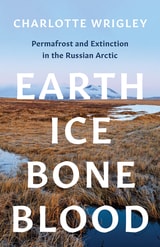
Earth, Ice, Bone, Blood
Permafrost and Extinction in the Russian ArcticCharlotte Wrigley
University of Minnesota Press, 2023
Exploring one of the greatest potential contributors to climate change—thawing permafrost—and the anxiety of extinction on an increasingly hostile planet
Climate scientists point to permafrost as a “ticking time bomb” for the planet, and from the Arctic, apocalyptic narratives proliferate on the devastating effects permafrost thaw poses to human survival. In Earth, Ice, Bone, Blood, Charlotte Wrigley considers how permafrost—and its disappearance—redefines extinction to be a lack of continuity, both material and social, and something that affects not only life on earth but nonlife, too.
Earth, Ice, Bone, Blood approaches the topic of thawing permafrost and the wild new economies and mitigation strategies forming in the far north through a study of the Sakha Republic, Russia’s largest region, and its capital city Yakutsk, which is the coldest city in the world and built on permafrost. Wrigley examines people who are creating commerce out of thawing permafrost, including scientists wishing to recreate the prehistoric “Mammoth steppe” ecosystem by eventually rewilding resurrected woolly mammoths, Indigenous people who forage the tundra for exposed mammoth bodies to sell their tusks, and government officials hoping to keep their city standing as the ground collapses under it. Warming begets thawing begets economic activity— and as a result, permafrost becomes discontinuous, both as land and as a social category, in ways that have implications for the entire planet. Discontinuity, Wrigley shows, eventually evolves into extinction.
Offering a new way of defining extinction through the concept of “discontinuity,” Earth, Ice, Bone, Blood presents a meditative and story-focused engagement with permafrost as more than just frozen ground.
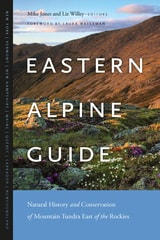
Eastern Alpine Guide
Natural History and Conservation of Mountain Tundra East of the RockiesEdited by Mike Jones and Liz Willey
University Press of New England, 2018
Ecological Feelings
A Rhetorical CompendiumJoshua Trey Barnett
Michigan State University Press, 2025
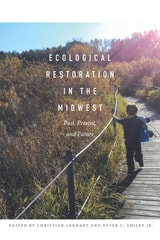
Ecological Restoration in the Midwest
Past, Present, and FutureChristian Lenhard and Peter C. Smiley, Jr.
University of Iowa Press, 2018
Most people do not realize it, but the Midwest has been at the forefront of ecological restoration longer than perhaps any other region in the United States, dating back to the 1930s. Because of its industrial history, agricultural productivity, and natural features such as the Great Lakes, the Midwest has always faced a unique set of ecological challenges.
Focusing on six cutting-edge case studies that highlight thirty restoration efforts and research sites throughout the region— Iowa, Indiana, Illinois, Wisconsin, Michigan, Minnesota, and Ohio— editors Christian Lenhart and Peter “Rocky” Smiley Jr. bring together a group of scholars and practitioners to show how midwestern restoration efforts have developed, as well as where they are headed. Whether cleaning up contamination from auto plants in Ohio, or restoring native prairie grasses along the Iowa highway, the contributors uncover a vast network of interested citizens and volunteer groups committed to preserving the region’s environment.
This study, intended for researchers, students, and practitioners, also provides an updated synthesis of restoration theory and practice, and pinpoints emerging issues of importance in the Midwest, such as climate change and the increase in invasive species it will bring to the region. Though focusing exclusively on the Midwest, the contributors demonstrate how these case studies apply to restoration efforts across the globe.
Contributors: Luther Aadland, David P. Benson, Andrew F. Casper, Hua Chen, Joe DiMisa, Steve Glass, Heath M. Hagy, John A. Harrington, Neil Haugerud, Constance Hausman, Michael J. Lemke, Christian Lenhart, Jen Lyndall, Dan Shaw, John A. Shuey, Peter C. Smiley Jr., Daryl Smith
Ecology of the Bay of Quinte
Health, Management and Global ImplicationsC.K. Minns
Michigan State University Press, 2022
Ecosystem-Based Management of Laurentian Great Lakes Areas of Concern
Three Decades of U.S. - Canadian Cleanup and RecoveryJohn H. Hartig
Michigan State University Press, 2021
Ecoviews Too
Ecology for All SeasonsWhit Gibbons and Anne R. Gibbons
University of Alabama Press, 2017
Discover the wonders of ecology through the changing seasons of the natural world.
Whit Gibbons and Anne R. Gibbons’s Ecoviews Too: Ecology for All Seasons is based on the popular weekly column “Ecoviews,” published by numerous newspapers for more than thirty years. A follow-up to Ecoviews: Snakes, Snails and Environmental Tales, this lively and entertaining book provides a fascinating and thought-provoking look at the ecology of animals, plants, and their habitats, and promotes awareness of pressing environmental issues.
Because nature, in all its myriad and amazing manifestations, can be enjoyed all year round, this collection is conveniently divided into four sections paralleling the seasons and tracking the adaptations and responses of wildlife to the relentless changes that occur at any location over time. The ecological vignettes focus on seasonal happenings in the cycle of life. The authors not only draw parallels between the natural world and human activities but also highlight unique behaviors of various plant and animal species. They often use humor to get across their message regarding the need to protect our native species and the habitats they depend on for survival.
An intriguing and captivating publication, Ecoviews Too is comprised of fifty informative essays that address ecological topics such as camouflage and mimicry, hibernation and estivation, the human need to encounter scary animals, the mysteries of plant dormancy in winter, the comeback of the wild turkey coinciding with the decline of bobwhites, the chemistry behind the color change in fall leaves, and the top ten environmental problems facing the world today. Educating, entertaining, and delighting a general audience, especially those with an interest in nature, Ecoviews Too provides a useful resource for students and scientists alike.
Elephant Memories
Thirteen Years in the Life of an Elephant FamilyCynthia J. Moss
University of Chicago Press, 2000
Cynthia Moss studied the elephants in Kenya's Amboseli National Park for decades, and her long-term research revealed much of what we now know about these complex and intelligent animals. In Elephant Memories she turns that knowledge in an accessible, engaging, even moving story of individual elephants and their complicated relationships. With Moss as our guide, we get to know a number of elephants who are in a family group that is led by matriarchs Teresia, Slit Ear, Torn Ear, Tania, and Tuskless. and we develop new understanding of what elephants do when allowed to live in the wild. An afterword offers a view of the the families from a few years later and addresses current conservation issues.
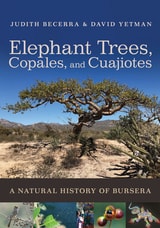
Elephant Trees, Copales, and Cuajiotes
A Natural History of BurseraJudith Becerra and David Yetman; Foreword by Exequiel Ezcurra
University of Arizona Press, 2024
In the United States, Bursera is represented by the short, contorted, and aromatic elephant tree of the hot Sonoran Desert and the stately and colorful gumbo limbo of southern Florida, while in the torrid lowlands of southern Mexico, the engines of evolution have produced forests dominated by dozens of species of Bursera, each with a peculiar ecological slot. This evolutionary tableau presents a complicated sex life that puzzles scientists. Recent research also reveals a gripping narrative of an epic struggle between trees and the insects that would subsist on their leaves: the insects seeking to exploit a food resource, the trees reacting with ever-changing, dramatic counter strategies. In addition to the fascinating and intricate workings of the genus’s ecological adaptations, burseras play a formative role in the lives of indigenous populations. Native peoples relish the plants’ aromatic resin, workable wood, and often colorful bark as a source for endless human applications.
Written in an engaging style, enhanced with two hundred color photographs, and complete with a compendium of species descriptions, this book will be an essential reference on a significant North American plant.
Emerald Labyrinth
A Scientist's Adventures in the Jungles of the CongoEli Greenbaum
University Press of New England, 2017
Environmental Change in the Lake Tahoe Basin
A Synthesis of Science and Public PolicyRobert N. Coats
University of Nevada Press, 2025
For over a century, scientific research and management efforts have aimed to mitigate the impacts of logging, mining, pollution, and invasive species while balancing urban development, tourism, and ecological preservation on the Lake. The book explores these challenges through a multidisciplinary lens, integrating environmental science, policy analysis, and case studies of both successful and failed management strategies. Written by experts who have played direct roles in key scientific discoveries and policy decisions, the book also examines the influence of environmental organizations and litigation in shaping conservation efforts.
At its core, the authors argue that the Tahoe Basin serves as a model for science-driven land and water stewardship. The book evaluates long-term monitoring programs, offering actionable recommendations for improving environmental oversight and resource management. Combining scientific analysis with accessible language, Environmental Change in the Lake Tahoe Basin serves as an up-to-date review of the region’s environmental challenges, providing an essential guide for scientists, resource managers, and policymakers.
The authors will donate all royalties from the sale of this volume to the Union of Concerned Scientist, www.ucs.org.
Explorer's Guide to Death Valley National Park, Fourth Edition
T. Scott Bryan
University Press of Colorado, 2020
Originally published in 1995, soon after Death Valley National Park became the fifty-third park in the US park system, The Explorer’s Guide to Death Valley National Park was the first complete guidebook available for this spectacular area. Now in its fourth edition, this is still the only book that includes all aspects of the park. Much more than just a guidebook, it covers the park’s cultural history, botany and zoology, hiking and biking opportunities, and more. Information is provided for all of Death Valley’s visitors, from first-time travelers just learning about the area to those who are returning for in-depth explorations.
This new edition features a number of important changes—including information on the boundary and wilderness changes that resulted from the Dingell Act of 2019, the reopened Keane Wonder Mine area, the devastating flash flooding of Scotty’s Castle, scenic river designations, the Inn and Ranch resorts, renovated and now operated as the Oasis at Death Valley—as well as new maps and updated color photos. With extensive input from National Park Service resource management, law enforcement, and interpretive personnel, as well as a thorough bibliography for suggested reading, The Explorer’s Guide to Death Valley National Park, Fourth Edition is the most up-to-date, accurate, and comprehensive guide available for this national treasure.
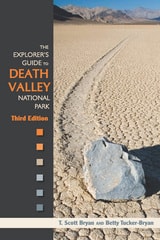
Explorer's Guide to Death Valley National Park, Third Edition
T. Scott Bryan and Betty Tucker Bryan
University Press of Colorado, 2015
Originally published in 1995, soon after Death Valley National Park became the fifty-third park in the U.S. park system, The Explorer's Guide to Death Valley National Park was the first complete guidebook available for this spectacular area.
Now in its third edition, this is still the only book that includes all aspects of the park. Much more than just a guidebook, it covers the park's cultural history, botany and zoology, hiking and biking opportunities, and more. Information is provided for all of Death Valley's visitors, from first-time travelers just learning about the area to those who are returning for in-depth explorations.
The book includes updated point-to-point logs for every road within and around the park, as well as more accurate map than those in any other publication. With extensive input from National Park Service resource management, law enforcement, and interpretive personnel, as well as a thorough bibliography for suggested reading, The Explorer's Guide to Death Valley National Park, Third Edition is the most up-to-date, accurate, and comprehensive guide available for this national treasure.
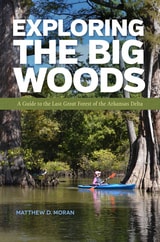
Exploring the Big Woods
A Guide to the Last Great Forest of the Arkansas DeltaMatthew D. Moran
University of Arkansas Press, 2016
Exploring the Big Woods: A Guide to the Last Great Forest of Eastern Arkansas is both a natural history and a guide to one of the last remnants of Mississippi bottomland forest, an ecosystem that once stretched from southern Illinois to the Gulf Coast.
Crossed by the White River and its tributaries, which periodically flood and release nutrients, the Big Woods is one of the few places in the Mississippi River Valley where this life-giving flood cycle persists. As a result, it is home to an unusual abundance of animals and plants.
Immense cypresses, hickories, sweetgums, oaks, and sycamores; millions of migrating waterfowl; incredible scenery; and the complex relationship between humans and nature are all to be discovered here.
Exploring the Big Woods will introduce readers to the natural features, plants, animals, and hiking and canoeing trails going deep into the forests and swamps of this rare and beautiful natural resource.