Results by title
55 books match the query 'Education and state' and 5 start with e
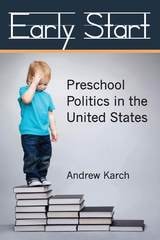
Early Start
Preschool Politics in the United StatesAndrew Karch
University of Michigan Press, 2014
In the United States, preschool education is characterized by the dominance of a variegated private sector and patchy, uncoordinated oversight of the public sector. Tracing the history of the American debate over preschool education, Andrew Karch argues that the current state of decentralization and fragmentation is the consequence of a chain of reactions and counterreactions to policy decisions dating from the late 1960s and early 1970s, when preschool advocates did not achieve their vision for a comprehensive national program but did manage to foster initiatives at both the state and national levels. Over time, beneficiaries of these initiatives and officials with jurisdiction over preschool education have become ardent defenders of the status quo. Today, advocates of greater government involvement must take on a diverse and entrenched set of constituencies resistant to policy change.
In his close analysis of the politics of preschool education, Karch demonstrates how to apply the concepts of policy feedback, critical junctures, and venue shopping to the study of social policy.
Economic Policy Reforms and the Indian Economy
Edited by Anne O. Krueger
University of Chicago Press, 2002
Economic Policy Reforms and the Indian Economy evaluates the effects of those changes and identifies areas of the Indian economy still in urgent need of reform. After an overview of Indian economic policies and development since independence, papers focus on the country's fiscal situation, the environment for private economic activity, education, the reservation of certain activities for small-scale industry, and determinants of differentials in rates of growth across the different Indian states. Contributors include respected academic specialists on India and policy reform, high-level Indian administrators, and present and past policymakers.
Education Policy in Developing Countries
Edited by Paul Glewwe
University of Chicago Press, 2013
Surveying many aspects of education—from administrative structures to the availability of health care to parent and student incentives—the contributors synthesize an impressive diversity of data, paying special attention to the gross imbalances in educational achievement that still exist between developed and developing countries. They draw out clear implications for governmental policy at a variety of levels, conscious of economic realities such as budget constraints, and point to crucial areas where future research is needed. Offering a wealth of insights into one of the best investments a nation can make, Education Policy in Developing Countries is an essential contribution to this most urgent field.
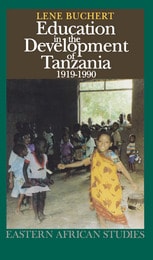
Education in the Development of Tanzania, 1919–1990
Lene Buchert
Ohio University Press, 1994
Deals with the realities of education in a debt-ridden African country trying to cope with the pressures of externally imposed educational budgets.
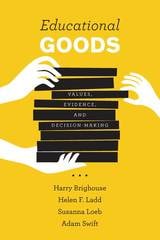
Educational Goods
Values, Evidence, and Decision-MakingHarry Brighouse, Helen F. Ladd, Susanna Loeb, and Adam Swift
University of Chicago Press, 2018
In Educational Goods, two philosophers and two social scientists address this very question. They begin by broadening the language for talking about educational policy: “educational goods” are the knowledge, skills, and attitudes that children develop for their own benefit and that of others; “childhood goods” are the valuable experiences and freedoms that make childhood a distinct phase of life. Balancing those, and understanding that not all of them can be measured through traditional methods, is a key first step. From there, they show how to think clearly about how those goods are distributed and propose a method for combining values and evidence to reach decisions. They conclude by showing the method in action, offering detailed accounts of how it might be applied in school finance, accountability, and choice. The result is a reimagining of our decision making about schools, one that will sharpen our thinking on familiar debates and push us toward better outcomes.